Introduction
Federal research budgets are shifting, and AI is where the money is moving. The National Science Foundation's FY2026 budget request includes $655.23 million for AI research NSF-wide, with $284.54 million routed through CISE alone.
DOE's Office of Science is telling a similar story, naming AI and machine learning as an increased-investment priority even as other budget lines shrink.
That's the good news. The hard part? Turning "AI is important" into a proposal a program manager will actually fund.
Many researchers struggle to narrow a broad AI interest into a fundable, testable research question. Add in new agency rules about disclosing AI tool use during drafting, and the proposal process gets more complicated fast.
This article walks through proposal structure, the AI research topics gaining traction in 2026, DOE and NSF-specific requirements, and how to handle AI writing tools without triggering a misconduct review.
Key Takeaways
- Tie your AI question to one agency priority; broad "AI in industry X" claims rarely fund
- NSF, DOE, NIH, and NASA handle AI-tool disclosure differently, and the rules keep shifting
- Scientific foundation models, trustworthy AI, and AI-HPC convergence lead 2026 funding priorities
- Knowing how program managers score proposals often separates funded work from rejected work
Anatomy of a Winning AI Research Proposal
Framing the Contribution, Not the Field
Your title and abstract have one job: name the specific, novel AI contribution. Skip the throat-clearing about how transformative AI has become. Program managers read hundreds of these.
"Deep Learning for Materials Science" tells them nothing. "Uncertainty-Aware Surrogate Models for Fusion Plasma Simulation" tells them exactly what you're proposing and why it matters.
The problem statement and significance section follows the same logic. The most common rejection reason is an unfocused topic, not weak science.
Ground the gap in literature from the last 1–2 years, not a 2019 survey paper. Reviewers can tell a proposal built on current work from one padded with dated citations.
Questions, Methods, and Resources
A sharp gap only helps if the questions that follow are specific, testable, and mapped to your methods. Vague questions produce vague reviews.
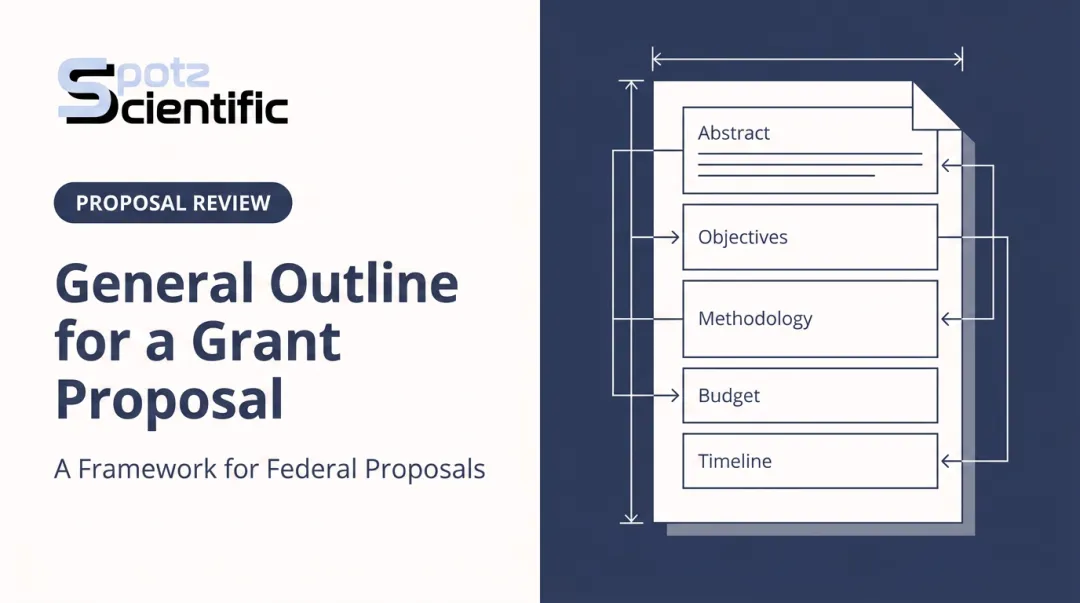
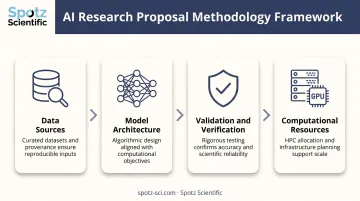
Your methodology section should cover, in order:
- Data sources: where training and validation data come from, and how you'll access them
- Model architecture: what you're building and why it fits the problem—not what's trendy
- Validation and verification: how you'll know the model actually works
- Computational resources: specific HPC or GPU needs, justified against the methods above
Broader impacts, timeline, and budget close the package. Timeline and budget must match the methods you promised—no orphan milestones or unexplained GPU lines.
Agency expectations diverge on impact:
- NSF: explicit Broader Impacts as a standalone review criterion
- DOE: scientific impact and workforce development tied to mission relevance
Write for the agency you're submitting to, not a generic template.
Trending AI Research Topics and Project Ideas for 2026
Broad enthusiasm doesn't fund proposals. Specificity does. Here's where the money is actually pointed heading into 2026:
- Scientific machine learning (SciML) - AI augmenting physics-based simulations in climate, materials science, and fusion energy. Check DOE ASCR's published SciML priority documents before you draft a word.
- Foundation models for scientific discovery - LLMs and other foundation models applied to research workflows. Map current focus areas through NSF's National AI Research Institutes (29 institutes, 500+ collaborating institutions).
- Trustworthy, explainable, and robust AI - fairness, uncertainty quantification, and verification for high-stakes science. NSF's AI Research Institutes solicitation named explainable AI, safety, robustness, and alignment as priority themes, and that emphasis hasn't faded.
- AI-HPC convergence - efficient training and inference on exascale systems. DOE's FY2026 justification flags foundation-model tools and next-generation HPC integrated with AI and quantum as active priorities.
- Agentic AI and multi-agent systems - "self-driving lab" concepts that automate scientific workflows, combining robotics, edge AI, and closed-loop experimentation.
One rule overrides all of these: always cross-check the current NOFO. Priority areas shift year to year. A topic that was hot in a 2024 solicitation may not appear in the 2026 version at all.
Navigating DOE and NSF Funding Requirements for AI Proposals in 2026
Agencies are increasingly building AI-specific expectations directly into individual solicitations rather than agency-wide policy. That means the NOFO itself, not general guidance, is your source of truth.
DOE Office of Science: Disclosure and Priority Alignment
DOE's requirements for AI tool disclosure vary by specific NOFO, and misuse can constitute research misconduct under DOE's existing fabrication, falsification, and plagiarism standards. There's no single blanket disclosure rule for external applicants, which makes reading each solicitation's language non-negotiable.
DOE is consistent on mission alignment. ASCR's FY2026 thrusts should show up explicitly in your narrative:
- Breakthrough tools and technologies
- Deep understanding of AI and physical models
- High-precision R&D
- Hardware innovation
If your proposal doesn't map to one of these, a reviewer will notice.
NSF Considerations for AI Research Proposals
NSF's posture is softer but not optional. The agency encourages proposers to describe generative AI use in the Project Description, and investigators remain fully accountable under existing research misconduct policy regardless of disclosure.
CISE and the National AI Research Institutes program each maintain distinct priorities. Review the current solicitation before drafting rather than assuming last year's focus areas still apply.
Early-Career Funding Pathways: DOE ECRP and NSF CAREER
Both programs demand multi-year plans that integrate research and education, but the mechanics differ:
| Feature | DOE ECRP | NSF CAREER |
|---|---|---|
| Eligibility | Untenured tenure-track PI, doctorate since 2015 | Untenured tenure-track PI, no prior CAREER award |
| Narrative limit | 15 pages | 15 pages |
| Award amount | $875,000 total | $400,000+ ($500,000+ for BIO, ENG, OPP) |
| Duration | 5 years | 5 years |
Getting a proposal at this scale right often means getting a second set of eyes on it before submission. Spotz Scientific's red-team reviews apply a program-manager lens to drafts before they go out the door.
Bill Spotz spent eight years as a DOE ASCR program manager overseeing more than $264 million in scientific computing research. Strategic advice on a specific NOFO can catch misalignment issues that are invisible from inside your own draft.
Should You Use AI Writing Tools to Draft Your Proposal?
Federal agencies generally permit AI-assisted drafting for brainstorming, organizing, and editing. What they don't permit is treating the output as a shortcut to originality. You, the PI, remain fully responsible for accuracy and authorship whether AI use is disclosed or not.
Best practices:
- Use institutionally licensed AI tools rather than public consumer versions
- Never enter unpublished data, proprietary methods, or sensitive results into a public AI system
- Keep a record of what tools you used and how, even where disclosure isn't strictly mandatory
The risks of over-relying on these tools are real. NIH, citing concerns about AI-enabled overproduction, now caps most PIs at six new, renewal, resubmission, or revision applications per calendar year for due dates on or after September 25, 2025.
NIH has also stated that substantially AI-developed applications aren't considered the applicant's original ideas, which puts them squarely in research misconduct territory.
If you're unsure where the line sits between "helpful drafting assistant" and "problem," a red-team review before submission is a cheap way to find out before a program officer does.
Common Mistakes to Avoid When Writing an AI Research Proposal
Most rejected AI proposals fail for a small set of repeatable reasons:
- Choosing a topic too broad to evaluate. "AI for scientific discovery" isn't a research question. Narrow it until it's testable.
- Underestimating computational feasibility. If you plan to train large models, justify HPC or GPU needs at the real scale of the work—not with a placeholder paragraph.
- Skipping required sections. NSF's Broader Impacts section and DOE's Data Management and Sharing Plan aren't optional add-ons. Since October 2025, DOE can reject an application outright for a missing data plan, before it reaches merit review.
These are exactly the issues a second reader catches before a program manager does. A red-team review puts someone who has sat on the funding side of the table in front of your draft, reading it the way a reviewer would while you still have time to revise.
Frequently Asked Questions
Is it okay to use AI for a research proposal?
Most federal agencies, including NSF, DOE, and NASA, allow AI-assisted drafting if disclosed appropriately. The principal investigator remains fully responsible for the proposal's accuracy and originality regardless of what tools were used.
What are some good research projects in artificial intelligence?
Scientific machine learning, trustworthy and explainable AI, and AI-HPC convergence are strong 2026 project areas. Always check the current DOE or NSF NOFO, since specific priorities shift from year to year.
Do federal agencies like NSF and DOE require disclosure of AI tool use in proposals?
DOE embeds disclosure requirements in individual NOFOs, so rules vary by solicitation. NSF encourages disclosure in the Project Description but does not strictly require it. Either way, investigators remain accountable for the final submission.
What is the difference between a research proposal about AI and using AI to write a proposal?
One is your scientific subject matter—the AI system or method you propose to study or build. The other is a drafting tool used during preparation. They are evaluated under entirely different rules.
How long should an AI research proposal be?
Length depends entirely on the specific NOFO or solicitation. DOE ECRP and NSF CAREER both cap the main narrative at 15 pages, but other programs vary. Always follow the exact formatting rules of your target solicitation.
What should I include in the broader impacts section of an AI proposal?
Cover workforce development, educational integration, and the societal benefit of your proposed AI research. This is especially critical for NSF submissions, where Broader Impacts is a standalone, formally scored review criterion.