Introduction
A business proposal for funding is one of the most consequential documents you'll ever write. It's often the only document standing between your idea and a funding decision, whether that decision comes from a federal grant agency, a bank, or an investor.
Here's the frustrating part: strong businesses and research projects lose funding all the time for reasons that have nothing to do with the underlying idea. A misaligned budget. A missing required section. A funding ask that never quite justifies itself on paper.
This guide walks through exactly how to write a proposal that gets funded. You'll get the steps to follow, when you need a full formal document versus a lighter pitch, and what to prepare before you start typing. It also covers the factors that decide funding outcomes and the mistakes that sink otherwise promising work.
Key Takeaways
- Every proposal must answer four questions: what you do, what problem you solve, how much you need, and how you'll use or repay it
- Structure shifts by audience: investors want growth, banks want repayment ability, agencies want programmatic fit
- Most rejections stem from budget-narrative mismatches, vague funding asks, or ignored formatting rules
- Federal research grants add a second rulebook: NOFOs, RFPs, and agency-specific review criteria
How to Write a Business Proposal for Funding
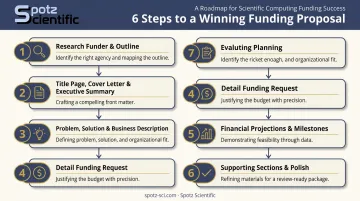
Step 1: Research Your Funder and Outline Your Proposal
Before writing a single sentence, figure out who's reading it. Each audience weighs different things:
| Audience | Primary Concern |
|---|---|
| Investors | Growth potential, return on investment |
| Banks/lenders | Repayment ability, collateral, cash flow |
| Grant agencies | Programmatic fit, technical merit |
If you're responding to a formal RFP or NOFO, read it line by line first. Note every required section, page limit, deadline, and eligibility rule before drafting anything. Agencies like NSF will flag or outright return proposals that skip required content or ignore preparation instructions, no matter how strong the science underneath.
Once you understand your audience, build a simple outline using the sections below as scaffolding. Writing from structure beats staring at a blank page every time.
Step 2: Write the Title Page, Cover Letter, and Executive Summary
Start with the basics: a clear title, your business or project name, contact information, and submission date on the cover page. Nothing fancy: just clean and correct.
Then draft your executive summary. Keep it to one or two pages, and front-load the essentials:
- What your business or project does
- The exact funding amount requested
- The expected outcome or return
If you're applying under a specific program, name it directly. Referencing the DOE Early Career Research Program or an exact NSF solicitation number signals preparation rather than a generic mass-submission.
Step 3: State the Problem, Your Solution, and Business Description
Lead with evidence, not assumptions. Use recent, credible data to establish the market gap or research need, then explain precisely how your product, service, or research approach addresses it. Vague statements like "there's a growing need" don't survive scrutiny.
Add your company or project description: mission, unique value, and what separates you from existing alternatives already competing for the same dollars.
Evidence matters more than most applicants realize. In fiscal year 2022, NSF funded only about 27% of the research proposals it received. That rate rewards specificity over generic claims. Reviewers look for a well-reasoned, assessable plan ahead of a compelling story alone.
Step 4: Detail Your Funding Request
State the exact dollar amount you need, then break it down line by line:
- Equipment and materials
- Staffing and personnel
- Expansion or operational costs
- Research and development
Every line item should tie back to a specific milestone. If you're requesting $150,000 for staffing, reviewers should be able to trace that hire directly to a deliverable in your timeline.
For grant proposals, costs also have to be allowable, reasonable, and allocable under the funder's cost principles. Federal cost guidance requires expenses to be necessary, consistent with what a prudent person would spend under similar circumstances, and properly assignable to the award. Padded numbers or double-counted costs get flagged fast.
Step 5: Build Financial Projections and Milestones
Include your core financial documents:
- Income statement
- Cash flow statement
- Balance sheet
- Break-even analysis
The SBA recommends three to five years of historical financials for established businesses, plus a five-year forward projection with first-year numbers broken out monthly or quarterly.
Pair these numbers with a timeline of measurable milestones. Funders want a realistic path grounded in evidence. Every projection should rest on documented assumptions and actual market research. Reviewers test the optimistic-looking numbers first, and unsupported projections are one of the fastest ways to lose credibility mid-review.
Step 6: Add Supporting Sections and Polish the Document
Round out the proposal with organizational background, key personnel qualifications, and an appendix: resumes, licenses, letters of support, as required for your specific request.
Then edit with a critical eye:
- Check formatting and design consistency throughout
- Strip out sensitive or proprietary information before sharing
- Tighten language; cut anything that doesn't earn its place
Finally, get a second set of eyes before you submit. A mentor, advisor, or subject-matter specialist catches unclear transitions and unsupported claims you've read past a dozen times already.
When and For Whom You Need a Full Business Proposal
Not every funding conversation needs a 40-page document.
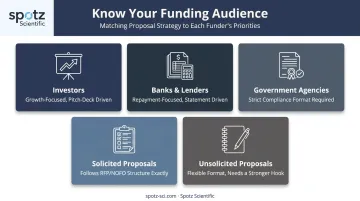
Formatting expectations shift dramatically by audience:
- Investors often want a pitch deck first and a full proposal later
- Banks expect a structured loan proposal built around financial statements
- Government agencies require strict adherence to their own prescribed format
Request type matters just as much as audience:
- Solicited proposals respond to a formal RFP or NOFO. The funder has already dictated the sections and order: follow that sequence exactly, with no creative liberties.
- Unsolicited proposals are submitted on your own initiative. They offer more flexibility, but need a stronger hook since you're competing for attention no one asked you to seek.
For early, informal conversations, a lighter format works fine: an elevator pitch, a short email, or a slide deck. Save the full written proposal for formal funding requests, competitive grants, or direct RFP/NOFO responses.
What You Need Before You Start Writing
Your proposal is only as credible as the materials behind it. Gather these before you draft anything:
- Business fundamentals: legal structure, existing financial statements, a working business plan to draw from
- Market research: competitor data and industry reports from credible sources (government datasets, academic studies), not assumptions
- Funder-specific guidance: the actual NOFO, RFP, or solicitation text, reviewed in full before you write
That last point matters more for specialized funding than most applicants expect. Federal scientific and research grants bury technical merit criteria inside dense solicitation language. A generalist reviewer, even a sharp one, can miss programmatic fit issues or methodology gaps that a subject-matter expert would catch immediately.
A reviewer who has sat on the other side of the table can catch those gaps early. Spotz Scientific, founded by a former DOE ASCR program manager who oversaw more than $264 million in research funding, reviews scientific computing proposals headed to DOE and NSF CISE with that insider perspective.
Beyond one-on-one red team review, the firm runs seminars on proposal practices and helps university faculty support offices build internal frameworks for DOE Early Career and NSF CAREER submissions. Those are resources worth tapping before drafting begins.
Key Factors That Determine Whether Your Proposal Gets Funded
Regardless of format, funders evaluate proposals against the same underlying criteria. Weakness in any single factor can sink an otherwise strong pitch.
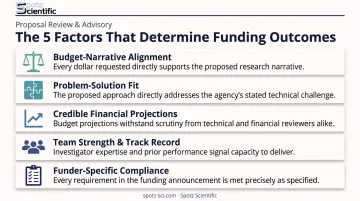
These five areas usually decide the outcome:
- Budget-narrative alignment. Reviewers check whether activity scale matches the dollars requested. Large-scale impact on a thin staffing budget often gets flagged or rejected.
- Problem-solution fit. Funders need a direct line from the identified need to your proposed activities. Vague problem statements lose ground to clearer competitors.
- Credible financial projections. Documented assumptions and real market research signal fiscal discipline. Unsupported optimism raises doubts about planning ability and ROI.
- Team strength and track record. Funders back people as much as ideas, especially for early-stage ventures and research proposals. Prior success or relevant expertise raises confidence in execution.
- Funder-specific compliance. Formatting, eligibility, and content rules are not optional. A missing attachment or exceeded page limit can kill a strong proposal before review.
That last factor is easy to underestimate. NSF guidelines confirm that proposals missing required sections or ignoring preparation instructions can be returned without review, so the science never gets evaluated at all.
Common Mistakes That Get Proposals Rejected
Four mistakes account for the majority of avoidable rejections:
- Vague funding asks: Every dollar requested should tie to a specific milestone or deliverable, not a rounded estimate
- Budget-narrative mismatch: Promising large-scale impact without the staffing or resources to deliver it—trace every activity in the narrative to a budget line
- Ignoring formatting requirements: Page limits, required forms, and RFP or NOFO sequencing; missing these can mean automatic disqualification
- Skipping outside review: Unclear language and unsupported claims sail through unnoticed until it is too late to fix
None of these need a better idea to fix. They need discipline in drafting and review—and a willingness to cut what does not hold up.
Frequently Asked Questions
Can an LLC get grant money?
Yes, LLCs can qualify for many government and private grants, though eligibility depends on the specific program. Some federal research grants and nonprofit-focused funds have additional structural requirements worth checking early.
What's the difference between a business proposal and a business plan?
A business plan is an internal, comprehensive roadmap covering your entire business. A proposal is an external, persuasive document tailored to one specific funding request or audience.
How long should a business proposal for funding be?
Length varies by funder. Investor pitch decks stay short and visual, bank loan proposals typically run 5–15 pages, and federal grant proposals can reach 40–100+ pages with required forms and attachments.
How much money should I ask for in my funding proposal?
Base your ask on itemized costs tied to specific milestones, not a rounded estimate. Match your request to the funder's typical award range or lending capacity.
Do I need a professional to help write my funding proposal?
Many applicants write successful proposals independently. Specialized technical funding, such as DOE or NSF scientific computing grants, often benefits from an advisor who understands agency-specific review criteria and Notice of Funding Opportunity (NOFO) requirements.
What's the difference between a business proposal and a grant application?
The proposal is your persuasive narrative and budget. The full grant application also includes required compliance documents: organizational certifications, financial statements, and supporting attachments.