Most proposal review advice comes from academics and grant writers. This guide draws on a different vantage point: the program manager's side of the table. Bill Spotz, founder of Spotz Scientific, spent eight years as a program manager at DOE's Advanced Scientific Computing Research (ASCR) office, co-leading the applied mathematics program and managing over $264 million in scientific computing research. That experience shapes every recommendation here.
This article covers how to read funder criteria before reviewing anything, what the core proposal components are and where proposals typically break down, how program managers actually make funding decisions, how to run a structured red team review, and what's distinctive about DOE Early Career and NSF CAREER applications.
Key Takeaways
- Always start with the specific NOFO's review criteria — reviewing without them is grading without a rubric
- Strong proposals clearly articulate significance, novelty, and feasibility in the first few pages
- Program managers weigh portfolio balance and agency fit, not just technical merit scores
- A red team review before submission is one of the highest-leverage steps you can take
- Early-career programs (DOE ECRP, NSF CAREER) evaluate independence and long-term vision as much as project quality
Start With the Funder's Review Criteria
Before reviewing any proposal — yours or a colleague's — read the Notice of Funding Opportunity (NOFO) or solicitation in full. Each program has its own scoring rubric, page limits, and priority areas. Reviewing without that document is like grading an exam without knowing what questions were asked.
NSF CISE vs. DOE ASCR: Key Differences
The two agencies structure their criteria differently, and those differences matter at the proposal level.
NSF CISE evaluates all proposals against two criteria, as defined in PAPPG NSF 24-1:
- Intellectual Merit — potential to advance knowledge
- Broader Impacts — potential to benefit society or advance desired societal outcomes
Reviewers apply five common elements to these criteria, including team qualifications, resource adequacy, and success assessment mechanisms. Solicitation-specific programs may add additional questions — NSF 24-571 on Correctness for Scientific Computing Systems, for example, adds criteria specific to that research area.
DOE ASCR uses a different ordered structure: scientific/technical merit, appropriateness of method, personnel competency and resource adequacy, budget reasonableness, and (in 2024) a PIER plan. Individual NOFOs control the actual criteria, and some — like the Quantum Testbed Pathfinder FOA — explicitly list additional policy factors such as portfolio balance and workforce pathways.
How to Use Criteria as a Checklist
Cross-reference the program's published review criteria against every major section of your draft before submission. NSF proposals must address both Intellectual Merit and Broader Impacts explicitly — not implied, not tucked into a paragraph. DOE proposals require a methodology section that maps directly to the "appropriateness of method" criterion with enough technical specificity to satisfy a domain reviewer.
If any criterion isn't clearly addressed in the proposal text, that's a gap — not a stylistic choice.
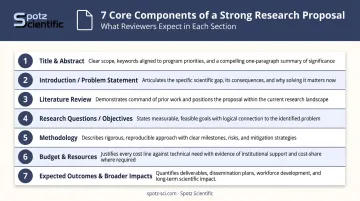
The 7 Core Components of a Strong Research Proposal
Federal proposals vary in formatting requirements by agency, but reviewers use a consistent mental scaffold when evaluating them. Weaknesses in any component can undermine an otherwise strong proposal.
| Component | What Reviewers Look For |
|---|---|
| Title & Abstract | Clear problem, approach, and impact in non-specialist language |
| Introduction / Problem Statement | Why the problem matters, and to whom |
| Literature Review | Demonstrates field awareness; identifies a specific gap |
| Research Questions / Objectives | Specific, measurable, tied directly to the stated problem |
| Methodology | Specificity about tools, validation, milestones, and contingencies |
| Budget & Resources | Realistic, justified, aligned with scope |
| Expected Outcomes & Broader Impacts | Defines what success looks like and who benefits |
Where Proposals Most Often Break Down
Literature review is consistently underestimated. It should not summarize existing work — it should build an argument for why a specific gap exists and why your approach is the right one to fill it. DOE ASCR reviewers flag proposals with too few citations to demonstrate command of the state of the art.
Methodology is where scientific computing proposals most commonly succeed or fail. "We will develop software" is not a methodology. Reviewers expect concrete answers to specific questions:
- Which algorithms or computational approaches will you use?
- What infrastructure do you need, and at what scale?
- How will results be validated?
- What is your contingency plan if the approach doesn't scale?
Milestones and resource requirements belong here with the same level of specificity.
Budget justification gets less attention than it deserves. Program managers flag budgets that appear inflated, poorly scoped, or opaque — and a weak justification signals poor project planning. Every major cost category needs an explanation, not just a number.
How Program Managers Actually Evaluate Proposals
Understanding the difference between peer review and program manager evaluation changes how you write a proposal.
Peer Review vs. Program Manager Judgment
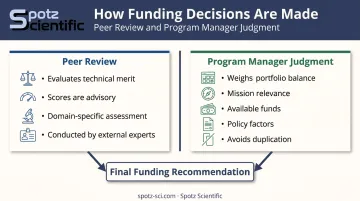
Peer reviewers assess technical merit in detail. But peer review scores are advisory — program managers make final funding recommendations by balancing technical scores against factors that reviewers don't control.
DOE's Merit Review System is explicit about this: final selection depends on mission relevance, available funds, policy factors, and cost considerations. A technically excellent proposal can be declined if the program already funds multiple projects using the same approach, or if the proposed work fits better in a different program within the agency.
At NSF, the program officer formulates the funding recommendation after "scientific, technical, and programmatic consideration." A GAO study on program managers at federal science agencies confirmed that managers actively identify portfolio gaps, help avoid duplication, and provide context to leadership — all of which happen before a funding decision is made.
What This Means for Your Proposal
Before submitting, study the program's currently funded portfolio. If the agency website lists active awards, read them. Ask whether your proposal is genuinely distinct from what's already funded, and whether it addresses a gap the program is likely trying to fill.
Program managers read abstracts and introductions first, and initial impressions form early. The opening pages must clearly establish:
- What problem you're solving
- Why it's significant to this program
- What's genuinely novel about your approach
Team Credibility
Reviewers and program managers pay close attention to track record. What they're evaluating isn't general expertise — it's evidence that this specific team has the technical capabilities to execute this specific work. Publications, prior grants, and demonstrated computational infrastructure are all credibility signals. A team proposing to develop novel algorithms at exascale needs to demonstrate prior experience with the relevant computational environments.
How to Conduct a Red Team Review of Your Proposal
A red team review is a structured, adversarial internal review where colleagues read your draft as skeptical external reviewers — actively looking for weaknesses, logical gaps, and unclear language, rather than offering encouragement.
The reason this works is straightforward: familiarity bias makes self-review unreliable. Researchers who wrote a proposal know what they meant, so they don't notice where the text is unclear. A red team exposes the assumptions the author took for granted.
Selecting Red Team Reviewers
- One person knowledgeable in the field but not deeply familiar with the specific project — to simulate reviewer distance
- One person from outside the subfield — to assess whether the significance and methodology sections are accessible to a broader scientific audience (common on multi-disciplinary review panels)
NSF policy places responsibility for thorough pre-submission review on the proposing organization, and research offices at institutions like NC State explicitly recommend red team reviews to test compliance, comprehensiveness, and competitiveness.
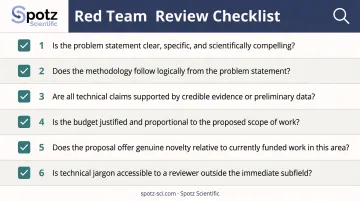
Red Team Checklist
Use these questions to structure the review:
- Does the proposal open with a clear, compelling problem statement?
- Is the connection between research questions and methodology logical and explicit?
- Are all technical claims adequately supported with specifics?
- Is the budget realistic and clearly justified for every major cost category?
- Does the proposal explicitly address how it's novel relative to prior and currently funded work?
- Is technical jargon explained on first use — not assumed?
Enlisting Expert Review Support
For high-stakes submissions such as NSF CAREER, DOE Early Career, and DOE major research initiatives, researchers often benefit from an external reviewer with program-level experience.
Spotz Scientific provides red team review for draft proposals and pre-proposals, with feedback grounded in Dr. Spotz's eight years managing DOE ASCR proposals. Services include:
- Draft proposal review — detailed critique of structure, clarity, and technical rigor
- Pre-proposal review — early-stage assessment before full submission
- Pricing — $200–$250/hour standard rate; $250–$300/hour for materials submitted less than two weeks before a deadline
Common Proposal Weaknesses to Catch Before Submission
These are the issues that cause technically sound proposals to score below their potential:
- Vague or overly broad research questions that don't map cleanly to a specific methodology
- A literature review that describes sources without making an argument — listing what others have done is not the same as demonstrating why a gap exists
- Missing or unconvincing discussion of novelty relative to currently funded work — program managers and reviewers both flag this
- Hypotheses centered on demonstrating researcher skill rather than addressing an unknown property — ASCR's official proposal guidance flags this explicitly
- Technical jargon without explanation — reviewers from adjacent disciplines penalize proposals that assume specialized knowledge
Each of these weaknesses tends to surface the same underlying problem: the proposal hasn't made its value clear to someone outside the immediate subfield.
The "So What" Test
After every section, ask: could a busy program manager quickly identify why this research matters, who it affects, and what will be different once it's complete? If any answer is unclear, the section needs revision — not just polish.
Reading the proposal aloud also catches a surprising number of problems. If a sentence is hard to say, it's hard to follow.
Special Considerations for DOE Early Career and NSF CAREER Proposals
Both programs are explicitly designed to support researchers establishing independent research agendas. That distinction changes what reviewers are actually evaluating.
What Reviewers Are Looking For
A proposal that reads as an extension of dissertation or postdoc work — even excellent work — is a common and costly framing mistake. Reviewers want to see evidence that the applicant has a distinct, self-directed research vision, not that they're continuing their advisor's program under their own name.
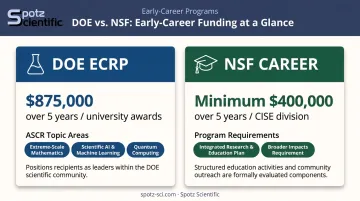
DOE ECRP evaluates potential for scientific community leadership, with ASCR topics including extreme-scale applied mathematics, scalable scientific AI and automation, and quantum computing and networking. The 2026 program specifies approximately $875,000 over five years for university awards.
NSF CAREER requires an integrated research and education plan and specifies a minimum of $400,000 over five years for CISE applicants. The educational and broader impacts component carries significant weight — and generic statements about "mentoring students" without a structured, specific plan are one of the most commonly flagged weaknesses in CAREER reviews.
A Note on Strategic Framing
Getting the program-specific details right — funding levels, topic alignment, education plan requirements — is necessary but not sufficient. How you frame your independent research identity is often what separates funded proposals from strong ones that don't advance.
Spotz Scientific provides consulting for both DOE Early Career and NSF CAREER applicants. Dr. Spotz reviewed and funded these programs as a former DOE program manager, which means the strategic advice on proposal framing, red team review, and program priority alignment comes from the evaluator's perspective, not just an advisor's. Contact info@spotz-sci.com to discuss your application.
Frequently Asked Questions
What are the 7 parts of a research proposal?
The standard components are: title/abstract, introduction/problem statement, literature review, research questions/objectives, methodology, budget and resources, and expected outcomes/broader impacts. Federal agencies may require different formatting — NSF's Project Description is typically 15 pages, while DOE uses NOFO-specific instructions.
What are the 5 C's of literature review?
The five C's are: Cite, Compare, Contrast, Critique, and Connect. In a federal proposal context, the goal is to build a logical argument that a specific research gap exists and that your approach is positioned to address it — not simply to summarize prior work.
What do DOE or NSF program managers look for in a research proposal?
Beyond technical merit, program managers evaluate fit with agency priorities, novelty relative to the funded portfolio, team credibility, and clarity of impact. A technically strong proposal that duplicates existing funded work or doesn't align with the program's current direction can still be declined.
What is a red team review, and why does it matter for federal proposals?
A red team review is a structured adversarial critique where colleagues read the proposal as skeptical reviewers, identifying gaps, unclear language, and logical weaknesses before submission. For federal proposals with limited resubmission opportunities, a single decline can cost a year or more — catching these issues internally before the deadline is far less costly than waiting for reviewer feedback.
What are the most common reasons federal research proposals get rejected?
The most frequent issues are weak problem framing, vague methodology, insufficient novelty justification, poor fit with program priorities, and unclear broader impacts. Even technically strong proposals fail when these elements aren't addressed with specificity.
How is reviewing a pre-proposal different from reviewing a full proposal?
Pre-proposals are evaluated primarily on significance, novelty, and fit — with less emphasis on methodological detail. The review focus should be on whether the core idea is compelling and well-positioned for the program before investing in a full submission.