According to the SBA's FY2022 annual report, federal agencies collectively obligated $4.73 billion across SBIR and STTR—yet only about 17.6% of Phase I proposals resulted in awards. The stakes are high, and the process is more nuanced than most first-time applicants expect.
This article breaks down each phase of the SBIR and STTR programs, clarifies the structural differences between the two, and explains the alternative pathways available within the system—so you can approach any phase with a clearer strategy.
Key Takeaways
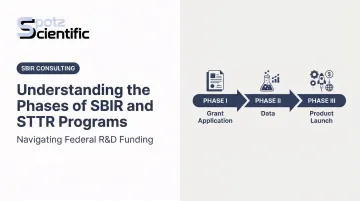
- SBIR and STTR programs share the same three-phase structure: Phase I tests feasibility, Phase II funds full R&D, and Phase III drives commercialization.
- Phase I and Phase II are federally funded; Phase III uses non-SBIR/STTR dollars.
- Phase 0 exists at select agencies — DOE in particular — as proposal preparation assistance, not a cash award.
- Fast Track and Direct to Phase II offer accelerated entry for teams that have already established feasibility.
- SBIR and STTR follow the same phase structure but differ in partnership requirements and agency participation.
What Are the SBIR and STTR Programs?
SBIR (Small Business Innovation Research) and STTR (Small Business Technology Transfer) are competitive federal funding programs mandated across U.S. agencies with qualifying R&D budgets. Both fund high-risk, early-stage innovation with commercial potential—and both are non-dilutive, meaning small businesses retain equity and retain IP rights in resulting work (with the government receiving specified use rights).
The programs were most recently reauthorized through September 30, 2031 under the Small Business Innovation and Economic Security Act (P.L. 119-83), signed April 13, 2026. Participation differs by program:
| Program | Participating Agencies |
|---|---|
| SBIR (11 agencies) | USDA, DOC, DoD, ED, DOE, HHS, DHS, DOT, EPA, NASA, NSF |
| STTR (5 agencies) | DoD, DOE, HHS, NASA, NSF |
The two programs share the same phase-based review structure, but STTR requires a formal partnership with a nonprofit research institution. That requirement shapes how research must be allocated and budgeted across every phase — affecting project timelines, subcontract terms, and cost-sharing arrangements from the outset.
Breaking Down Each SBIR/STTR Phase
The phase structure is intentionally progressive. Agencies use it to manage risk—investing deeper only when feasibility and performance have been demonstrated at each prior stage. Here's what each phase actually requires.
Phase 0: Pre-Phase I Preparation
Some agencies—most notably DOE—offer what they call "Phase 0," but it's not a cash award. DOE's Phase 0 provides no-cost proposal preparation assistance: education, market research support, and one-on-one guidance, with emphasis on first-time or underrepresented applicants. DHS uses similar language for its pre-application webinars and training events.
The key point: Phase 0 provides no federal SBIR/STTR funding. It exists to help applicants build a stronger Phase I proposal, not to fund early R&D. Not all agencies offer it—check directly with your target agency before assuming it's available.
Phase I: Establishing Feasibility
Phase I is the entry point. Its purpose is to demonstrate that the proposed innovation has technical merit, feasibility, and commercial potential—typically through proof-of-concept experiments, small-scale prototyping, or analytical modeling.
Current parameters (as of April 2026):
- Award ceiling: Up to $323,090 without SBA waiver approval
- Duration: Up to 6 months (SBIR) or 12 months (STTR); agencies may allow longer where appropriate
- Key deliverable: Final report documenting technical outcomes and a credible path toward Phase II
What reviewers evaluate varies by agency, but NSF's framework is instructive: proposals are assessed on intellectual merit, commercial impact, team expertise, business model, and competitive advantage—reviewed by at least three external experts.
Even at Phase I, a coherent commercialization narrative is expected. It doesn't need to be exhaustive, but reviewers want to see that the team understands the market.
For scientific computing teams submitting to DOE ASCR or NSF CISE, framing the research within the agency's stated program priorities is especially important. Spotz Scientific's Bill Spotz spent eight years evaluating proposals from the program manager's side at DOE ASCR, managing over $264M in scientific computing research. That perspective can sharpen a proposal's competitive positioning before it's submitted.
Phase II: Full-Scale R&D and Prototype Development
Phase II is where proof-of-concept becomes a working system. Building on Phase I results, the team expands R&D toward a functional prototype, conducts rigorous testing or validation, and advances the technology toward commercial readiness.
Current parameters:
- Award ceiling: Up to $2,153,927 without SBA waiver approval
- Duration: Up to 24 months
- Expectation: A detailed commercialization strategy is embedded in the proposal—not appended as an afterthought
Phase II is also where agencies offer supplemental mechanisms to help awardees bridge the funding gap between government support and private investment:
- NSF Phase IIB supplements: Available after a qualifying third-party cash investment of at least $100,000; NSF matches 50%, with supplements ranging from $50,000 to $500,000
- NIH Phase IIB: A competing renewal for projects requiring extraordinary time or effort beyond standard Phase II (only available through participating Institutes/Centers)
- Sequential Phase II (Navy): A government-initiated second Phase II within the original topic scope
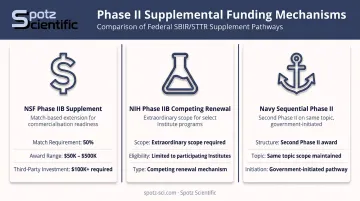
These mechanisms exist because crossing from funded R&D to commercial viability, often called the "Valley of Death," is where many otherwise strong projects stall.
Phase III: Commercialization
Phase III is the intended destination of the entire program. Critically, it is not funded by SBIR/STTR program dollars. Instead, it relies on private investment, government procurement contracts, or revenue.
What makes Phase III strategically significant is the procurement authority it unlocks. Under 15 U.S.C. 638(r)(4), agencies can award Phase III contracts to prior SBIR/STTR awardees without a new competitive solicitation. This sole-source eligibility is a meaningful competitive advantage—but it's an authority, not a guarantee. Agencies are permitted to issue noncompetitive awards; they're not obligated to do so.
In FY2022, agencies reported $2.769 billion in government Phase III obligations—though GAO notes this figure is likely an undercount, since firms aren't required to notify program offices and agencies don't always track lineage consistently.
SBIR vs. STTR: How Program Differences Affect Each Phase
The two programs follow the same phase structure, but STTR's partnership requirement changes the practical shape of every phase.
| Requirement | SBIR | STTR |
|---|---|---|
| Small business R&D minimum | 2/3 Phase I; 1/2 Phase II | 40% in each phase |
| Research institution requirement | None | Minimum 30% of work |
| Mandatory partner | No | Yes (nonprofit research institution) |
| Participating agencies | 11 | 5 |
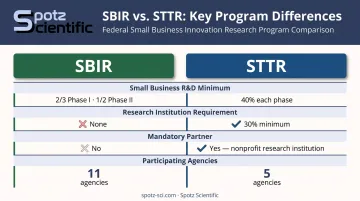
SBIR's more flexible subcontracting structure suits teams without established university partnerships. STTR is designed for collaborations where a research institution is doing substantive work—universities, federal labs, and similar entities. The formal partnership also requires an IP allocation agreement, which should be negotiated before the proposal is submitted, not after.
Program choice should follow your project's actual structure. A meaningful, ongoing university collaboration points to STTR; without one, SBIR is the cleaner starting point. Worth knowing: conversion between programs is possible at many agencies—one agency can fund STTR Phase II after SBIR Phase I if the R&D is continuous—but those decisions are discretionary, not automatic.
Alternative Funding Paths Within the SBIR/STTR Structure
The standard sequential path (Phase I → Phase II → Phase III) isn't the only route. Two alternative pathways exist for teams with different starting points.
Fast Track allows simultaneous submission of Phase I and Phase II applications in a single review. The primary benefit is reducing the funding gap between phases. The tradeoff: you need a fully developed Phase II plan at submission — a significant upfront investment before Phase I results exist. NIH and DOE both document Fast Track options, but availability varies by solicitation.
Direct to Phase II (D2P2) is designed for small businesses that have already demonstrated feasibility through prior work, without a prior SBIR/STTR Phase I award on that specific project. NIH and certain DoD/DARPA topics offer this pathway, though eligibility criteria and participation vary by agency and topic.
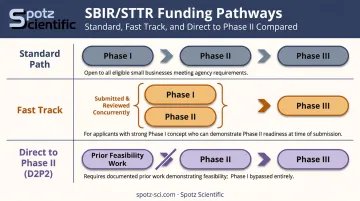
Two additional mechanisms are relevant depending on your stage:
- NIH Commercialization Readiness Pilot (CRP): Available to active Phase II or Phase IIB firms for late-stage R&D and technical assistance not normally supported in standard phases
- Cross-agency Phase II: A different agency may issue Phase II when it determines the work continues the same Phase I R&D (discretionary, but permitted government-wide)
Always consult the specific solicitation and your target agency's program manager before assuming any of these pathways are available.
Common Misconceptions About SBIR/STTR Phases
Misconception: A Phase I Award Secures Phase II Funding
Phase II is a separate competitive application evaluated on its own merits. GAO data shows a 51% Phase II-to-Phase I award ratio for FY2011–FY2020—meaning roughly half of Phase I awardees received a Phase II. That's an aggregate ratio, not an individual probability. Phase I success demonstrates eligibility; it doesn't guarantee anything.
Misconception: Phase III Is an Unfunded Afterthought
Phase III is the point of the entire program. It's where the government's investment is validated through commercialization—and where the sole-source procurement authority becomes a real market advantage for prior awardees. Treating it as an afterthought means arriving at the commercialization stage unprepared for the transition.
Misconception: SBIR/STTR Funds Can Cover General Business Expenses
Phase I and Phase II awards must fund R&D activities. General advertising, marketing campaigns, and sales expenses are not allowable.
One structured exception exists: Technical and Business Assistance (TABA) permits defined commercialization support, including:
- Up to $6,500 in Phase I (DOE program)
- Up to $50,000 in Phase II (DOE program)
- Allowable uses: market research and certain marketing materials
The line is between targeted commercialization support and general business promotion.
Frequently Asked Questions
What are the phases of the SBIR and STTR programs?
Both programs are structured into three phases: Phase I (feasibility and proof of concept), Phase II (full R&D and prototype development), and Phase III (commercialization). Phase 0 exists at select agencies as proposal preparation assistance, not a funded phase.
What is the difference between SBIR/STTR Phase I and Phase II?
Phase I focuses on demonstrating technical feasibility with a smaller, shorter award (up to $323,090 for up to 12 months). Phase II funds full-scale R&D and prototype development with a larger award (up to $2,153,927 for up to 24 months), based on Phase I results.
What is SBIR/STTR Phase III?
Phase III is the commercialization stage where technology reaches the market. It receives no SBIR/STTR program funding, but prior awardees gain statutory eligibility for sole-source government procurement contracts, bypassing the standard competitive bidding process.
What is the purpose of an SBIR/STTR Phase 0 award?
Phase 0 (offered by DOE and DHS, among others) provides no-cost proposal preparation assistance, including education, market research support, and advisory guidance, to help applicants, particularly first-timers, build more competitive Phase I proposals.
Can you go directly to Phase II without completing Phase I?
Yes, through the Direct to Phase II (D2P2) option—available at NIH and select DoD/DARPA programs. Applicants must document Phase I-equivalent feasibility through prior work. Eligibility requirements and availability vary by agency and solicitation.
What is the difference between the SBIR and STTR programs?
Both follow the same phase structure and award criteria. STTR requires a formal partnership with a nonprofit research institution (minimum 30% of work) and is available through only 5 agencies. SBIR allows more flexible subcontracting and operates across 11 agencies.