Introduction
Only about 1 in 10 SBIR Phase I proposals gets funded. At NIH, the 2024 success rate was 10%; the SBA counted 17,798 Phase I proposals and 2,927 awards in FY2022 — a 16% selection rate across all agencies. Your proposal competes in a crowded field, reviewed under real-time pressure.
Here's what many applicants miss: reviewers score your proposal against explicit criteria before they evaluate your science. A technically strong idea buried in dense jargon, or framed without a credible commercial path, loses points before a reviewer reaches your most compelling results.
This article breaks down what actually happens during SBIR Phase I review: the scoring criteria across major agencies, what makes a research plan convincing, how to present your team, and the mistakes that sink otherwise solid proposals.
Key Takeaways:
- Criteria differ across NSF, NIH, DOE, and DoD — read your specific solicitation first
- Commercialization is evaluated at Phase I across all four agencies — it is not optional
- Vague milestones, unsupported claims, and poor organization are the most common scoring liabilities
- Your abstract is often the first thing a reviewer reads — make it work
- Contacting a program manager before submission can clarify fit and strengthen your framing
How SBIR Phase I Review Actually Works
The review structure varies more across agencies than most applicants realize. Here's how the major agencies actually run it:
| Agency | Panel Structure | Program Manager Role |
|---|---|---|
| NSF | At least 3 external experts in technology, commercialization, or both; panelists prepare written reviews before discussion | Program Director reads independently, selects reviewers, may conduct due diligence, recommends the decision |
| NIH | SRO assigns ≥3 reviewers; each writes critiques and preliminary Overall Impact scores before the panel meeting; final score = mean × 10 | SRO manages fair review; Program Official weighs in on fundability separately |
| DOE | ≥3 technical experts (~50% federal lab, ~30% university, ~10% government, ~10% private sector); administrative screening precedes merit review | Selection Official may consider program balance and available funds after merit review |
| DoD | Engineers or scientists evaluate using only what's in the proposal; no universal reviewer count or consensus procedure published | Components select based on technical value, cost, and topic alignment |
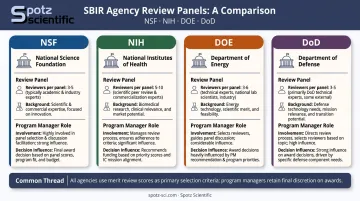
Two practical takeaways cut across all of these structures:
- Program managers do not score proposals, but they influence which ones advance. At NSF especially, the Program Director conducts a separate review and recommends the final decision. Contacting a program manager before submission to confirm topic fit affects how your proposal is routed and received — not just whether it's politely acknowledged.
- There is no single SBIR review model. NSF publishes its review process, NIH has its peer review framework, and DOE describes its process through an evaluator tutorial. Each is the authoritative guide for that agency.
Generic SBIR advice — including what's in this article — is a starting point. Reading your solicitation carefully is not optional.
The Core Evaluation Criteria Reviewers Score
All four major agencies assess some version of the same five dimensions, but the labels, weights, and priorities differ.
Technical Merit and Innovation
NSF screens for innovative technology with meaningful technical risk. DOE scores the degree of innovativeness and the significance of the scientific challenge. DoD expressly evaluates "incremental progress toward the topic solution", so incremental work is not automatically disqualifying if it moves the topic forward.
The practical implication: don't just assert novelty. Explain what currently exists, what gap your approach addresses, and why your method represents a real technical advance. Reviewers will ask "how do they know that?" at every unsupported claim.
Significance and Feasibility
Reviewers need a well-defined problem with a measurable gap (not a vague framing like "improving efficiency"). Pair the problem statement with evidence that Phase I can establish feasibility:
- A justified technical approach
- Clear risk identification and mitigation
- Quantitative success criteria (NSF explicitly requires these in the Project Description)
- Realistic scope for the Phase I timeline and budget
For NIH, the current framework asks whether studies can be performed well within the proposed time and whether weaknesses reduce confidence in feasibility. DOE reviewers assess the soundness of the work plan for demonstrating feasibility. The question isn't whether your idea will eventually work — it's whether this Phase I can credibly test it.
Commercialization Potential
Proposals from academic or research backgrounds most often lose ground here. SBIR is not an academic grant program. All four agencies evaluate commercial or government-market potential:
| Agency | How Commercialization Is Evaluated |
|---|---|
| NSF | Reviewed alongside intellectual merit |
| NIH | Marketable-product potential placed under Significance |
| DOE | Scored as part of the Impact criterion |
| DoD | Government/private-sector application is the third ranked criterion |
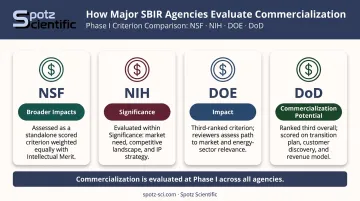
A credible commercialization section names a specific target customer, articulates a value proposition, and shows real market awareness. A TAM figure pulled from an industry report is not market awareness.
Reviewers can tell the difference between an applicant who understands their potential customer and one who ran a quick search. Specificity is what distinguishes the two.
Broader Impacts
NSF's Broader Impacts criterion applies to SBIR proposals, not just standard research grants. DOE's FY2025 Release 1 included Impact as an equally weighted criterion alongside the technical approach and cost-effectiveness. Most applicants underdevelop this section, which makes it a clear opportunity to differentiate your proposal with specific, substantiated claims about societal or national benefit.
Strong Broader Impacts responses include:
- Named populations or sectors that benefit from the work
- Quantified or bounded claims (not "will benefit many")
- Connection to national priorities (energy security, workforce development, infrastructure)
What Reviewers Look for in Your Research Plan
A research plan that reads like an academic project description will underperform. The difference between a plan that scores well and one that doesn't often comes down to how outcomes are framed.
Outcome-Oriented Objectives vs. Open-Ended Activities
Weak framing: "We will study the effect of X on system performance."
Strong framing: "We will demonstrate that X achieves Y performance threshold under Z conditions, measured by [specific metric] at [specific point in the timeline]."
The distinction signals whether the PI thinks like a scientist or like a technical entrepreneur. Reviewers score on that distinction.
Quantified Go/No-Go Milestones
NSF explicitly requires milestones, risk mitigation, and quantitative success criteria in the Phase I Project Description. NIH and DOE both assess whether the approach sets clear, measurable milestones. Vague checkpoints like "we will test the prototype" leave reviewers without any basis for confidence that the team knows what success looks like.
Each milestone should answer three questions:
- What will be measured?
- At what point in the timeline?
- What threshold constitutes proof of feasibility?
Scope and Solicitation Alignment
Reviewers are alert to both extremes: proposals that try to accomplish too much (suggesting the team doesn't understand Phase I's limited budget and timeline) and proposals that are too modest to establish meaningful feasibility.
Every proposal is also evaluated for responsiveness to the named solicitation topic. Agencies screen for this before merit review even begins:
- DOE: Administrative screening occurs first — proposals that mismatch the topic, lack sufficient technical content, or don't propose actual R&D can be eliminated before a reviewer reads a single page.
- NSF: The Project Pitch gate tests innovation, technical objectives, market opportunity, and team fit before a full proposal is invited.
Map your proposal explicitly to the solicitation language.
Team Qualifications and Feasibility
PI Effort Rules — and Why Reviewers Notice
PI employment and effort requirements are not uniform across agencies:
- NSF: PI must be primarily employed (≥51%) by the small business; minimum one calendar month of effort per six months of performance
- NIH: More than half of the PI's time must be in the small business's employ at award and during the project
- DOE: At least 20 hours/week employed by the applicant; minimum 3 hours/week devoted to the Phase I project
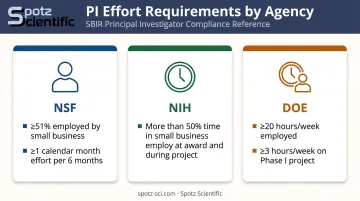
Low PI effort is a credibility signal, not just a compliance issue. Reviewers interpret it as evidence that the company isn't serious about the project. Make sure stated effort is compliant and genuinely reflects the PI's commitment.
Presenting the Team Compellingly
Biosketches should not simply list credentials — they should directly connect each team member's experience to the technical requirements of the proposed work. A mismatch between the team's documented background and the proposal's technical demands is among the clearest warning signs reviewers cite.
DoD's evaluation criteria explicitly include qualifications of principal investigators, supporting staff, and consultants — including their ability to commercialize. Consultants and advisors count only when their roles, expertise, and time commitments are documented in the proposal.
A reviewer's-eye assessment of your team section before submission can catch presentation gaps that internal reviewers miss. Spotz Scientific's red team review service offers that outside perspective, drawing on Bill Spotz's eight years as a DOE ASCR program manager and his oversight of more than $264M in scientific computing research.
How to Organize Your Proposal for the Review Process
Don't Make Reviewers Hunt for Evidence
Reviewers must assign scores for each criterion. If the relevant evidence is scattered or buried, even a technically strong proposal can receive mediocre scores — the reviewer simply can't find what they need to justify a high rating.
Use structure deliberately:
- Section headings that map to evaluation criteria by name
- Summary tables to present milestones, team roles, or comparisons at a glance
- Bold key claims so a fast reader can extract them without reading every sentence
The Abstract Is Your First (and Sometimes Only) Shot
All three grant-making agencies have specific abstract requirements:
- NSF: One page with separate "Overview," "Intellectual Merit," and "Broader Impacts" headings; should be understandable to a scientifically literate lay reader
- NIH: Maximum 30 lines; written to help the public understand the research's value
- DOE: Stand-alone PDF of no more than one page covering the problem, approach, expected results, public benefit, and commercial applications
Reviewers often form their initial impression from the abstract. It should state the problem, the proposed innovation, and the commercial opportunity in plain, accessible language — giving reviewers the context they need before they reach your technical plan.
Writing for Two Audiences Simultaneously
The accessibility requirement in the abstract extends to the full proposal. NSF's mixed technical and commercial panels make this especially explicit: a proposal must convince a technical expert that the team is credible, while remaining understandable to a reviewer who may not be a narrow specialist. NIH's abstract guidance reinforces the same principle.
Achieving this balance requires deliberate editing and outside reader feedback. Ask a colleague unfamiliar with the project to read a draft — if they can follow the argument, a non-specialist reviewer likely can too.
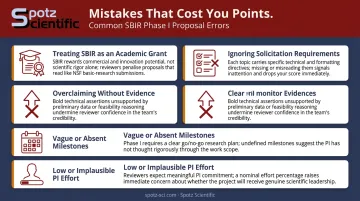
Common Mistakes That Cost You Points
Treating SBIR as an academic grant: Proposals centered on knowledge generation, publications, or basic discovery consistently underperform on commercial impact criteria. The program's purpose is marketable innovation, not scientific output.
Ignoring solicitation requirements: DOE screens out proposals that fail eligibility requirements, mismatch the topic, or lack sufficient technical content — before merit review begins. DoD has deemed proposals noncompliant for missing a single required signed disclosure. Formatting errors and missed sections signal carelessness and trigger administrative disqualification.
Overclaiming without evidence: Superlatives ("revolutionary," "unprecedented"), unsourced market figures, and performance claims without supporting data erode reviewer trust. Every significant assertion needs a reference, preliminary data, or a logical argument the reviewer can follow — understated and evidence-backed beats enthusiastic every time.
Vague or absent milestones: Reviewers need to see specific success criteria, not activity descriptions. "We will run experiments" is not a milestone.
Low or implausible PI effort: Below-threshold or suspiciously low effort commitments raise immediate questions about whether the company is genuinely behind the project.
Frequently Asked Questions
How long do SBIR reviewers typically spend reading a Phase I proposal?
No official benchmark has been published by NSF, NIH, DOE, or DoD. Reviewers handle multiple proposals per cycle — NIH notes that applicants receive applications about six weeks before the panel meeting. Clarity, organization, and a compelling abstract carry disproportionate weight because time-constrained reviewers rely on what they can find quickly.
Do SBIR reviewers need to be experts in my specific technical field?
Not necessarily. NSF uses both technical and commercial experts; NIH assigns qualified scientific reviewers; DOE draws from federal labs, universities, and private sector; DoD uses engineers or scientists. No agency guarantees a narrow specialist for every proposal. Write so that the closest expert finds your technical claims credible and an adjacent expert can still follow the argument.
What is the most common reason SBIR Phase I proposals are not funded?
The most frequently documented shortfalls are: insufficient evidence of genuine innovation, weak or missing feasibility demonstration, an unconvincing commercialization argument, and failure to follow solicitation instructions or address all required criteria. Proposals that treat SBIR as an academic grant program are consistently penalized on commercial impact criteria.
How important is commercialization for a Phase I proposal compared to Phase II?
All four major agencies evaluate commercial potential at Phase I — it is not deferred to Phase II. At Phase I, reviewers expect a named target customer, a clear value proposition, and genuine market awareness. Phase II requires a more detailed commercialization plan, but the foundation should already be present in Phase I.
Can I resubmit an SBIR Phase I proposal if it is not funded?
Resubmission policies vary by agency. NIH generally permits one A1 resubmission with a one-page introduction addressing prior review critiques. NSF requires substantial revision and a new invited Project Pitch before resubmission. DOE encourages applicants to address reviewer comments and apply again under an available FOA.
Does the review process differ significantly between agencies like DOE, NSF, and NIH?
Yes, meaningfully. NSF combines scientific merit, societal impact, and commercial translation through a mixed panel. NIH uses independent preliminary scoring followed by panel discussion and separate programmatic funding decisions. DOE separates technical merit review from a Selection Official's portfolio judgment, while DoD evaluates proposals against named topics with explicit criterion ordering. Each agency's solicitation is the definitive guide — scoring structures are not interchangeable.