Most people only think about "proposal reviewers" as the panelists sitting on a review board. But the reviewer who matters most often works before your proposal ever reaches that panel.
This article breaks down what a proposal reviewer actually does, how official agency reviewers differ from pre-submission reviewers, and why bringing one in early can be the difference between a funded proposal and a rejected one.
Key Takeaways
- Proposal reviewers evaluate merit, compliance, and clarity as panelists or independent pre-submission experts
- Pre-submission review catches compliance gaps and weak framing early enough to fix
- Single-PI programs like DOE ECRP and NSF CAREER benefit most from outside review
- Skipping review risks a technical rejection that costs a full year's delay
What Is a Proposal Reviewer?
A proposal reviewer is anyone, agency-appointed panelist or independent expert, who critically evaluates a proposal against funding criteria before a decision gets made.
The term shows up in book publishing and business RFPs too. But the stakes climb sharply in federal scientific grant funding, where formal peer review directly determines who gets money and who doesn't.
For a researcher applying to DOE or NSF, the reviewer functions as a critical part of the pipeline, turning a rough draft into a fundable proposal.
Official Peer Reviewers vs. Pre-Submission Reviewers
These two reviewer types do different jobs at different times.
Official agency peer reviewers are appointed panelists who score your submitted proposal against published criteria:
| Agency | Reviewer Panel | Evaluation Focus |
|---|---|---|
| NSF | 3-10 external experts | Intellectual Merit and Broader Impacts using five shared review elements |
| DOE Office of Science | At least 3 qualified reviewers | Mission relevance, technical quality, and cost realism |
Pre-submission (or "red team") reviewers work on the other side of the deadline. They're experienced professionals, often former program managers, hired by the research team to critique drafts before anything gets submitted. Their job is to simulate exactly what an agency panelist will scrutinize, then flag it while there's still time to fix it.
Spotz Scientific specializes in this second category. Founder Bill Spotz spent eight years as a DOE ASCR program manager, managing over $264 million in scientific computing research, and applies that firsthand perspective to red-team reviews for DOE ASCR and NSF CISE proposals.

Key Advantages of Using a Proposal Reviewer
The advantages below focus on outcomes researchers actually track: funding success, panel scoring, and time saved during revisions. Not abstract benefits. These gains compound when the reviewer has direct experience with your target agency's actual review process, not just general grant-writing knowledge.
Identifies Compliance and Technical Gaps Before Submission
A reviewer checks your draft against the solicitation's fine print: page limits, required sections, budget justification, data management plans. Missing any of these can sink an otherwise strong proposal.
NSF's own policy guide confirms this risk is real. Proposals can be returned without review for issues like an over-length Project Description or a missing Broader Impacts section. CAREER proposals listing a co-PI get returned outright, since it's a single-PI program by design.
A good reviewer works through your draft the way an assigned panelist would, catching these problems before they become scoring problems. This matters most for:
- First-time submissions where the applicant hasn't seen a solicitation's full requirements play out
- Multi-PI proposals with more moving parts to track
- Programs with strict formatting rules, such as DOE ASCR or NSF CISE solicitations
Strengthens Alignment With Funding Agency Priorities and Mission
Technical quality alone doesn't win funding. DOE Office of Science selection explicitly weighs mission relevance alongside technical merit, plus available funds and cost realism. NSF layers in portfolio factors like transformational potential and capacity building on top of Intellectual Merit and Broader Impacts scores.
A reviewer checks whether your framing, motivation, and impact statements actually speak to what the agency says it cares about. Someone with insider program management experience recognizes the language and emphasis that resonates in real panel discussions, because they've sat in the room.
This shows up in panel review scores, relevance and fit ratings, and the likelihood of advancing past initial screening. It matters most for novel or interdisciplinary research areas, and for early career researchers unfamiliar with an agency's internal culture.
Increases Overall Competitiveness and Funding Success Rate
Researchers struggle to critique their own work objectively. You've lived with your idea for months. An outside reviewer hasn't, which is exactly why they catch weak arguments you've stopped noticing.
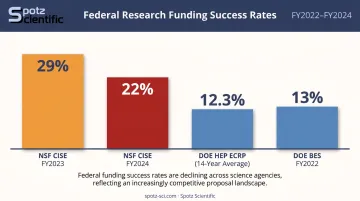
Iterative reviewer feedback mirrors the scrutiny of an actual panel. That's the point: surface the weak spots while there's still time to fix them, not after a rejection notice arrives. No study has quantified a universal success-rate lift from pre-submission review. DOE program-level data shows why every improvable point matters: HEP's ECRP success rate has run around 12.3% over 14 years, and BES reported roughly 13% in FY2022. In fields this competitive, small weaknesses carry real weight.
This benefit weighs heaviest for single-PI early career proposals (DOE ECRP, NSF CAREER), where there's often no institutional grants office providing this level of scrutiny before submission.
What Happens When Proposal Review Is Skipped
Skipping review doesn't just mean missing polish. It creates specific, preventable failure points:
- A weak or inconsistent narrative that never quite connects your methodology to agency priorities
- Unnoticed compliance errors that trigger administrative rejection regardless of how strong the science is
- A lost funding cycle, often a full year, spent resubmitting mistakes an afternoon of review could have caught
DOE's ECRP and NSF's CAREER program both run on annual cycles with a single deadline. Miss it, or get returned without review, and you're waiting roughly a year for another shot. That's a steep price for a formatting error or a mission-fit gap that a second set of eyes would have caught.
How to Get the Most Value from a Proposal Reviewer
Review works best when it happens early enough to allow real revision, not as a last-minute polish job. A few practical rules:
- Engage a reviewer at the draft or pre-proposal stage, not days before the deadline. Feedback you receive with no time to act on it isn't worth much.
- Choose a reviewer with direct insider experience in your target program, ideally a former DOE or NSF program manager who has actually scored proposals like yours.
- Build in time for iteration. One pass rarely catches everything; a second look after revisions often surfaces different issues.
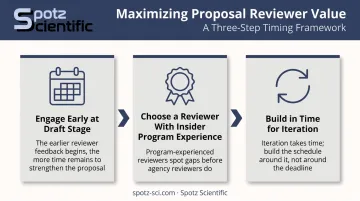
Spotz Scientific's red-team review service is built around this timing. Standard review runs $200–250/hour when materials arrive at least two weeks before a NOFO deadline, giving enough runway for a genuinely thorough pass. Materials submitted within that window shift to a $250–300/hour premium rate to cover the compressed turnaround.
Either way, the review applies Bill Spotz's firsthand DOE ASCR program management experience directly to your proposal, before it ever reaches an actual panel.
Conclusion
The value of a proposal reviewer comes down to three things: objectivity you can't provide yourself, compliance assurance that prevents avoidable rejections, and alignment with what funders say they value.
These advantages don't max out on a single pass. They compound when you engage a reviewer early and revisit feedback iteratively, rather than treating review as a final rubber stamp. Proposing scientific research with confidence starts with knowing someone who's sat on the other side of the table has already stress-tested your work.
Frequently Asked Questions
What is a proposal review?
It's the structured evaluation of a proposal's quality, compliance, and merit. This happens either through official agency panelists after submission or through an independent reviewer before submission.
What's the difference between a peer reviewer and an external proposal reviewer?
Peer reviewers are agency-appointed panelists who score proposals after they're submitted. External reviewers are hired beforehand to critique drafts and simulate how the panel will react.
When should I hire a proposal reviewer during the proposal-writing process?
The ideal time is at the draft or pre-proposal stage, when there's still enough runway to meaningfully revise based on feedback rather than just polish the wording.
Do I need a proposal reviewer for programs like DOE ECRP or NSF CAREER?
Yes, especially for these programs. They're single-PI and highly competitive, and applicants often lack the institutional support that would otherwise catch gaps.
What does a proposal reviewer actually look for?
Reviewers check compliance with solicitation requirements and technical and scientific soundness, then confirm the proposal aligns with the funding agency's stated mission and priorities.
Can a proposal reviewer guarantee my proposal will get funded?
No reviewer can guarantee funding outcomes. Thorough review does catch compliance errors and framing gaps that commonly cause rejection, reducing preventable weaknesses before submission.