Introduction
Most researchers approach federal funding the same way: they wait for a NOFO to land in their inbox, then scramble to write something that fits. That reactive habit is expensive.
CISE funding rates show how brutal the math can be. The Information and Intelligent Systems (IIS) program funds roughly 15% of proposals, while the Office of Advanced Cyberinfrastructure (OAC) funds around 33%. A single well-timed proposal isn't enough to compete in that environment.
Without a strategy, researchers waste months on poorly matched opportunities. They miss narrow eligibility windows, like DOE Early Career or NSF CAREER, that only open once per year. And they never build the track record program managers expect to see across multiple award cycles.
This article covers four things: understanding the federal funding landscape, building a multi-year strategy, executing and sustaining it, and avoiding the mistakes that sink otherwise strong researchers. The perspective here comes from the agency side, not generic grant-writing advice.
Key Takeaways
- A grant strategy is a multi-year plan spanning many proposals
- NSF reviewed 38,340 competitive proposals in FY 2023, so alignment beats volume
- Career-stage programs like DOE Early Career have strict, limited eligibility windows
- Diversifying across agencies and mechanisms protects researchers from shifting federal priorities
- Relationship-building with program managers should continue year-round, well ahead of deadlines
What Is a Grant Strategy for Researchers?
A grant strategy is a multi-year plan that aligns your scientific goals with realistic, well-matched federal funding opportunities. It's a living pipeline that evolves as your research priorities and funding landscape change, not a document you file away after writing it once.
Here's the distinction that trips up most researchers: a proposal is a single submission responding to one NOFO. A strategy is everything around it: your pipeline of submissions over several years, the relationships you build with program managers, and the career milestones (tenure, promotion, lab expansion) that your funding needs to support.
This portfolio-management mindset replaces the one-time bet of a single proposal with sustained, career-spanning investment.
Why a One-Off Proposal Approach Fails
Program managers and reviewers can spot a scattershot submission almost immediately. A proposal that doesn't map to stated agency priorities reads differently than one written by a researcher who clearly understands the program's mission.
A deliberate strategy consistently outperforms ad hoc applications, and the numbers back this up. NSF's FY 2023 Merit Review Digest shows the agency evaluated 38,340 competitive proposals that year. With volume like that, alignment often determines whether a proposal gets funded or declined.
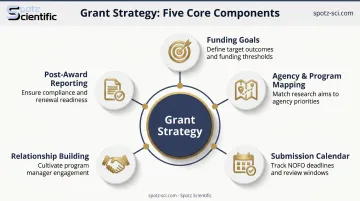
A real grant strategy includes:
- Funding goals tied to career trajectory and lab capacity
- Agency and program mapping across DOE, NSF, and other mechanisms
- A submission calendar tracking deadlines and internal review windows
- Relationship building with program managers, sustained year-round
- Post-award reporting that reinforces your credibility for the next cycle
Understanding the Federal Funding Landscape (DOE and NSF)
DOE's Office of Science and NSF run on fundamentally different logic, even when funding similar computational work. DOE's Advanced Scientific Computing Research (ASCR) office funds work that advances computational capabilities for modeling complex phenomena. NSF's CISE directorate funds foundational computer science and engineering research judged against broader societal goals.
Review criteria differ too. NSF applies its two long-standing merit review criteria: Intellectual Merit and Broader Impacts. DOE ASCR instead evaluates technical merit, approach, and increasingly, Promoting Inclusive and Equitable Research (PIER) plans. A proposal written for one agency's rubric will read as slightly off-target to the other.
Program Manager Priorities and Insider Knowledge
Program managers work within current portfolio priorities set by their agency's budget and leadership. They're looking for proposals that clearly map to what's already been funded, not just technically sound science in a vacuum.
This is where insider experience matters. Bill Spotz spent eight years as a DOE program manager co-leading the ASCR applied mathematics program, overseeing more than $264 million in scientific computing research. That kind of tenure teaches you the unwritten priorities behind a NOFO — the framing a reviewer expects to see, even when the solicitation text doesn't spell it out.
A researcher who understands those unwritten expectations can reframe a proposal's significance section. Instead of restating generic impact language, the narrative speaks directly to what the program office is trying to accomplish that fiscal year.
Mapping Opportunities to Your Research Agenda
Build a running list of relevant NOFOs and track their release cycles:
- DOE ASCR program calls (applied math, computer science, data facilities)
- NSF core programs within CISE
- SBIR/STTR solicitations, if commercialization fits your work
Career-stage programs deserve special attention. DOE's Early Career Research Program and NSF's CAREER program both restrict applicants to one submission per competition and three attempts over a lifetime. Miss the window, and it doesn't reopen for a decade of your career.
Attend program manager webinars and request informational calls where permitted. This mirrors exactly how funder relationships work in traditional grant-seeking: the goal is learning what a solicitation doesn't say out loud.
Building a Winning Grant Strategy: Core Components
A strategy is only useful if it's built from concrete, repeatable components. Here's how the pieces fit together.
Set Multi-Year Funding Goals
Align your funding goals with your career stage. An early-career award often comes first, followed by standard research grants, and eventually larger center-scale opportunities like NSF Expeditions awards, which can reach $15 million over seven years for large teams.
Set realistic annual submission targets based on your actual writing capacity, not an aspirational number. Two well-crafted proposals beat five rushed ones every time.
Categorize and Prioritize Opportunities
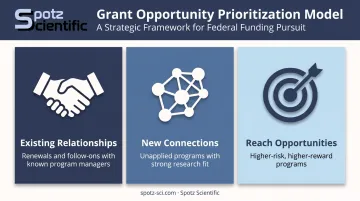
Adapt a simple three-tier model to your research funding pipeline:
- Existing relationships: renewals or follow-ons with program managers who already know your work
- New connections: programs you haven't applied to, but where your research fits well
- Reach opportunities: higher-risk, higher-reward programs worth a shot but not your primary bet
Build a Submission Calendar
Track everything in one shared calendar: NOFO release dates, letters of intent, full proposal deadlines, and your institution's internal review timelines. Internal deadlines often arrive weeks before the agency's, and missing them can knock you out before the agency even sees your work.
Diversify Across Agencies and Mechanisms
Relying on a single agency or program is a fragile strategy. Federal funding priorities shift with budget cycles and administration changes, and a program that funded you last year may look different this year.
Explore both DOE and NSF, plus mechanisms like SBIR/STTR for applied or commercializable work. Strategic, program-specific advisory helps determine fit and positioning early. Reviewing a specific NOFO before you commit writing time to it can save you from sinking weeks into a draft that was never a strong match.
Relationship-building with program officers should be continuous. Send updates when you publish, not just when you need something.
Executing Your Strategy: From Prospecting to Submission
Once a NOFO looks promising, run it through a quick go/no-go decision before committing serious writing time:
- Eligibility: Do you meet the career-stage, institutional, or citizenship requirements?
- Alignment: Does your research genuinely map to the program's stated priorities this cycle?
- Capacity: Do you have the writing bandwidth to produce a competitive draft, not just a complete one?
If a NOFO passes that filter, tailor the narrative to its specific language and review criteria. Reusing boilerplate from a previous submission is one of the fastest ways to signal a mismatch to reviewers who read dozens of these a cycle.
Once that tailored draft takes shape, get a red-team review before you submit. Spotz Scientific provides exactly this kind of rigorous, reviewer's-eye critique for draft proposals and pre-proposals.
Standard reviews run $200 to $250 an hour, rising to $250 to $300 an hour for materials submitted less than two weeks before a deadline. The pricing structure makes a point: the earlier you get eyes on a draft, the more thorough and useful that review can be.
Sustaining Momentum: Relationships, Reporting, and Renewals
Winning a grant isn't the finish line. What you do after the award shapes your next submission.
- Post-award reporting to DOE or NSF is a credibility test. Timely, substantive reports signal to program managers that you're a reliable investment for future cycles.
- Ongoing communication keeps you visible between cycles. Share publications, results, and progress updates with your program manager rather than waiting for the next formal deadline.
- Early renewal planning matters most when transitioning from an early-career award to a standard research grant. Start that conversation a year or more before your current award ends.
Common Grant Strategy Mistakes That Cost Researchers Funding
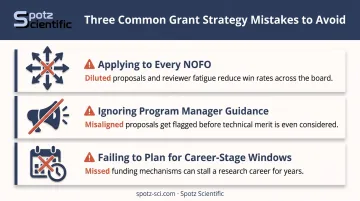
Three mistakes show up again and again, and all three are avoidable with a real strategy in place.
- Applying to every NOFO regardless of fit spreads effort across mismatched opportunities and dilutes quality everywhere. Two strong, targeted proposals beat five generic ones.
- Ignoring program manager guidance by skipping webinars or overlooking priority statements leads to technically sound proposals that miss what's actually being funded this cycle.
- Failing to plan for career-stage windows risks losing DOE Early Career or NSF CAREER eligibility, which is time-limited and unforgiving. Researchers who wait too long often discover they've aged out or missed the annual window.
Frequently Asked Questions
What is a grant strategy?
A grant strategy is a structured, multi-year plan that aligns your research goals with well-matched federal funding opportunities. It goes beyond any single proposal to cover your entire funding pipeline over time.
What does a grant strategist do?
A grant strategist maps funding opportunities to your research agenda, reviews draft proposals for weaknesses, and advises on positioning before you submit. Spotz Scientific offers this type of consulting support to researchers targeting DOE and NSF programs.
What are the 5 types of grants?
In federal science funding, common categories include early-career awards, standard single-investigator research grants, continuing multi-year grants, center-scale collaborative awards like NSF Expeditions, and SBIR/STTR grants for small businesses.
How often should researchers apply for federal grants?
There's no universal benchmark, but your writing capacity should drive the number. Programs like NSF CAREER and DOE Early Career limit you to one submission per competition and three attempts over your career.
How do I find the right NOFO for my research?
Check agency websites regularly, reach out to program managers when outreach is permitted, and map each opportunity's stated priorities against your actual research focus before committing to write.
How long does it take to build an effective grant strategy?
Building an effective grant strategy takes multiple funding cycles to refine. Most researchers adjust their approach as they learn which programs and program managers respond best to their work.