While reauthorization applies to all federal agencies running SBIR and STTR programs, NSF applicants face some of the most consequential new requirements. Proposal volume caps, expanded national security screening, and an entirely new high-value funding category each demand attention from anyone planning submissions in FY2027 and beyond.
Key Takeaways
- SBIR and STTR programs are reauthorized through September 30, 2031 under Public Law 119-83
- Agency-set proposal caps take effect beginning FY2027 — shifting the advantage to quality over volume
- National security screening now extends to ownership, personnel, investors, and foreign affiliations
- Strategic Breakthrough Awards offer up to $30M for post-Phase II companies that can secure matching funds
- NSF solicitation 26-510 (May 2026) anticipates ~$210M in funding across approximately 340 awards
What Is NSF SBIR and Why Does Reauthorization Matter?
Under 15 U.S.C. Section 638, federal law requires agencies with qualifying R&D budgets to set aside a fixed percentage for small business innovation. The core program parameters are:
- SBIR: Required for agencies with extramural R&D budgets above $100 million — minimum 3.2% set-aside
- STTR: Required for agencies exceeding $1 billion — minimum 0.45% set-aside
According to SBIR.gov, these programs invest approximately $4 billion annually across roughly 4,000 companies. The FY2022 annual report puts the figure at $4.73 billion obligated through 6,559 new Phase I and Phase II awards.
A key feature that makes these programs attractive: the federal government takes no equity from awardees and companies retain their intellectual property. Non-dilutive capital plus full IP ownership makes SBIR and STTR among the most founder-friendly funding mechanisms available for early-stage deep-tech companies.
Reauthorization is not automatic. Congress must actively renew these programs, and without that legal authority, agencies lose the ability to issue new solicitations or make new awards — regardless of whether appropriated funds exist. It is a legal authorization problem, not a budget problem — and that distinction is precisely what drove the funding gap between October 2025 and April 2026.
The Six-Month Lapse: What Happened and Why
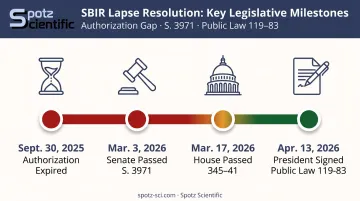
The previous authorization expired September 30, 2025. The House had passed a clean one-year extension (H.R. 5100) by voice vote on September 15, 2025, but the Senate did not act before the deadline, causing both programs to lapse beginning October 1.
Here is how the timeline resolved:
| Date | Event |
|---|---|
| Sept. 30, 2025 | Existing authority expired; lapse began Oct. 1 |
| Mar. 3, 2026 | Senate passed S. 3971 by voice vote |
| Mar. 17, 2026 | House passed S. 3971, 345–41 (Roll No. 89) |
| Apr. 13, 2026 | President signed it as Public Law 119-83 |
During the lapse, agencies could not issue new solicitations or awards. A Senate Small Business Committee analysis — drawn from 2022 agency projections — estimated that more than $80 million and approximately 280 NSF companies could be affected, alongside more than $1.6 billion across DOD programs.
These figures are scenario estimates rather than measured 2025–2026 outcomes, but they signal how many companies and agencies were left in limbo — unable to receive new funding while waiting for Congress to act.
Existing contracts continued to be honored throughout the lapse. New awards, however, were suspended until reauthorization was enacted — the resolution the timeline above describes.
Key Changes in the Small Business Innovation and Economic Security Act of 2026
Public Law 119-83 extends authorization through FY2031, giving agencies and applicants over five years of planning certainty. Three programmatic changes carry the most weight for NSF applicants.
Proposal Limits Starting FY2027
Beginning with FY2027, each agency's SBIR/STTR program director must set a maximum number of proposals a company may submit per fiscal year, per solicitation, or per topic. Agencies must publish their limits at least 90 days before the start of each fiscal year.
The driving concern behind this provision: GAO's March 2024 analysis found that during FY2011–FY2020, just 22 of 6,865 Phase II recipients — fewer than 1% of companies — captured 11% of Phase II awards and 10% of dollars. The concentration was highly agency-specific: DHS directed 26% of its Phase II awards to this cohort, while NSF directed 0%. The legislative response targets the national pattern, even where agency-specific problems didn't exist.
Agencies may grant narrow waivers for time-sensitive, urgent mission needs, but those waivers are capped at 5% of an agency's topics per year.
Enhanced National Security and Foreign Risk Screening
Eligibility screening now extends to foreign affiliations, investment ties, technology licensing arrangements, and business relationships with entities in countries of concern. This review covers any covered individual, owner, key personnel, or affiliate.
Companies appearing on any of eight designated federal lists are explicitly excluded from participation:
- UFLPA Entity List
- Treasury's Non-SDN Chinese Military-Industrial Complex Companies List
- DOD's Section 889 Prohibition List and Section 1260H list
- Commerce's Military End User List and Entity List
- FCC Covered List
- CBP's Withhold Release Orders and Findings List
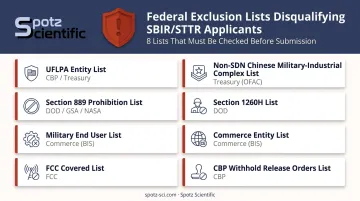
This is more extensive than checking a single watch list. Applicants with international collaborators, overseas licensing arrangements, or foreign investors need to treat those relationships as eligibility-critical facts before submission.
Phase III Transition Improvements
Moving from Phase II completion to full commercialization has long frustrated SBIR recipients. The Act targets several friction points directly:
- Requires acquisition workforce training on Phase III authorities and sole-source execution
- Calls for simplified, standardized model contracts
- Directs procurement center representatives to advocate for maximum use of Phase III transition authorities
These are process improvements, not a new set-aside category.
Strategic Breakthrough Awards: A New Path Through the Valley of Death
The Act creates a genuinely new funding mechanism for companies that have proven their technology and are ready to scale.
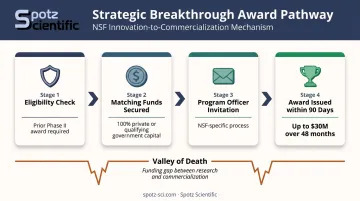
What it is: A Phase II funding vehicle available to agencies whose annual required SBIR expenditures exceed $100 million, with individual awards up to $30 million structured as a single award or milestone-triggered payments over up to 48 months.
Who qualifies:
- Holds at least one prior Phase II award (Phase I alone is not sufficient)
- Can secure 100% matching funds from new private capital, new qualifying non-SBIR/STTR government funding, or a combination
- Can support the application with market research demonstrating the technology addresses an identified critical need
- Receives an invitation from the cognizant program officer (for NSF awardees specifically)
Why it matters: Strategic Breakthrough Awards are designed to bridge the "valley of death", the gap between Phase II completion and scaled commercial deployment. By requiring matched private capital, the mechanism is structured to attract outside investors alongside federal funding — compressing the timeline to market. That urgency extends to agencies as well: contract awards must be completed within 90 days of proposal receipt once an applicant is invited.
What These Changes Mean for NSF SBIR Applicants
NSF posted solicitation 26-510 on May 22, 2026, relaunching with $210 million in anticipated funding across approximately 340 awards. Applicants who were in a holding pattern can now move forward. The new environment, however, rewards different behaviors than the old one.
Proposal Limits
NSF currently limits companies to two Project Pitches in a rolling 12-month period and two full proposals per fiscal year. When FY2027 caps are formally established — announced at least 90 days in advance — applicants who previously relied on volume will need to invest more in each individual submission. Every proposal carries more weight when your submission count is fixed.
National Security Screening
Researchers with international collaborations, foreign co-investigators, or technology licensing arrangements with overseas partners should proactively review their disclosure picture before submitting. The eight-list screening framework is more comprehensive than most applicants expect. At minimum, review:
- All foreign national co-investigators and collaborators
- Existing technology licensing agreements with overseas partners
- International institutional affiliations of key personnel
- Any prior or pending foreign government funding
Incomplete or ambiguous disclosure creates delays — and sometimes denials — that preparation could have prevented.
Strategic Breakthrough Awards
This mechanism is worth advance planning for any company that has completed Phase I or Phase II NSF work and is approaching commercial readiness. The 100% matching requirement means eligibility strategy begins long before the award application — specifically in how you structure relationships with private investors and what market validation evidence you can bring to the agency.
Taken together, these three shifts reward preparation over volume — and raise the cost of a poorly positioned submission. Working with advisors who understand how program officers evaluate proposals becomes more consequential in this environment. Spotz Scientific's founder, Bill Spotz, spent eight years as a DOE program manager overseeing more than $264 million in scientific computing research — the kind of insider perspective that helps researchers build proposals aligned with program priorities, not just technically sound ones.
Frequently Asked Questions
What is the current status of NSF SBIR reauthorization?
SBIR and STTR programs were fully reauthorized on April 13, 2026, when President Trump signed the Small Business Innovation and Economic Security Act of 2026 (S. 3971) as Public Law 119-83. NSF posted its FY2026 solicitation (26-510) in May 2026, and the programs are actively accepting applications through FY2031.
Has the SBIR program been reauthorized for 2026?
Yes — the reauthorization covers FY2026 through FY2031, giving agencies including NSF full legal authority to issue new solicitations and awards. Funds remaining at the end of FY2026 may be carried into FY2027 under the Act.
Is SBIR funding frozen?
No. The six-month lapse that began October 1, 2025 ended with the April 13, 2026 signing. Agencies are actively issuing solicitations and awards. Existing contracts continued to be honored throughout the lapse; only new awards were suspended.
What are the biggest changes in the new SBIR reauthorization?
The most significant changes are agency-set proposal limits beginning FY2027 (published at least 90 days in advance), expanded national security and foreign risk screening against eight federal lists, and a new Strategic Breakthrough Award category offering up to $30 million for qualified Phase II awardees with matching funds.
How do the new proposal limits affect NSF SBIR applicants?
NSF will publish its own per-company or per-topic submission caps at least 90 days before FY2027 begins. Applicants who previously submitted high volumes will need to be more selective — prioritizing proposal quality over quantity.
What are Strategic Breakthrough Awards and who qualifies?
Strategic Breakthrough Awards are a new Phase II funding category with awards up to $30 million over 48 months. To qualify, companies must hold at least one prior Phase II award, secure 100% matching funds from private or qualifying government sources, and submit market research confirming the technology addresses a critical need. NSF awards also require a program officer invitation.