Generic writing advice won't cut it here. This guide is written for scientific researchers, graduate students, university faculty, and research teams pursuing funding from agencies like NSF and DOE. It covers what a research proposal actually is, the sections every strong proposal needs, a step-by-step writing process, and — critically — what reviewers on the other side of the table are actually evaluating.
Key Takeaways
- A research proposal is both a planning document and a persuasive argument for an external audience
- Every core section — from problem statement to methodology — must answer the reviewer's "so what?" and "can they do it?" questions
- NSF reviewers score on Intellectual Merit and Broader Impacts; DOE ECRP uses six ordered criteria — know which framework applies before you write a single word
- Vague methodology and misalignment with the NOFO are the two most common rejection triggers
- Federal proposals require a fundamentally different level of rigor than thesis proposals or internal grant applications
What Is a Research Proposal and Why Does It Matter?
A research proposal is a structured document that describes what you plan to study, why it matters, and how you intend to carry it out — written to persuade a committee, supervisor, or funding body to support the work.
It serves two purposes simultaneously:
- Forces you to think through feasibility, methodology, and scope before the work begins
- Justifies to an external audience — one with the power to say yes or no — why your project deserves resources
The distinction between a research plan and a research proposal matters. A plan is for you. A proposal is for an audience with the power to say yes or no.
That audience changes depending on where you're submitting — and so do the expectations.
Where Proposals Are Required
Proposals appear across several contexts, each with distinct requirements:
- PhD and thesis programs — typically a few pages, reviewed by a dissertation committee
- Institutional grant applications — vary by institution; often 5–15 pages
- Federal competitive programs — NSF CAREER, NSF Future CoRe, DOE Early Career Research Program, DOE ASCR open solicitations — can run 15–30+ pages with strict formatting, mandatory components, and compliance screening before merit review even begins
At the federal level, DOE and NSF collectively obligated over $23.9 billion in R&D in FY 2024, with DOE alone at $16.9 billion. That scale means program offices receive far more proposals than they can fund — and noncompliant submissions are often returned before a reviewer reads a single substantive sentence.
Key Sections Every Research Proposal Needs
Most federal proposals share a common architecture. Understanding what each section must accomplish (not just what it contains) is what separates competitive submissions from rejected ones.
Title
A strong title is 10–15 words, specific, and precise without relying on acronyms or jargon. It must immediately signal the research focus to a reviewer skimming dozens of submissions. Vague titles ("Studies in Computational Methods") waste an opportunity to make an immediate impression.
Introduction and Problem Statement
This is the pitch. It must:
- Articulate the central research problem clearly
- Explain why the topic is timely and significant
- Identify the specific gap in existing knowledge that the proposed work addresses
The problem statement must answer "so what?" — and answer it unmistakably. Reviewers who can't identify the gap after one reading move on.
Literature Review
The literature review demonstrates command of the field and proves the proposed work is original. A strong lit review synthesizes sources into a logical case for why new research is necessary — it's not a summary of prior work, but an argument built from it.
A well-constructed literature review will:
- Organize thematically, not chronologically
- Show how prior work supports, limits, or leaves open your research questions
- Make the gap in existing knowledge unmistakable before the methodology section begins
Research Design and Methodology
This section gets the most scrutiny. It must specify:
- Research type (qualitative, quantitative, computational, experimental)
- Data collection or experimental procedures
- Analysis plan
- Ethical considerations or safeguards against failure
Vague or underspecified methods are a frequent rejection trigger at both NSF and DOE — domain expert reviewers notice immediately when procedures don't connect to research questions.
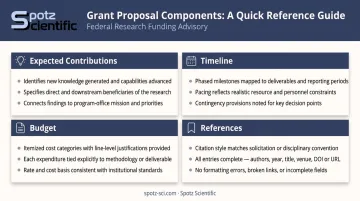
Contributions, Timeline, Budget, and References
- Expected contributions — articulate what new knowledge, capabilities, or practices result, and for whom
- Timeline — realistic phases with milestones; overly optimistic timelines signal inexperience
- Budget — when required, itemize and justify each cost category tied directly to the methodology; federal budgets are closely scrutinized
- References — follow the required citation style exactly; errors here undermine credibility across the whole submission
How to Write a Research Proposal: Step-by-Step
Step 1: Choose a Focused Research Topic and Identify the Gap
Start by narrowing a broad area of interest into a specific, tractable research question. Reviewers are skeptical of proposals that seem to take on too much — a well-defined topic signals maturity and realistic planning.
Use existing literature to map what is known and where genuine gaps exist. If you can't articulate the gap in two sentences, the topic isn't narrow enough yet.
Step 2: Write a Working Title and Draft Your Introduction
Write the title and introduction early as anchors — but plan to revise them last, once the full proposal has taken shape.
The introduction must move readers from general problem context to the specific research question. End with a clear problem statement and a concise statement of significance. If the "so what?" isn't explicit by the end of the introduction, reviewers will struggle to justify funding it.
Step 3: Conduct and Synthesize Your Literature Review
A literature review is not a summary catalog of papers read. It is a structured argument that:
- Maps the current state of the field
- Exposes what is missing or unresolved
- Builds the rationale for the new study
Organize thematically. Show how your work advances, challenges, or fills gaps in prior scholarship — reading widely matters less than arguing clearly why the new study is necessary.
Step 4: Design Your Methodology
Methodology is where proposals succeed or fail on technical grounds. Specify every major decision in the research design:
- What type of study and why
- What data, experimental inputs, or computational resources are required
- What analytical approach connects to your research questions
- What safeguards address potential pitfalls or sources of bias
Address failure modes proactively. A proposal that acknowledges what could go wrong — and explains how it will be handled — is far more credible than one that presents only an optimistic path. Program managers fund research, not guarantees; they want to see that you've thought through the hard cases.
Step 5: Articulate Expected Contributions and Build Your Timeline
Contributions should make explicit:
- What new knowledge will result
- What capabilities or practices will be enabled
- Who benefits — the field, a specific community, a broader public
Timeline should be phased with concrete milestones. If your timeline requires everything to go right, add buffer — experienced reviewers have managed enough projects to spot an overpacked schedule immediately.
Step 6: Compile Your Budget and Finalize References
For federal proposals, every budget line must be itemized and justified with a direct connection to a specific research activity described in the methodology. A budget line that can't be traced back to the work plan is a red flag.
References must follow the citation style required by the agency or institution exactly. Errors in a reference list signal carelessness, and reviewers have no reason to assume that carelessness stops at the bibliography.
What Funding Agency Reviewers Actually Look For
Understanding the reviewer's position changes how you write. Program managers and review panels at NSF and DOE receive far more proposals than they can fund, and they are scanning against explicit criteria — not reading for general impressiveness.
NSF's Two Core Criteria
NSF evaluates all proposals on two criteria:
- Intellectual Merit — the potential to advance knowledge; is the problem significant and the approach sound?
- Broader Impacts — the potential to benefit society beyond the immediate project
Both criteria receive full consideration. Neither alone is sufficient for funding. These two frameworks should shape how the entire proposal is written — not just a single section at the end.
NSF typically obtains reviews from 3–10 external experts before a program officer makes a funding recommendation, where portfolio balance and agency priorities also factor in.
DOE's Ordered Review Criteria
DOE ECRP uses six criteria in descending importance:
- Scientific and/or Technical Merit
- Appropriateness of the Proposed Method or Approach
- Competency of Personnel and Adequacy of Resources
- Reasonableness and Appropriateness of the Budget
- Data Management Plan
- Leadership Potential
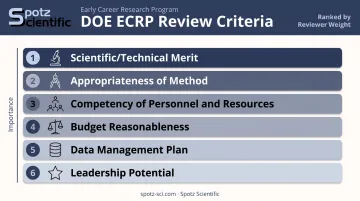
This is a different framework from NSF's two-criterion model — and treating them interchangeably is a mistake.
NOFO Alignment Is a Threshold Requirement
Proposals that are excellent but misaligned with a program's current priorities are routinely rejected. DOE screens applications for eligibility, responsiveness, completeness, technical content, and program relevance before detailed merit review begins. NSF may return noncompliant proposals without review.
Read the NOFO carefully. Reflect its language and stated priorities back through your proposal — not as mimicry, but as genuine alignment between your research agenda and the program's mission.
The Feasibility Test
Reviewers assess whether the proposed team can actually deliver the work. A proposal should include:
- Evidence of the team's qualifications and relevant prior work
- Preliminary data where available
- A realistic plan that matches the scope to the timeline and budget
An ambitious vision without credible execution infrastructure rarely clears the feasibility threshold.
Navigating these frameworks — across programs like DOE ASCR, NSF CISE, or DOE Early Career — requires understanding how each agency structures its review process. Spotz Scientific provides red team review and strategic NOFO advisory for federal scientific computing proposals. Dr. Bill Spotz co-led DOE's applied mathematics program and managed over $264M in research funding during his eight years as a DOE ASCR program manager.
Common Mistakes to Avoid
Vagueness in Methodology
The most common weakness in any methodology section is describing what you plan to do without explaining how. Expert reviewers notice immediately when procedures are underspecified or when the analytical approach isn't clearly tied to the research questions.
If you wouldn't be confident defending each methodological choice in front of a panel of domain experts, the section needs revision — not polish.
Failure to Demonstrate Significance and Originality
Many proposals describe a project without convincingly arguing why it matters or why it hasn't already been done. The problem statement and literature review must work together to make the gap — and the urgency of filling it — unmistakable. A useful test: if a reviewer can still ask "why is this necessary?" after reading your introduction, that answer belongs in the introduction — not buried in a later section.
Mismatching the Proposal to the Funding Context
Proposals written generically — without tailoring to the specific agency, program, and funding cycle — rarely succeed. Common examples:
- Using incorrect terminology for the agency
- Ignoring stated priorities in the solicitation
- Submitting a scope of work that doesn't fit the award size or duration
- Missing required components that trigger automatic screening failures (no co-PI letter for CAREER, unauthorized attachments for ECRP)
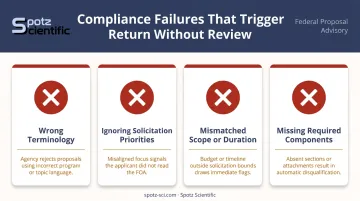
Each federal program has compliance requirements that, if missed, result in return without review — before a single reviewer evaluates the science.
Frequently Asked Questions
What is the format of a research proposal?
While formats vary by institution and funding agency, most proposals include a title, introduction/problem statement, literature review, methodology, expected contributions, timeline, and references. Federal agency submissions typically add a detailed budget, budget justification, data management plan, and a statement of broader impacts.
How long should a research proposal be?
Length varies significantly by context. Thesis proposals may be a few pages; federal grant proposals typically run 10–30+ pages. Agency solicitations specify a strict page limit — NSF CAREER and DOE ECRP both cap Project Descriptions at 15 pages — and exceeding it will disqualify your submission.
What is the difference between a research proposal and a research plan?
A research plan is an internal organizational tool for the researcher. A research proposal is a persuasive document written for an external audience — a funding body, dissertation committee, or supervisor — to justify why the research should be approved and resourced.
What do funding agency reviewers look for in a research proposal?
NSF reviewers evaluate Intellectual Merit (significance and soundness of approach) and Broader Impacts (contributions beyond the immediate study). DOE ECRP uses six ordered criteria, with scientific merit first. Both agencies also assess feasibility, originality, and alignment with program priorities.
How is writing a proposal for a federal funding agency different from writing a thesis proposal?
Federal proposals must align tightly with a specific NOFO, address explicit review criteria, include a detailed budget with justifications, and compete against a large pool of experienced research teams. Non-compliant submissions are returned without review before merit evaluation begins.
What is the most common reason research proposals get rejected?
The most common rejection triggers are:
- Misalignment with the funding program's stated priorities
- An underdeveloped or vague methodology
- Failure to establish the significance of the research gap
- A timeline or budget that doesn't match the proposed scope