The stakes are real, and the margin between a funded proposal and a rejected one rarely comes down to the quality of the science alone. Preparation, strategic alignment with the funder, and execution quality drive outcomes far more than most researchers expect.
This guide covers exactly what to do before you write a single word, how to draft each section of the proposal, which elements reviewers scrutinize most, and the mistakes most likely to get you rejected.
Key Takeaways
- Start 6–12 months before the deadline — identifying the right opportunity takes longer than expected
- Every section must tell a coherent story connecting your research question to broader scientific impact
- Reviewers weigh feasibility as heavily as novelty — budget, timeline, and methodology must all align
- Contact the program officer before submission — most researchers skip this step, and it shows
- Rejection is normal; treat reviewer feedback as a resubmission roadmap
Before You Start Writing: What to Prepare
Most researchers underestimate how much groundwork comes before the actual writing.
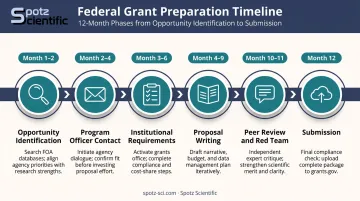
Start 6–12 months out. Read the Notice of Funding Opportunity (NOFO) or solicitation thoroughly — not as a general overview but as a legal document with binding requirements. Assess whether your research genuinely aligns with the funder's current priorities, not just broadly with the agency's mission.
Get institutional requirements moving early. These take longer than expected:
- Internal routing approvals and sign-offs
- Letters of support from collaborators
- Co-investigator biosketches (must be current and in SciENcv format for NSF)
- Negotiated indirect cost rate agreements
- Data Management and Sharing Plan (NSF requires a separate two-page plan)
For new institutions, NSF recommends active SAM registration and a valid UEI at least 90 days before submission. SAM activation alone can take weeks if information cannot be verified.
Research what the agency has already funded. The NSF Award Search database covers funded projects since 1989. DOE's PAMS system surfaces Office of Science abstracts and award amounts.
Proposals that mirror the funder's current thematic focus consistently score better. Reviewers respond to framing that matches their program's priorities — so understanding what's already been funded directly sharpens how you position your work.
How to Write a Research Grant Proposal: Step by Step
Step 1: Define Your Research Idea and Assess Funding Fit
Before anything else, you need a clearly articulated research question. You should be able to answer three things in two or three sentences:
- What are you trying to discover or demonstrate?
- Why does it matter to the field right now?
- Why is it both timely and novel?
If that summary takes more than a paragraph, the idea needs sharper definition before the proposal writing starts.
From there, evaluate fit honestly. Cross-reference your research scope against the specific program's stated objectives — not the agency's general mission. Review recently awarded projects for thematic fit. If your question belongs in a different solicitation, better to know that now than after investing three months in writing.
That fit assessment directly shapes the next step: how you read the funding opportunity and who you contact before writing a word.
Step 2: Study the Funding Opportunity and Contact the Program Officer
Read the NOFO like a contract. Highlight mandatory requirements, formatting rules, scoring criteria, and any language signaling what reviewers will weight most heavily. Missing a single required element can result in disqualification before peer review begins.
Then contact the program officer — 4 to 6 months before the deadline, not the week before. Send a concise one-page project summary and ask whether your project aligns with the program's current priorities.
Most researchers skip this step entirely. NSF's official guidance explicitly encourages early program officer contact, even during initial planning stages. For DOE's general FY2026 open NOFO, pre-applications are optional but encouraged as a way to initiate discussion with program managers. For the 2026 DOE Early Career program, a pre-application was mandatory.
Bill Spotz of Spotz Scientific spent eight years as a DOE ASCR program manager. His Strategic Advisory Services are designed specifically for this stage — helping researchers assess NOFO fit and determine the most competitive approach before investing time in a full draft.
Step 3: Write the Core Proposal Narrative
Open with significance. The first section must answer why this research problem matters now, what gap in current knowledge it addresses, and what the scientific community gains. Reviewers decide quickly whether a proposal deserves serious attention — don't save the compelling argument for page three.
The research design carries the most weight. The methodology must be logically connected to your research questions, technically credible, and internally consistent with your anticipated outcomes. If you have preliminary results, include them. Reviewers treat pilot data as evidence of feasibility; proposals making ambitious claims without supporting evidence read as high-risk.
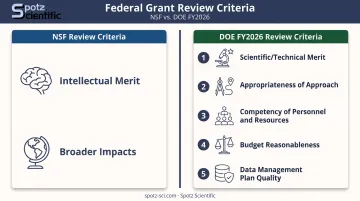
Structure your narrative around the review criteria that apply to your submission:
- NSF: Intellectual Merit and Broader Impacts
- DOE FY2026 open NOFO (descending priority): scientific/technical merit → appropriateness of approach → competency of personnel and resources → budget reasonableness → data management plan quality
Write directly. Reviewers read dozens of proposals. Hedging language, undefined acronyms, and dense paragraphs without headers cost you credibility. Use section headers, define terms on first use, and write with confidence.
Step 4: Build a Realistic Budget and Timeline
The budget signals whether you understand the full scope of the work. Every line item should be justified by the science. The budget narrative should explain not just what you're requesting but why that amount is necessary.
For reference on program-specific benchmarks:
| Program | Approximate Award Size |
|---|---|
| NSF CAREER | Minimum $400K over 5 years (most directorates); $500K minimum for BIO, ENG, OPP |
| DOE Early Career (university) | ~$875K over 5 years |
| NSF Future CoRe / CISE | ~$150K–$250K/year for 3–4 years |
Include a structured project timeline mapping milestones to specific funding periods. An overly ambitious schedule raises red flags. A well-paced plan demonstrates project management maturity — reviewers look for this, especially in early-career applications.
Step 5: Revise, Seek External Feedback, and Submit
Once a complete draft exists, circulate it to two audiences:
- Subject matter peers — for technical accuracy and methodological soundness
- Non-specialist colleagues — for clarity, narrative flow, and whether the significance lands
Both types of readers catch different problems. Don't skip one for the other.
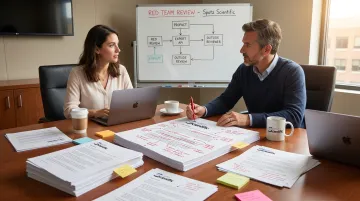
A structured pre-submission red team review adds another layer. Spotz Scientific's red team review service evaluates draft proposals through the lens of an actual program manager — identifying weaknesses in logic, gaps in compliance, and underdeveloped sections before the proposal reaches the agency. This is particularly valuable for DOE ASCR and NSF CISE submissions where competition is intense. The service covers both full proposals and pre-proposals, and applies to DOE Early Career and NSF CAREER applications specifically.
Submit at least two to three days before the deadline. Agency portals like Research.gov and Grants.gov have technical failure modes that can derail a last-minute upload. NSF itself recommends initiating a Grants.gov submission at least five business days before the deadline.
Key Elements Every Strong Research Grant Proposal Must Include
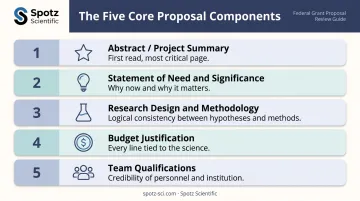
Strong proposals share a common structure — not because agencies demand conformity, but because reviewers expect to find specific information in specific places. Missing or weak execution in any of these five components can sink an otherwise compelling idea.
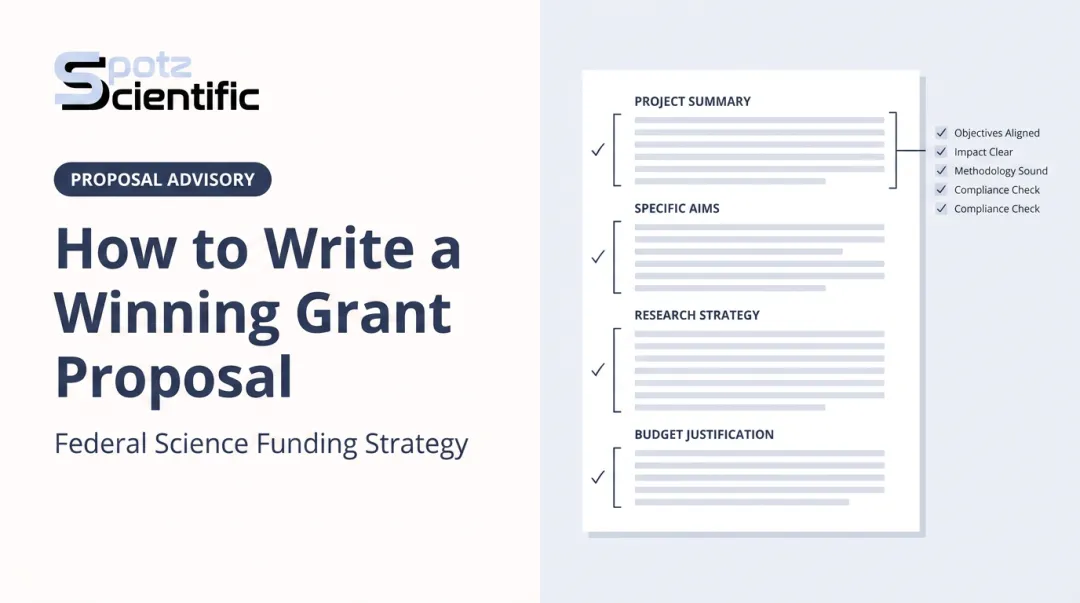
Abstract / Project Summary
Often the first section read, and sometimes the only one before reviewers form an initial impression. For NSF, the Project Summary is limited to one page and must separately address an overview, Intellectual Merit, and Broader Impacts. DOE requires a self-contained summary of no more than one page covering objectives, methods, and potential impact.
Write it last. Treat it as the proposal's most important page.
Statement of Need and Significance
This section answers "why now." Cite the current state of the field, identify the specific gap your work fills, and make an explicit argument for why the problem is important enough to fund. Vague significance claims consistently produce poor scores.
Research Design and Methodology
Reviewers, many of whom are active researchers themselves, will probe for logical consistency between your hypotheses, methods, and anticipated outcomes. Unconventional methods should be explicitly justified, not assumed to be self-evident.
Budget Justification
NSF permits up to five pages and requires justification for every line. DOE requires a budget form for each support year with explanations matching the dollar amounts. Requests that appear padded or underjustified raise credibility concerns with program managers.
Team Qualifications and Institutional Capacity
Reviewers assess whether this team, at this institution, can execute the proposed work. Biosketches should be current and tailored to the proposal. Collaborator roles should be clearly defined.
Highlight institutional resources directly relevant to the project: computing infrastructure, existing data access, relevant labs. Generic capability lists add length without adding credibility.
Common Mistakes That Get Research Grant Proposals Rejected
Misalignment with funder priorities. Submitting a technically strong proposal to the wrong program — or framing it in the wrong language — is one of the most common and avoidable rejection causes. Mirror the solicitation's terminology and emphasis throughout the narrative.
Weak or absent preliminary results. Reviewers treat pilot data as feasibility evidence. Even a small proof-of-concept or computational test strengthens your case. Ambitious claims without supporting results read as high-risk — no matter how sound the underlying idea.
Formatting and compliance failures. Agencies screen for compliance before any reviewer reads the science. Common grounds for return without review include:
- Noncompliant fonts or type sizes (DOE requires at least 11-point; NSF specifies acceptable fonts explicitly)
- Missing sections, page limit overruns, or margin violations (DOE requires 1-inch margins)
- Late collaborative components or unauthorized support letters
DOE screens for eligibility, completeness, and responsiveness before merit review begins. NSF's PAPPG 24-1 lists each of these as grounds for return. One formatting failure can end a submission before it reaches a single reviewer.
What to Do If Your Research Grant Proposal Is Rejected
Rejection is statistically normal. NSF's FY2024 agency-wide funding rate was 26%, meaning nearly three in four proposals were declined. In competitive directorates like IIS within CISE, the rate was 15%. The researchers who eventually succeed treat rejection as diagnostic information, not a verdict on their science.
When you receive a declination, two steps matter most:
Request reviewer comments. For NSF declinations, the PI receives verbatim unattributed reviews, a panel summary when applicable, and the basis for the decision. Formal reconsideration must be requested in writing within 90 days.
Map feedback to specific sections. Go through reviewer comments systematically and identify which section each critique targets. Agencies respond favorably to resubmissions that address feedback explicitly, not wholesale rewrites that ignore the reviewers' actual concerns.
Interpreting reviewer comments accurately is where many resubmissions go wrong — PIs fix surface-level concerns while missing the underlying objection. An outside perspective from Spotz Scientific, whether through a red team review or a strategic advisory session, helps identify what actually needs to change before you invest time in a revision.
Conclusion
Most researchers underestimate how much of a winning grant proposal is decided before they write a single word. The process starts months before the deadline and demands more institutional coordination — IRB sign-off, budget approvals, letters of collaboration — than most scientists plan for.
Researchers who treat proposal writing as a skill — one built through program officer conversations, outside feedback, and honest post-submission review — outperform those who treat it as an afterthought to the science.
If you're preparing a DOE ASCR or NSF CISE submission, an outside reviewer who knows how program managers read proposals can catch the gaps you've stopped seeing. That perspective is often the difference between a fundable proposal and one that stalls at review.
Frequently Asked Questions
Who writes a grant proposal?
Grant proposals are typically written by the principal investigator (PI) — the lead researcher — with input from co-investigators, institutional grants offices, and sometimes professional consultants. For complex federal submissions to agencies like DOE or NSF, outside advisory support is increasingly common.
What is the average amount for a research grant?
Award sizes vary widely by program. NSF CAREER awards start at a minimum of $400K over five years; DOE Early Career university awards run approximately $875K over five years. Smaller CISE research programs like Future CoRe typically fund $150K–$250K per year.
How long does it take to write a research grant proposal?
Most competitive federal proposals require 1 to 3 months of active writing, with total preparation — from identifying the opportunity to submission — spanning 6 to 12 months.
What is a program officer and should I contact one before submitting?
Program officers manage specific funding programs at agencies like NSF or DOE. Reaching out before submission with a brief project summary is encouraged. They can confirm program fit, flag overlaps with recently funded work, and offer informal guidance on whether your project belongs in their portfolio.
How do I find the right funding opportunity for my research?
Start with agency websites (NSF.gov, science.osti.gov), Grants.gov, and your institution's Office of Research. Match your specific research area to the program's stated scope before investing time in a full proposal. The NSF Award Search and DOE PAMS databases show what has already been funded, which helps you identify gaps your work can fill.
What are the most common reasons research grant proposals are rejected?
The most frequent causes: misalignment with funder priorities, lack of preliminary data, weak or inconsistent methodology, non-compliance with formatting rules, and an unclear statement of significance.