Introduction
"RFP" means something different depending on who's asking. A corporation hiring a consultant, a firm chasing a government bid, and a scientist applying for a DOE grant are all talking about the same concept. The stakes and rules diverge fast.
Competition is tighter in 2026 for all three. Organizations submitted an average of 166 RFPs last year, up from 153, while win rates in North America slid to just 37%, according to Loopio's 2026 RFP Trends and Benchmarks report.
Budgets are tighter. AI-generated submissions are flooding inboxes.
This guide breaks down what RFP consulting actually is, how proposals get scored, and the strategies that separate winners from the pile. We'll also cover a specialized corner of the field: federal scientific research proposals, where the rules look nothing like a typical corporate bid.
By the end, you'll have a framework for deciding whether an opportunity is worth pursuing and how to strengthen whatever you submit next.
Key Takeaways
- Proposal volume rose to 166 submissions per organization in 2026 while win rates fell in most regions
- Compliance failures, not weak ideas, sink more proposals than anyone admits
- A go/no-go filter before writing saves more hours than any writing technique
- Federal science proposals (DOE, NSF) use peer merit review, not standard procurement scoring
- Independent expert review catches blind spots that internal teams routinely miss
What Is RFP Consulting? Understanding the Basics
A Request for Proposal is a formal solicitation. An organization or agency publishes one when it wants qualified parties to propose how they'd deliver a project, not just what it costs.
RFP consulting works on both sides of the table: some consultants help organizations write clearer RFPs, while others help bidders craft stronger responses.
Who actually uses these consultants?
- Corporations sourcing outside consulting or vendor services
- Government agencies running formal procurement
- Nonprofits managing large-scale vendor selection
- Research institutions responding to federal funding solicitations
That last category behaves nothing like the others, which is why it gets its own section later in this guide.
RFP vs. RFQ vs. RFT vs. RFI: What's the Difference?
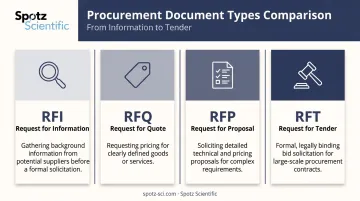
These acronyms get thrown around interchangeably, but they serve distinct stages of a procurement lifecycle. According to GSA's guidance for small business contractors, the sequence typically runs like this:
- RFI (Request for Information): Early-stage market research. No bid required, just capability information.
- RFQ (Request for Quotation): Used when the buyer already knows what it needs and wants price comparisons for standard products or services.
- RFP (Request for Proposal): Used when the buyer wants a complete solution compared on approach, technical capability, experience, and price.
- RFT (Request for Tender): Common outside the U.S., typically for clearly defined goods or works with prescriptive requirements.
Some fields skip this vocabulary entirely. Federal science agencies issue Notices of Funding Opportunity (NOFOs) or Funding Opportunity Announcements (FOAs) instead, and they function as a highly specialized cousin of the RFP.
Does an RFP Cost Money?
Responding to an RFP rarely costs a submission fee. It costs time. According to Loopio's 2026 benchmark data, teams spend an average of 33 hours per RFP, with roughly nine people contributing to each response.
Hiring outside help is a different story. Common fee models include:
- Hourly rates for targeted reviews or advisory sessions
- Project-based fees for full proposal development
- Retainers for ongoing procurement support
Specialized expertise, particularly in technical or scientific fields, tends to command higher hourly rates than generalist proposal writing.
Why RFP Consulting Matters More in 2026
Three forces are converging to make this year harder than the last.
AI tools have lowered the barrier to entry. RFP-team AI adoption jumped from 68% to 79% in a single year, and 62% of teams now use AI to generate specific RFP answers, a 16-point increase from 2024, according to 2026 Loopio benchmark. More competitors can submit polished-looking proposals with less effort. That means more submissions chasing the same opportunities.
Budgets are under a microscope. Federal agencies and institutional sponsors are scrutinizing scientific merit, risk, and return more aggressively than in prior cycles. Tighter appropriations and rising research costs push review panels to demand clearer justification for every dollar requested.
Generic content is easy. Insider knowledge isn't. When AI can produce a serviceable executive summary in minutes, the differentiator shifts to something AI can't fake: actual experience sitting on the other side of the table.
- Former program managers know which review criteria actually move the needle
- Agency-side reviewers know what disqualifies a proposal before the technical section gets a full read
- Neither can be reverse-engineered from a public solicitation or NOFO
That gap is what specialized consulting fills. Generic proposal-writing help loses ground to niche, insider expertise.
The Anatomy of a Winning RFP Response
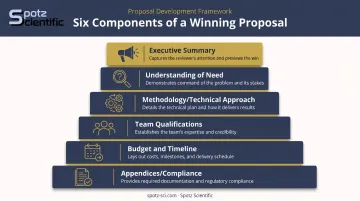
Strip away industry differences, and most consulting or grant-style proposals share the same skeleton:
- Executive summary – the pitch in miniature
- Understanding of the need – proof you actually read the problem
- Methodology or technical approach – how you'll do the work
- Team qualifications – who's doing it and why they're credible
- Budget and timeline – what it costs and when it happens
- Appendices and compliance items – the boring stuff that gets you disqualified if missing
What Evaluators Are Actually Scoring
Federal procurement evaluators formally weigh past performance, technical excellence, management capability, and personnel qualifications, per FAR 15.304. In plain terms, most evaluators—federal or corporate—score four things:
- Fit – do you understand our actual problem?
- Confidence – can you realistically deliver?
- Value – is the impact clear and the cost justified?
- Compliance – did you follow the format, page limits, and instructions?
Here's the part teams underestimate: reviewers are often generalists or panelists juggling dozens of submissions. A brilliant technical approach buried in dense jargon loses to a clearer, plainer one nearly every time.
Common Mistakes That Sink Proposals
The failures repeat across industries:
- Generic boilerplate that could apply to any client
- Missing mandatory compliance items or attachments
- Vague or padded budget lines
- Ignoring page limits or formatting rules
That last one isn't a minor foot-fault. In one GAO case involving QED Systems, a proposal was ruled ineligible entirely because a subcontractor failed to remove specified cost information as instructed.
DOE's standard NOFO terms are just as strict: reviewers disregard any pages beyond the stated limit rather than reading them.
Most first-time or overextended teams skip the one fix that catches these issues: independent expert review of the draft before submission.
Proven Strategies to Win More RFPs and Proposals
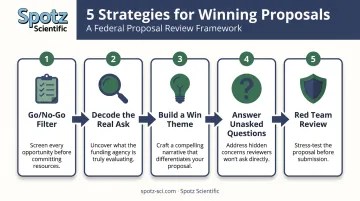
Winning more RFPs is less about longer responses and more about pursuing the right opportunities—and making every page serve the evaluator. These five practices separate competitive submissions from the rest.
Run a go/no-go filter before committing. Before investing 30-plus hours into a response, honestly assess your fit, your capacity, and your realistic odds. Chasing every opportunity dilutes the effort you could put into the ones you can actually win.
Decode what's really being asked. The literal questions in an RFP rarely capture the issuer's underlying strategic goal. Look past the checklist: what outcome is the evaluator accountable for delivering?
Build one specific win theme and thread it through everything. Skip generic claims like "proven track record." Pick a single, concrete differentiator and repeat it consistently across the executive summary, technical approach, and team sections.
Answer questions nobody asked. Address risk mitigation, ease of implementation, and the concerns the issuer should have raised but didn't. This signals that you understand their world better than a competitor reading the same document.
Get a red team review before submission. An independent reviewer stress-tests clarity, compliance, and competitiveness from the evaluator's chair, not the writer's. This single step catches more fatal flaws than any amount of internal proofreading.
Specialized RFP Consulting for Scientific and Federal Research Proposals
Federal science agencies play by their own rulebook. The U.S. Department of Energy Office of Science and the National Science Foundation don't issue RFPs; they issue NOFOs and FOAs. Functionally, these behave like a highly specialized RFP, but the evaluation mechanism is completely different.
Instead of procurement officers scoring compliance and price, these solicitations go through peer or merit review panels. DOE's Office of Science reviews weigh scientific and technical merit, method appropriateness, and budget reasonableness, generally scored by at least three qualified reviewers.
NSF uses Intellectual Merit and Broader Impacts as its two core criteria, per the current NSF CAREER solicitation.
This creates unique challenges that generalist proposal writers rarely anticipate:
- Aligning the proposal with an agency's specific mission priorities, not just the stated topic area
- Satisfying technical peer reviewers who know the field as well as the applicant does
- Navigating budget rules—NSF's five-page justification limit and DOE cost-principle standards—that look nothing like commercial pricing
The NSF CAREER program alone requires a minimum award of $400,000 over five years, caps applicants at three lifetime attempts, and forbids co-PIs. DOE's Early Career Research Program runs on a similar five-year structure, with awards reaching $875,000 for university-based researchers.
Insider experience matters here. Someone who has sat on a review panel knows which sections reviewers weight heavily and which boilerplate phrases get skimmed past.
That is the niche Spotz Scientific fills. Founder Bill Spotz spent eight years as a DOE Office of Science program manager, co-leading the applied mathematics program and overseeing more than $264 million in scientific computing research before founding the firm. That vantage point informs three specific services:

- Red team reviews of draft proposals or pre-proposals headed to DOE ASCR or NSF CISE
- Strategic advisory on specific NOFOs, particularly for DOE Early Career and NSF CAREER applicants
- Institutional support for university faculty offices managing down-selection when submission limits apply
Standard consulting runs $200–250/hour, rising to $250–300/hour when materials arrive less than two weeks before a NOFO deadline.
How to Choose the Right RFP Consulting Partner
Not every proposal consultant is interchangeable, and matching expertise to opportunity matters more than most people assume.
Match domain experience to your field. A generalist consultant can polish prose, but someone with direct evaluator or program-manager experience in your specific field knows what actually moves a score. For a scientific computing proposal to DOE ASCR, that distinction is the difference between a review that sounds credible and one that does not.
Clarify what you actually need. Are you looking for:
- Strategic advice on a specific solicitation before you start writing
- An independent red-team review of a near-final draft
- Structural feedback and coaching while you remain the author
These are different services with different price points, and vague requests lead to mismatched engagements.
Ask about confidentiality and conflicts of interest. This matters especially in competitive federal research fields, where a small reviewer pool means your consultant may have prior relationships with agency staff or other applicants. Get clarity on this before signing anything, not after.
Frequently Asked Questions
What is a request for proposal in consulting?
An RFP is a formal solicitation document inviting qualified consultants or firms to propose their approach, team, and cost for a defined project or problem. It's how organizations compare multiple potential partners before committing.
What's the difference between an RFP, RFQ, and RFT?
An RFP focuses on approach and methodology. An RFQ focuses on price for a known deliverable. An RFT is a formal tender often used for clearly defined goods or works. Terminology overlaps by industry and country.
Does an RFP cost money?
Responding to an RFP typically costs the bidder time and internal resources rather than a submission fee to the issuer. Hiring outside help to strengthen your response does carry a separate consulting cost.
What does an RFP consultant do?
RFP consultants help issuing organizations draft clearer solicitations, or help bidders develop, review, and strengthen proposal responses—often specializing in one side.
How much does it cost to hire an RFP consultant?
Fees vary by scope: hourly for a targeted review, project-based for full proposal development. Specialized expertise, such as former federal program managers, often runs $200–300 per hour; generalist rates are typically lower.
Are federal funding solicitations like DOE or NSF NOFOs considered RFPs?
They're not called RFPs, but functionally they operate the same way. NOFOs and FOAs invite formal proposals evaluated against defined criteria, just through peer and merit review panels instead of standard procurement scoring.