
Introduction
Starting an independent research career means juggling publishing pressure, teaching loads, grant deadlines, and professional identity-building — often simultaneously, and without adequate guidance. A 2020 Wellcome survey of over 4,000 researchers found that only 44% felt their workplace provided adequate wellbeing support — a figure that captures something most early career researchers already feel but rarely say out loud.
This stage — roughly the first five to eight years after completing a PhD or securing an independent position — is uniquely high-stakes. The habits, networks, and reputation you build now compound over decades. Getting the foundations right makes later opportunities follow more naturally; mistakes are recoverable, but they cost time you won't get back.
This guide covers the areas that matter most in these early years:
- Building a focused, recognizable research identity
- Publishing strategically rather than just frequently
- Cultivating mentorship and productive collaboration
- Competing effectively for federal funding (DOE, NSF, and beyond)
- Protecting the time and health that make everything else possible
Key Takeaways
- Build a recognizable research niche early, then expand deliberately into adjacent areas
- One strong paper outweighs several mediocre ones — prioritize quality over output volume
- Invest in mentorship and sponsorship relationships that open doors, not just offer advice
- Apply for DOE Early Career and NSF CAREER grants early — eligibility windows close
- Guard your time and treat your wellbeing as a professional responsibility, not a luxury
Build a Focused Research Identity
Own a Problem Before You Expand
Being known as "the person who studies X" makes you easier to cite, easier to collaborate with, and easier to fund. A clear niche gives journal editors a reason to think of you as a reviewer, conference organizers a reason to invite you to speak, and program managers a reason to see your proposal as filling a gap in their portfolio.
The strategic move is to build depth first, then use that credibility to reach laterally into adjacent fields. Researchers who arrive at interdisciplinary projects with an established track record bring something concrete. Those who try to be interdisciplinary before establishing anything bring much less.
Aligning your identity with active funding priorities from the start matters too. Understanding what DOE ASCR funds in applied mathematics and what NSF CISE prioritizes in computing research helps you frame your work in ways that resonate with program managers — not just with your scientific peers.
Manage Your Digital Presence
Your online presence is often the first thing a potential collaborator, journal editor, or program officer encounters. Three platforms deserve attention:
- ORCID — a free persistent identifier now integrated across nearly 1,200 institutions, publishers, and funders; an unmaintained record is a missed connection
- Google Scholar — the default citation lookup for most researchers; an unclaimed profile means someone else controls what appears under your name
- Personal academic website — where you control the narrative, list current projects, and make it easy for people to contact you
Update all three regularly. A stale profile signals either inactivity or inattention — and program officers do look.
Broaden Your Methodological Range
Researchers limited to one or two methods risk being excluded from major collaborative projects that require complementary approaches. Seek out training workshops at conferences, short courses through professional societies like SIAM, and campus opportunities that extend your toolkit. The goal is enough range to be a useful collaborator beyond your immediate subfield, not expertise in everything.
Publish Strategically, Not Just Prolifically
Quality Over Quantity — With Caveats
Search committees and postdoc advisors weight publication quality heavily. A 2023 analysis of mathematics faculty hiring found that citations and authorship of high-profile papers were among the strongest predictors of placement — not raw publication counts. Evidence from adjacent fields suggests the same holds across quantitative STEM.
That framing can also become a rationalization for inaction. A polished draft sitting in a folder has zero academic impact. The practical principle: move manuscripts through the pipeline consistently, and don't let the perfect block the good enough.
A useful rhythm: have one paper under review while actively writing the next. This keeps the pipeline moving without forcing rushed work.
Extract Full Value from Your Doctoral Research
Your PhD thesis is a publication asset that most early career researchers underuse. Each chapter typically contains:
- A theoretical or conceptual contribution
- A methodological approach worth documenting
- Preliminary results that can frame a future study
- Final findings that may stand alone as a journal article
Treat the thesis as raw material, not a finished product. Multiple standalone publications can emerge from a single dissertation — this is not self-plagiarism when each paper addresses a distinct contribution.
Write Clearly — and Get Feedback Before Submitting
Good academic writing is a learnable skill that directly affects whether a paper clears peer review. Desk rejections often happen before reviewers ever evaluate the science.
Before submitting, get structured feedback:
- Ask a trusted colleague in your subfield to check the argument and evidence
- Ask someone outside your immediate area to flag where the setup is unclear
- Treat a weak abstract as a red flag — if the framing isn't obvious there, reviewers will notice
The same clarity principle applies to grant proposals. Reviewers are busy. If your core argument isn't obvious in the first paragraph, it may never land.
Network, Find Mentors, and Collaborate Actively
Mentors and Sponsors Serve Different Functions
Aim for at least two mentors — one within your institution and one outside it. Each offers different networks, different honesty, and different leverage. What you ultimately need from both is honest guidance on where you actually stand, not just encouragement.
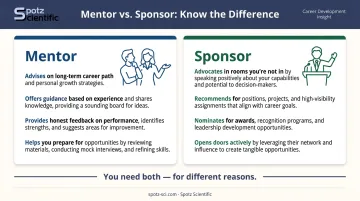
But mentorship and sponsorship are distinct. A mentor advises. A sponsor advocates for you in rooms you're not in — recommends you for positions, nominates you for awards, and puts their credibility behind yours. Research from the National Academies distinguishes these roles clearly, and the distinction matters for career advancement: sponsors generate opportunities, mentors help you prepare for them.
Make Conferences Work Harder
Most researchers treat conference attendance as presence. It should be strategy:
- Present complete papers rather than early-stage ideas — you want feedback that improves a manuscript, not a concept
- Use audience questions to identify weaknesses before journal submission
- Volunteer to review abstracts and papers — this builds editorial relationships and field knowledge simultaneously
- Join special interest groups and ECR networks at other institutions; these connections often become collaborators and co-authors
Calibrate When to Say Yes and When to Say No
Early in your career, say yes to most opportunities: talks, collaborations, review requests, committee work. Exposure and relationship-building accumulate in ways you rarely predict in advance, and you can't know which connection will matter most.
As your career develops and demands multiply, "no" becomes a professional skill. Saying yes to everything eventually crowds out the deep work that defines a research career. The shift from seizing opportunities to selecting them is a sign of maturity, not disengagement.
Pursue Early Career Grants and Federal Funding
Why Early and Repeated Applications Matter
Federal programs designed specifically for early career researchers don't stay open indefinitely. Two of the most consequential:
| Program | Eligibility | Award Size | Notes |
|---|---|---|---|
| DOE Early Career Research Program | Within 10 years of PhD; untenured | ~$875K / 5 years (university) | FY2024: 786 applications, 91 awards |
| NSF CAREER | Untenured assistant professor; ≥50% tenure-track | Min. $400K / 5 years | ~500 awards / ~$250M annually |
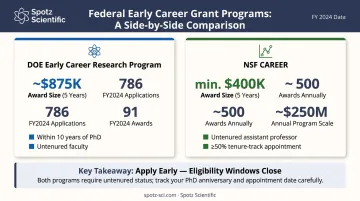
DOE Early Career eligibility for FY2026 requires a doctorate on or after January 1, 2015 — a window that closes whether you apply or not. Most researchers are eligible for a maximum of three competitions. Missing early cycles means fewer shots, not the same number of shots later.
Read the NOFO — Then Call the Program Officer
A Notice of Funding Opportunity tells you the formal criteria. What it doesn't tell you is where the program's current priorities actually sit, which research directions are oversubscribed, and whether your approach is a fit for this cycle.
Both DOE and NSF encourage applicants to contact program officers before submitting. Many ECRs skip this step because it feels presumptuous. It isn't — program officers expect these conversations, and the insights they provide can reshape a proposal before a word of the first draft is written.
What a Winning Proposal Actually Needs
Reviewers read quickly and in volume. Competitive proposals share these characteristics:
- A clearly identified gap — not "this field is interesting" but "this specific problem remains unsolved and here is why it matters"
- A specific, testable research question — not a broad theme but a concrete inquiry with defined scope
- A feasible methodology — evidence that you have the skills, collaborators, and resources to execute
- A strong track record narrative — even early-career researchers have preliminary results, publications, and relevant experience; the proposal should make these visible and connected
The first paragraph is not where you build to your argument — it's where you make it. Reviewers who don't understand your core contribution in the opening often don't recover it later.
Knowing what a strong proposal requires is one thing. Knowing whether your draft actually delivers on those criteria is another — that's where red team review becomes critical.
Get a Red Team Review Before You Submit
The most effective step an ECR can take before submitting is having experienced reviewers stress-test the draft. A red team review surfaces arguments that aren't landing and justifications that need evidence.
It also catches the places where a proposal drifts from funder priorities — problems that cause rejection at the agency but are fixable when caught beforehand.
This is what Spotz Scientific provides for ECRs preparing DOE Early Career and NSF CAREER applications. Founder Bill Spotz spent eight years as a DOE ASCR program manager, co-leading the applied mathematics program and overseeing more than $264 million in scientific computing research.
His red team reviews and strategic advisory sessions draw directly on that insider perspective — not just knowledge of what the criteria say, but understanding of how program managers actually read and evaluate proposals.
Engagements can begin with strategic NOFO advisory before a draft exists, proceed through red team review of a complete draft, or both. Standard consulting is available at $200–$250/hour; contact info@spotz-sci.com to discuss your timeline and program.
Protect Your Time and Sustain Your Wellbeing
Treat Deep Work as Non-Negotiable
Research output — the writing, thinking, and analysis that actually moves a career — requires uninterrupted time. Administrative tasks and email will expand to fill whatever space you allow them.
Block calendar time specifically for research and treat it with the same seriousness as a teaching commitment. Tackle the hardest task first in the day before context-switching drains cognitive resources. Both are structural decisions about what you're actually prioritizing, not optional productivity tips.
A small 2022 study of a faculty writing group found that more than 85% of participants reported protected writing time positively influenced their productivity. The sample was small and self-reported, but the direction of the finding is consistent with how cognitive work actually functions.
Name Impostor Syndrome and Keep Working
Impostor syndrome is widespread in academia. A systematic review found prevalence estimates ranging from 9% to 82% depending on the population and measurement tool. The wide range reflects genuine variation in how it's measured — not whether the experience is real. It's common enough to be considered nearly universal among high-achieving academics.
Practical responses that help:
- Document wins weekly, even small ones — the record counters selective memory
- Talk about it with peers; isolation amplifies the feeling
- Reframe self-doubt as evidence of high standards, not incompetence
Wellbeing Is a Performance Variable
A 2023 analysis of the 2020 Nature global postdoc survey found 32% burnout, 36% depression, and 38% anxiety among nearly 7,700 postdocs from 93 countries. These numbers are global and reflect patterns that cross countries and institutions.
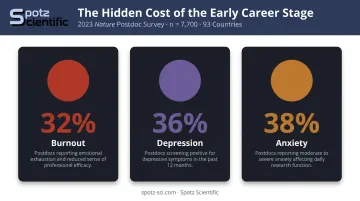
Physical health, sleep, and stress management directly affect cognitive performance. Seek institutional mental health resources before reaching burnout — not after. Most early career researchers know this in principle; the challenge is acting on it before the warning signs become symptoms.
Frequently Asked Questions
What are some tips for early career researchers?
Build a focused research niche and publish quality work consistently. Cultivate mentors and sponsors, pursue federal early career grants proactively, and protect time for the deep work that actually advances your career. Wellbeing is part of the equation, not separate from it.
What makes someone an early career researcher?
Definitions vary by institution and funding program. DOE and NIH use a 10-year post-PhD window; NSF CAREER focuses on untenured assistant professor status rather than years since degree. Generally, ECR status applies to researchers within five to ten years of their doctorate or in their first independent position.
How do you become an early career researcher?
Complete a PhD, gain postdoctoral or equivalent research experience, and begin establishing an independent research agenda. Building a track record of peer-reviewed publications and securing your first independent grants are the key milestones of that transition.
Is 40 too late to become a scientist?
No. Research on scientific impact shows that a scientist's highest-impact paper is distributed randomly across their publication sequence, not concentrated in early career years. Many funding programs and institutions recognize non-traditional pathways, and what matters is the quality of your independent contribution.
What is the DOE Early Career Research Program?
The DOE Early Career Research Program provides five-year federal funding to researchers within ten years of their PhD, supporting work aligned with the Department of Energy's Office of Science mission areas. University awards are approximately $875,000 over five years. Acceptance rates are typically in the single digits, making it among the most selective early career awards in scientific computing.
How important is grant writing for early career researchers?
Grant writing is foundational to an independent research career. Federal awards like DOE Early Career and NSF CAREER provide funding and career-defining recognition that compound over time. Developing proposal writing skills early, and getting experienced feedback on drafts, is one of the highest-return investments an ECR can make.