Introduction
In eight years as a DOE program manager, one pattern stood out: scientifically excellent DOE and NSF proposals get rejected every year, and the science usually isn't the problem. Reviewers simply can't answer one question fast enough: why fund this project, from this team, right now?
That's the gap proposal win themes close.
The term originated in commercial RFP writing, where consultants use win themes to beat a competitor's bid. But the logic transfers directly to federal scientific research proposals. Panelists read dozens of submissions under real-time pressure, and they need a clear reason to rank yours above the rest.
This article defines proposal win themes for scientific and research funding contexts, then walks through a step-by-step process for developing them for DOE Office of Science and NSF CISE submissions.
Key Takeaways
- A win theme is a concise, evidence-backed case for why your project deserves funding over competitors.
- Published criteria—NSF's Intellectual Merit/Broader Impacts, DOE's Scientific/Technical Merit—serve the same purpose as a formal scorecard.
- One to three developed themes outperform a long list of scattered strengths.
- Win themes must run through your summary, narrative, and biosketch, not just one section.
What Are Proposal Win Themes in a Scientific Research Proposal?
A proposal win theme is a short, evidence-backed statement that links what a funding agency cares about to what your specific project, approach, and team can deliver. It answers the reviewer's real question: why this proposal, why this team, why now?
The concept comes from commercial proposal writing, where it's typically defined as a feature, a benefit, and a proof point, built from the evaluator's perspective on why a solution deserves to win. Federal science proposals don't have an "evaluator scorecard" the way a commercial RFP does. There's no procurement officer scoring you against a competitor's price sheet.
Instead, NSF and DOE publish merit review criteria that function the same way. They tell you exactly what a panelist has to weigh before scoring your proposal. Translating those criteria into your specific argument determines whether a panelist can score your proposal favorably.
The Three Pillars of a Strong Win Theme
Unlike marketing copy, a win theme for DOE or NSF is a targeted statement built around three pillars:
- Significance – Does the work matter to the agency's stated mission and program priorities?
- Approach – Is the technical plan innovative, feasible, and well-reasoned?
- Team – Can this PI and this group actually execute it, based on track record and resources?
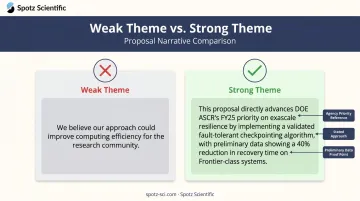
A Good Theme vs. a Weak Theme
Here's the difference in practice, using a DOE ASCR-style scientific computing proposal as the example.
Weak: "Our team has extensive experience in scientific computing and is well-positioned to conduct this research." This could describe almost any applied math group in the country. It gives a reviewer nothing to cite in their written evaluation.
Strong: "This project addresses ASCR's stated need for scalable uncertainty quantification methods for exascale simulations. Our preliminary results demonstrate a measurable reduction in computational overhead using a novel Bayesian framework, already deployed on a DOE leadership-class system." This version names the program priority, states the approach, and backs it with preliminary data.
Win themes should center on the specific research gap the agency cares about, not restate the PI's CV. A list of past accomplishments only matters when it's tied directly to why it makes this project more likely to succeed.
Why Win Themes Matter for DOE and NSF Reviewers
Panel reviewers don't read your proposal in isolation. They read a stack of them, sometimes 15 to 20 per person, in the weeks before a panel meeting.
Then they write a justification for their score and defend it out loud to colleagues who read a different stack entirely. A clear win theme gives them language they can lift straight into that written review.
Both agencies publish exactly what reviewers are supposed to weigh:
| Agency | Review Criteria |
|---|---|
| NSF | Two National Science Board-approved criteria (Intellectual Merit and Broader Impacts), evaluated through five elements: creativity, feasibility, team qualifications, and adequacy of resources |
| DOE Office of Science | Four criteria ranked by importance: Scientific and/or Technical Merit, Appropriateness of Method, Competency of Personnel and Resources, and Reasonableness of Budget |
Your win themes should map onto these criteria directly. Generic language like "cutting-edge" or "world-class" doesn't help a reviewer check a box. A theme that explicitly demonstrates intellectual merit does.
That differentiation matters: competition for these programs is intense. NSF's overall funding rate was 29% in FY2023, and some CISE divisions fund fewer than one in five submissions in a given year. When most proposals get declined, one that reads like every other submission in the pile has almost no chance.
Early Career Programs Add a Layer
The DOE Early Career Research Program and NSF CAREER award carry additional expectations beyond straight scientific merit. CAREER proposals must present an integrated five-year plan connecting research and education, with reviewers explicitly weighing career development potential. Win themes for these programs have to address both the science and the career narrative, not just one or the other.
Program managers also weigh unwritten priorities that never show up in the solicitation text, like how a project fits their portfolio or what their advisory committee wants to see more of.
Bill Spotz spent eight years as a DOE Office of Science program manager overseeing more than $264 million in scientific computing research. That vantage point on how reviewers actually think shapes how he helps researchers frame their themes.
How to Develop Win Themes for Your Research Proposal
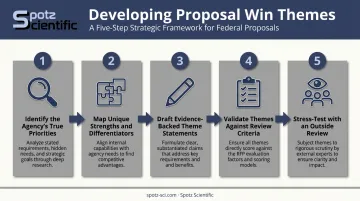
Developing a win theme follows a five-step process that starts with the solicitation and ends with an outside gut check.
Step 1: Identify the Agency's True Priorities
Read the NOFO closely, not just the technical scope, but the stated priorities and how criteria are weighted. DOE ranks its four review criteria in order of importance, so scientific merit deserves more theme-development attention than budget framing.
Then dig deeper:
- Review recent award abstracts in your program area
- Read workshop reports and strategic plans from the specific office
- Note recurring language across multiple documents; it often signals an unwritten priority
Step 2: Map Your Unique Strengths and Differentiators
List what genuinely sets your proposed approach apart:
- A novel method, algorithm, or computational technique
- Unique dataset or facility access competitors don't have
- Interdisciplinary collaboration that adds real capability
- Preliminary results that de-risk the approach
Then catalog the credibility elements behind each one: publications, prior funded awards, or institutional resources like access to a leadership-class computing system.
Step 3: Draft Concise, Evidence-Backed Theme Statements
Use a simple template to force clarity:
"This project addresses [agency priority/gap] through [innovative approach], and this team's [specific qualification] uniquely positions us to deliver it."
For a scientific computing proposal, that might read: "This project addresses DOE ASCR's need for energy-efficient scientific software through a novel co-design methodology. This team's prior deployment of that method on a leadership-class system uniquely positions us to deliver measurable results."
Step 4: Validate Themes Against Review Criteria
Take each draft theme and check it against the solicitation's listed criteria, line by line. If a theme doesn't clearly support Intellectual Merit, Broader Impacts, or DOE's Method and Approach category, sharpen it or cut it before you draft the full narrative.
Step 5: Stress-Test with an Outside Review
Someone unfamiliar with your work should be able to read your project summary and state your win theme back to you. If they can't, it isn't clear enough yet.
This is exactly the gap a red team review closes. Spotz Scientific offers this kind of outside review for draft proposals and pre-proposals, reading your submission the way a DOE or NSF panelist would and flagging where the theme gets lost.
Common Win Theme Categories for Scientific Computing Proposals
Most successful DOE ASCR and NSF CISE proposals build their win themes around three recurring categories.
| Win Theme Category | What It Proves | Example Evidence |
|---|---|---|
| Innovation and Novel Approach | Advances the state of the art | Preliminary results, novel algorithm, peer-reviewed publication |
| Mission Significance | Aligns with agency strategic priorities | Direct reference to program priority documents or workshop reports |
| Team Track Record | Team can deliver | Prior funded awards, unique facility access, preliminary data |
Innovation and novel approach demonstrates that your algorithm, method, or modeling technique advances the state of the art, not just applies an existing one. Scientific machine learning and new HPC methods are common vehicles for this theme, since ASCR's own workshop reports flag them as priority research directions with real funding behind them.
Mission significance ties your research directly to a stated strategic priority. NSF's recent budget requests show continued heavy investment in AI infrastructure and advanced computing systems, so proposals aligned with those focus areas carry weight beyond the technical content alone.
Team track record and feasibility proves the team can execute, using preliminary results, prior funded projects, or access to specialized resources like a national lab facility.
Most proposals need only one theme per category, not a theme for every possible strength.
How to Weave Win Themes Throughout Your Proposal (and Avoid Weak Ones)
A win theme buried on page seven does nothing. It needs to appear in your project summary, get reinforced in your narrative's introduction and significance sections, and echo again in your conclusion. Reviewers often skim the summary first and the conclusion last, so those spots carry disproportionate weight.
Apply the "So What" Test
Every capability claim needs a mission-level payoff attached:
- "We have access to a leadership-class supercomputer." So what?
- "This access enables simulations at a scale otherwise infeasible for our field, directly advancing the program's stated exascale-readiness goal."
If you can't complete the "so what," the claim isn't a win theme yet.
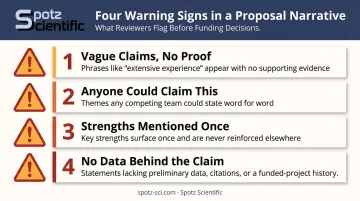
Red Flags That Signal a Weak Theme
These patterns show up constantly in first drafts:
- Vague claims like "extensive experience" with no proof point attached
- Themes that any competing team could claim word-for-word
- Strengths mentioned once and never reinforced elsewhere
- Claims without preliminary data, citations, or funded-project history behind them
Catching these weaknesses in your own writing is genuinely hard. You know what you meant to say, so it reads as clear even when it isn't. That's the value of an independent red team review or a pre-proposal consultation. Spotz Scientific offers both, built specifically to catch generic or misaligned themes before a program officer ever sees them.
Frequently Asked Questions
What is a proposal win theme?
A proposal win theme is a concise, evidence-backed statement of why a proposal should be selected. In research funding, that means why a specific project and team deserve funding over competing submissions.
What is a winning proposal?
A winning proposal aligns clearly with the agency's stated priorities and review criteria, backing every claim with evidence. It also carries a consistent narrative from the summary through the conclusion.
How do you calculate proposal win rate?
The basic formula is proposals funded divided by proposals submitted. Federal agencies track this as a "success rate" or "funding rate" at the program or agency level rather than a commercial win rate.
What is the RFP win strategy?
In commercial proposals, this means aligning capture strategy with proposal writing before the RFP drops. The research-funding equivalent is matching your submission strategy to the NOFO's priorities and merit review criteria well before drafting begins.
How many win themes should a research proposal include?
Most strong proposals succeed with one to three well-developed themes, reinforced with different evidence throughout the document. A longer list dilutes each one and gives reviewers less to remember.
Can the same win themes be reused across NSF and DOE proposals?
Core strengths, like a novel method or strong preliminary results, can carry over. But each theme needs to be re-tailored to the specific agency's mission language and review criteria to stay credible.