NSF uses three distinct due date categories, each with different consequences for late submission. Many researchers don't realize this distinction exists until after it costs them a review cycle. This guide breaks down every deadline type defined in the PAPPG NSF 24-1, explains how deadlines vary by program and submission stage, and walks through the practical timeline management that keeps submissions on track.
Key Takeaways
- NSF uses three deadline types — target dates, deadline dates, and submission windows — with different consequences for missing each
- All proposals must arrive by 5 PM in the submitter's local time zone on the due date
- Missing a deadline date means rejection; missing a target date may only delay your panel review
- Your institution's sponsored programs office (SPO) typically requires proposals 5–10 business days before the NSF deadline — treat this as mandatory
- Start planning 4–5 months out — your first move should be contacting the relevant program officer
Understanding NSF Deadline Types
The Three Official Categories
The PAPPG NSF 24-1, Chapter I.F.1 defines three distinct due date types. The differences between them are substantial:
| Due Date Type | What It Means | Consequence of Missing It |
|---|---|---|
| Target Date | Proposals submitted after this date are still accepted | May miss a specific panel or committee meeting; delays funding decision |
| Deadline Date | Hard cutoff — proposals not accepted after this date | Not accepted or returned without review |
| Submission Window | A designated acceptance period with start and end dates | The end date converts to and carries the same policies as a deadline date |
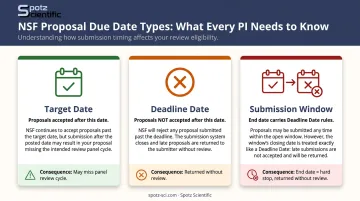
That last row matters more than it looks: once a submission window closes, it carries the same hard-stop consequences as a deadline date — not the flexibility of a target date.
The 5 PM Local Time Rule
Every NSF due date — regardless of type — operates on the same clock:
- Proposals must be received by 5 PM in the submitting organization's local time zone
- If a deadline falls on a weekend, it shifts to the following Monday
- If a deadline falls on a federal holiday, it shifts to the next business day
- Letters of Intent and preliminary proposals follow the same 5 PM standard
This time zone rule matters for institutions near time zone boundaries and for any team member assuming deadlines are anchored to Eastern time.
How NSF Deadlines Vary by Program and Submission Stage
Not all NSF programs operate on the same cycle. Some accept proposals at any time; others run fixed annual deadlines; several require staged submissions with separate deadlines at each stage.
Open vs. Fixed Deadline Programs
The contrast can be stark even within the same agency:
- NSF BIO Division of Environmental Biology (NSF 24-543): Accepts proposals at any time — no deadline, no submission window
- NSF CAREER (NSF 22-586): July 22, 2026, a hard deadline date, recurring the fourth Wednesday of July annually
- CyberAICorps Scholarship for Service (NSF 26-503): Uses both a fixed July 21 deadline and April 3 target dates within the same solicitation
That last example matters: a single solicitation can use more than one due date type for different submission components. Read the program description before anything else — the deadline structure determines your entire submission timeline.
Pre-Submission Requirements: LOIs, Preliminary Proposals, and Concept Outlines
Some solicitations require documents before a full proposal is accepted:
- Required Letters of Intent: Failure to submit a required LOI results in the full proposal being returned without review. Treat it as a hard prerequisite, not an optional courtesy step.
- Concept Outlines: Certain proposal types require a Concept Outline submitted via NSF's ProSPCT tool or directly to a Program Officer. NSF will only accept a full proposal after the Program Officer issues a formal concurrence email, which you upload in Research.gov's "Program Officer Concurrence Email" section.
Missing either of these pre-submission steps carries the same consequence as missing a deadline date on the full proposal.
Directorate-Specific Patterns
Deadline cadences vary meaningfully by directorate:
- CISE programs tend toward fixed annual cycles, though some shift between annual and biannual
- BIO programs are more likely to operate with open submissions or rolling windows
- Program cycles can change — always confirm the current cycle directly with the program officer and verify the active solicitation
For programs with predictable annual deadlines — NSF CAREER being the clearest example — missing the deadline means waiting a full year for the next cycle. For CAREER applicants, that means starting internal review and budget preparation at least six months out.
Special Exceptions and Extensions to NSF Deadlines
Natural or Anthropogenic Events
PAPPG 24-1, Chapter I.F.2 permits flexibility when a qualifying event — such as a natural disaster, infrastructure failure, or other anthropogenic disruption — affects a proposer's ability to submit on time. The conditions:
- Requires approval from the cognizant NSF Program Officer
- NSF generally permits an extension of up to five business days
- Requests should be submitted before the deadline if at all feasible
- The Program Officer's written or verbal guidance governs; if written approval is available, it should be uploaded as an Additional Single Copy Document
NSF Closure Policy
When NSF closes due to inclement weather or a covered non-appropriation reason, deadline dates automatically extend to the first business day after reopening.
Government shutdowns work differently. Footnote 5 of the PAPPG states that the automatic closure extension does not apply to lapses in appropriation. During a shutdown, NSF issues situation-specific guidance — there is no automatic extension, and researchers cannot assume deadlines will shift.
Claiming an Exception
Three steps are required to claim a deadline exception:
- Check the "Special Exception to the Deadline Date Policy" box on the NSF Cover Sheet
- Upload a statement describing the nature of the event under Nature of Natural or Anthropogenic Event in Research.gov
- Include written Program Officer approval if available
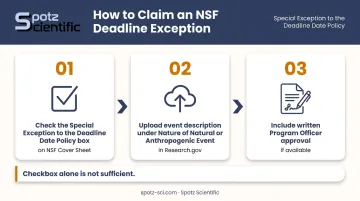
The checkbox alone, without prior Program Officer approval, is not sufficient.
Timing Mistakes That Can Derail Your NSF Proposal
Ignoring the SPO Internal Deadline
The most common institutional mistake: forgetting that the SPO review period is itself a hard requirement.
Most research offices require complete proposal packages 5–10 business days before the NSF deadline — with some requiring 10 or more for proposals involving subawards. For example:
- University of Nebraska Omaha's OSP requires 10 business days for domestic sponsor proposals
- Proposals requiring subawardee documentation require 15 business days
Missing the internal SPO deadline can prevent institutional submission even if the NSF deadline has not passed.
Waiting Too Long to Contact the Program Officer
Researchers who first contact a program officer four weeks before a deadline risk discovering their proposal doesn't fit the program — after months of writing. NSF's own guidance recommends reaching out "as early as possible," including during early proposal planning.
Contacting the program officer 4–5 months before the deadline gives enough runway to reframe the proposal or redirect effort before you've committed to a direction that won't survive review.
Confusing Target Dates and Deadline Dates
A researcher who assumes a late submission to a deadline date will simply roll into the next review cycle will find their proposal returned without review. The distinction between these two date types is not bureaucratic fine print; it determines whether you get reviewed at all.
Best Practices for Building Your NSF Submission Timeline
Start With Backward Planning
Identify the NSF deadline first, then work backward:
- NSF deadline date — the fixed end point
- SPO internal deadline — typically 7–10 business days before NSF deadline (aim for the higher end)
- Complete proposal draft due — allow at least 1–2 weeks before SPO submission for revisions
- Supporting documents complete — Data Management Plan, Broader Impacts statement, Facilities document
- Program officer contact — 4–5 months before the deadline
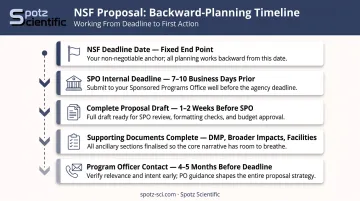
Each milestone gates the next. Missing one compresses every downstream step.
Contacting the Program Officer at the Right Time
An initial email to the program officer — with a one-paragraph description of the proposed research — should go out 4–5 months before the deadline. This conversation accomplishes three things:
- Confirms program fit before significant writing begins
- Flags upcoming solicitation changes or shifts in program priorities
- Shapes the proposal's framing with input from someone who will evaluate it
Sending this email one month before the deadline is too late to act on most of what you learn.
Building in Institutional Review Time
For single-institution proposals, plan to submit to the SPO 7–10 business days before the NSF deadline — not the minimum 5. That buffer allows time for corrections, AOR certification, and any last-minute document issues.
Multi-institutional collaborative proposals add a layer of complexity:
- Each subaward institution must complete its own internal review and AOR approval before the lead institution can submit
- All components of a separately submitted collaborative proposal must meet the deadline, or the entire collaboration may be returned without review
- The effective internal deadline for multi-institutional submissions is often two to three weeks before the NSF deadline
Managing Deadlines Across Multiple Programs
For researchers actively pursuing multiple programs — particularly CISE and NSF CAREER — a rolling submission calendar is the clearest way to stay current. Track:
- NSF deadline dates and target dates
- LOI and preliminary proposal due dates
- SPO internal deadlines for each submission
- Program officer contact windows
NSF CAREER applications carry a fixed annual deadline: miss it and you wait a full year to resubmit. For these high-stakes submissions, outside advisory support — covering proposal strategy, red-team review, and alignment with NSF CISE priorities — is most effective when engaged well in advance. Spotz Scientific works with CAREER applicants on this kind of early-stage planning, with consulting rates ranging from $200–250/hour for standard timelines.
Conclusion
NSF proposal deadlines are not uniform, and treating them as if they were is one of the most avoidable mistakes in the federal funding process. Target dates, deadline dates, and submission windows each carry different consequences for late submission — and understanding which applies to your program is as important as the proposal itself.
Successful deadline management means tracking multiple layers simultaneously:
- The NSF due date and its type (target vs. deadline vs. window)
- Your institution's SPO internal submission deadline
- Any LOI or preliminary proposal requirements
- The program officer contact window for early questions
Each layer requires deliberate attention — miss one and the others may not matter.
The researchers who submit with confidence are those who begin planning 4–5 months out — not 4–5 weeks out. If navigating these requirements feels uncertain, working with an advisor who knows the NSF funding process from the inside can help you submit with far greater confidence.
Frequently Asked Questions
What time are NSF proposals due?
All NSF proposals must be received by 5 PM in the submitting organization's local time zone on the established due date. If a deadline falls on a weekend, it shifts to the following Monday; federal holidays shift it to the next business day.
What is the NSF two-month rule for proposal deadlines?
This rule refers to a salary compliance policy, not a deadline rule. PAPPG 24-1, Chapter II.D.2.f(i)(a) limits salary compensation in proposal budgets for senior/key personnel to no more than two months of their regular salary per year across all NSF awards. Exceeding this cap without prior approval can jeopardize an award.
Is NSF accepting and reviewing proposals during a government shutdown?
No automatic extension applies during a government shutdown. The PAPPG explicitly excludes lapses in appropriation from its standard closure extension policy, so NSF issues separate, situation-specific guidance for each shutdown.
What is the difference between an NSF target date and a deadline date?
Proposals submitted after a target date are still accepted but may miss a specific review panel, potentially delaying the funding decision by six months or more. Proposals submitted after a deadline date will not be accepted and will be returned without review.
How far in advance should I submit my proposal to my institution's SPO?
Most SPOs require 5–10 business days before the NSF deadline. Plan for the higher end of that range — or earlier for multi-institutional proposals — to allow time for corrections, subaward coordination, and AOR certification.
What happens if I miss an NSF deadline date?
The proposal will not be accepted and will be returned without review. Exceptions require documented extraordinary circumstances and prior approval from the cognizant NSF Program Officer — they are not granted routinely, and the checkbox on the Cover Sheet alone is not sufficient.