
Yet the program is intensely competitive. DOE awarded $138 million to just 91 researchers in FY2024, and FY2026 plans for approximately 100 awards with up to $145 million in funding. Strong science alone is not enough to win one.
This guide covers everything serious applicants need to understand: program structure, eligibility, funding amounts, the selection process, and what separates winning proposals from those that don't advance.
Key Takeaways
- University-based awardees receive ~$875,000 over five years; national lab researchers receive ~$2.75M over five years
- The current eligibility window is 10 years post-PhD (as of FY2026), not 12
- A mandatory pre-application stage gates access to full submission — only invited applicants may proceed
- Alignment with your target program office's specific priorities is non-negotiable
- Reviewers evaluate your career trajectory and vision, not just the research plan itself
What Is the DOE Early Career Research Program?
Established in FY2010 by the DOE Office of Science, the ECRP was designed to address a real gap in the funding landscape: the period immediately after a researcher gains independence is often when they do their most formative work, yet sustained multi-year funding is hardest to secure at that stage.
The program has funded 961 researchers since inception through FY2024, including 631 university-based awardees and 330 national laboratory researchers. Annual cohorts have ranged from 83 to 93 awards in recent years, with annual funding commitments between $110M and $138M.
Two Goals, One Program
The ECRP serves a dual mission:
- Advancing scientific discovery in priority areas aligned with DOE's Office of Science agenda
- Developing the next generation of STEM leaders by supporting researchers at the outset of their independent careers
Reviewers evaluate both dimensions together: scientific merit and whether this researcher has the trajectory to become a leader in their field. A strong proposal addresses each one directly, not as an afterthought.
Eligibility Requirements and Funding Amounts
Eligibility Criteria
The program has two distinct tracks:
- Academic track: Untenured, tenure-track assistant or associate professors at U.S. academic institutions
- Laboratory track: Full-time, non-postdoctoral, permanent employees at DOE or NNSA national laboratories, or Office of Science scientific user facilities
Both tracks require that applicants received their PhD within the past 10 years at the time of application. FY2024 temporarily extended this window to 12 years, but FY2026 returned to 10 years, with eligibility limited to doctorates received on or after January 1, 2015. Life event extensions of three months or longer may also apply.
Research must also fall within the eligible Office of Science program areas; proposals outside these scopes are not reviewed, regardless of scientific merit.
Funding Amounts
| Track | Total Award | Duration |
|---|---|---|
| University-based | ~$875,000 | 5 years |
| National laboratory | ~$2,750,000 | 5 years |
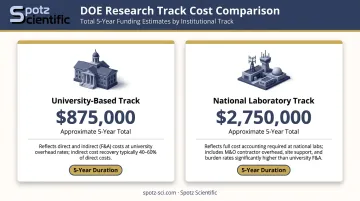
The funding gap between tracks reflects how costs are counted, not how DOE values the research. Laboratory awards cover full salary, benefits, and operating costs for DOE employees. University awards cover summer salary and research expenses, with the institution's regular employment structure covering the rest.
The five-year duration is what makes this program genuinely different. Researchers can pursue long-horizon questions without re-competing for funding every one to three years — a disruption that derails even well-designed research programs.
Research Areas Covered by the Program
The FY2026 NOFO lists seven eligible program areas. Note that Accelerator R&D and Production (ARDAP) — included in FY2025 — was omitted from FY2026. Researchers in that space should verify current eligibility before investing in a proposal.
The seven current areas:
- Advanced Scientific Computing Research (ASCR) — computing, mathematics, networking, modeling, simulation, and prediction of complex phenomena
- Basic Energy Sciences (BES) — fundamental understanding of matter and energy at electronic, atomic, and molecular scales
- Biological and Environmental Research (BER) — predictive understanding of biological, Earth, and environmental systems
- Fusion Energy Sciences (FES) — plasma science and the scientific foundations for fusion energy
- High Energy Physics (HEP) — elementary constituents of matter, energy, space, and time
- Isotope R&D and Production (IRP) — domestic supply and R&D of critical isotopes for medicine, energy, security, and science
- Nuclear Physics (NP) — experimental and theoretical research into atomic nuclei and fundamental matter
Each program office maintains distinct scientific priorities that shift year to year. Reading only the general ECRP solicitation will not prepare you for those differences.
Applicants should study the specific program office's current agenda, review recent award abstracts, and check any supplementary guidance published alongside the main NOFO.
How the DOE Early Career Award Selection Process Works
The Pre-Application Gate
Every recent ECRP competition has required a mandatory pre-application submitted through an authorized institutional representative. This is not a formality. Only applicants who receive an encouragement notice after pre-application review are permitted to submit a full proposal.
Pre-applications are evaluated on:
- Responsiveness to NOFO objectives
- Scientific and technical merit
- Appropriateness of the research approach
- Likelihood of scientific impact
This stage is your first real evaluation — and your first opportunity to gauge whether your proposal direction fits the program office's current priorities before you invest weeks in a full application.
Full Proposal Review Criteria
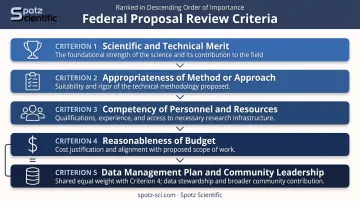
Full applications are assessed by panels of outside scientific experts — researchers in the same or adjacent fields — using the following criteria in descending order of importance:
- Scientific and/or technical merit
- Appropriateness of method or approach
- Competency of personnel and adequacy of resources
- Reasonableness and appropriateness of budget
- Data management/sharing plan and potential for scientific community leadership (weighted equally with criterion 4)
Portfolio-Level Considerations
Selection for award negotiations is explicitly not a commitment to fund. After peer review, program managers play an active role in shaping the final cohort — considering not just individual proposal merit but also the balance of topics, approaches, and institutions across the portfolio.
A proposal can score well in peer review and still not receive an award if it duplicates coverage already strong in the portfolio, or falls outside the program office's current investment emphasis. This reflects how program offices manage a coherent scientific agenda — not arbitrary gatekeeping, but deliberate portfolio balance. Applicants who understand this dynamic can frame their work to complement existing investments rather than compete with them.
How to Build a Winning DOE Early Career Research Proposal
Lead with a Sharp Research Question
Reviewers evaluate hundreds of proposals. Yours needs to state its central question clearly within the first few pages — what you're asking, why it matters to the field right now, and why you are specifically positioned to answer it. Generic framings like "this research will advance fundamental understanding of X" don't land. Specificity does.
Connect Explicitly to Program Office Priorities
The DOE Office of Science website publishes program office priorities, solicitation language, and award abstracts from prior years. Use all of them. Reviewers and program managers can tell immediately whether an applicant has done this work or is submitting a repurposed proposal.
Reference solicitation language where relevant. Mirror the framing of priority areas — not superficially, but in ways that demonstrate genuine alignment between your research agenda and the program office's current scientific investment strategy.
Build a Compelling Career Narrative
Unlike standard research grants, the ECRP invests in the researcher as much as the project. The biographical section and career development plan carry real weight. Reviewers want to see:
- A coherent scientific identity that is clearly independent from your PhD and postdoctoral advisors
- Evidence of intellectual leadership in your emerging research area
- A credible trajectory toward becoming a recognized field leader
Many technically strong researchers undersell this section. If your proposal reads like a continuation of your mentor's work, that's a problem — even if the science is excellent.
Get a Red Team Review
One of the highest-impact steps you can take before submission is having experienced reviewers critically evaluate your draft. A red team review examines scientific merit, clarity, alignment with program priorities, and overall competitiveness — identifying weaknesses while there's still time to fix them.
Spotz Scientific offers this service specifically for ECRP applicants. Bill Spotz spent eight years as a program manager at DOE's ASCR office, co-leading the applied mathematics program and managing over $264 million in scientific computing research. His red team reviews draw directly on that insider perspective, applying the same evaluative lens that program managers use when they read your proposal.
Consulting engagements are available at $250/hour (standard) or $300/hour for expedited review when materials arrive fewer than two weeks before a deadline. Reach out at info@spotz-sci.com.
Study Past Award Profiles
The DOE Office of Science publishes abstracts from prior ECRP cohorts. Reading them is some of the most useful preparation available. Look for patterns in how successful awardees framed their research questions, scoped their five-year plans, and articulated broader impacts:
- How research questions were framed with precision and scope
- How five-year plans balanced ambition with credibility
- How broader impacts were grounded in specific, measurable outcomes
Most applicants skip this step. That's a mistake.
Common Mistakes to Avoid When Applying
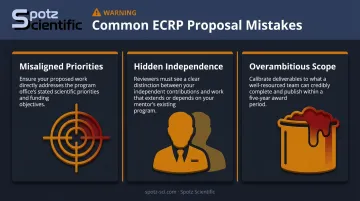
Fit the cycle, not just the field. Scientifically excellent proposals that don't align with the target program office's current priorities will not advance — full stop. This is the most common and most avoidable reason for rejection. Read the solicitation language carefully and verify that your research direction maps to what the office is actually funding this cycle.
Make your independence visible. Review panels weigh demonstrated scientific independence heavily. Failing to clearly distinguish your own research identity from your PhD or postdoc mentor's work can sink an otherwise strong proposal. Your intellectual autonomy needs to be explicit on the page — don't assume reviewers will infer it.
Scope for what you can actually deliver. Five years sounds like a long time. Reviewers don't see it that way. An overly ambitious plan reads as unfocused and raises doubts about whether any of it will get done. Aim for one demonstrable, high-impact result per funding year — that coherence is far more convincing than a broad agenda.
Frequently Asked Questions
How much is the DOE Early Career Award?
University-based researchers receive approximately $875,000 over five years. National laboratory and user-facility researchers receive approximately $2,750,000 over five years. The difference reflects how DOE accounts for costs — lab awards cover full salary and operating expenses, while university awards supplement existing employment.
What is an early career award?
An early career award is a competitive federal grant providing substantial, sustained funding to researchers in the early stage of their independent scientific careers. The DOE version specifically targets researchers within 10 years of their PhD, providing a multi-year runway to pursue high-impact work before tenure pressures intensify.
Who is eligible for the DOE Early Career Research Program?
Eligibility is limited to untenured tenure-track assistant or associate professors at U.S. academic institutions, or full-time permanent employees at DOE national laboratories or Office of Science user facilities, who received their PhD within the past 10 years (as of FY2026).
How competitive is the DOE Early Career Research Program?
Highly competitive. Recent cohorts have ranged from 83 to 93 awards annually from a large pool of applicants. Scientific merit alone won't carry a proposal. Alignment with the specific program office's priorities matters just as much, and portfolio-level considerations shape the final selections.
How does the peer review process work for the ECRP?
Outside scientific experts evaluate proposals using criteria weighted toward scientific merit, approach, and personnel competency. Program managers also shape the final portfolio, weighing coverage balance across topics and institutions. Individual review scores inform but don't fully determine outcomes.
When does the DOE Early Career Research Program solicitation open each year?
Opening dates have varied considerably — from November through March in recent cycles. Monitor the DOE Office of Science website and Grants.gov for the annual Funding Opportunity Announcement. Because mandatory pre-applications are due within weeks of the NOFO release, have your research direction defined and a draft narrative underway before the solicitation appears.