That gap — between technically sound and actually funded — is where most proposals are won or lost. Execution, framing, and understanding what reviewers actually weight heavily all matter as much as the science itself.
This guide walks through the complete structure of a grant proposal, what to prepare before you write a single word, the factors that most influence review outcomes, and the mistakes that knock otherwise strong proposals out of consideration.
Key Takeaways
- Read the full NOFO first — your proposal structure must follow the funder's requirements, not your own.
- Vague or unmeasurable outcomes in the problem statement and objectives are among the most common rejection causes.
- Both underquoting and overquoting raise flags — budget accuracy signals competence to program managers.
- Alignment with the specific program's priorities matters more than general scientific excellence.
- A red-team review before submission catches what authors can't see in their own work — and it's the step most applicants skip.
How to Write a Grant Proposal: Step by Step
Step 1: Write a Strong Cover Letter
The cover letter is your first contact with the funder. State immediately who you are, how much you're requesting, and for what purpose — no preamble, no throat-clearing. For federal scientific proposals targeting DOE ASCR or NSF CISE, keep the tone professional and mission-aligned.
Briefly connect your proposed work to the specific program priorities in the NOFO. Do not repeat content that will appear in the proposal body — the cover letter's job is to orient the reader, not preview every section.
Step 2: Craft a Compelling Executive Summary
Program managers often read this first to assess fit before going further. Cover four things concisely:
- The project's purpose and anticipated outcomes
- Total funding requested
- Why this team is positioned to do this work
- How the project connects to the funder's current priorities
Keep it to one or two pages. Write it last, once all other sections are finalized — it should accurately reflect the full proposal, not a draft version of it.
Step 3: Write a Direct Problem Statement
This section must establish a specific gap in knowledge, capability, or infrastructure, supported by quantitative evidence such as published data or prior research findings. Avoid circular reasoning ("we need funding to do this research"). The problem must exist independently of your desire to study it.
Connect the gap to your target agency's stated mission:
- DOE ASCR: Tie the problem to ASCR's mission of discovering, developing, and deploying computational and networking capabilities for modeling, simulation, and data analysis
- NSF CISE: Connect the gap to current priorities in AI, cybersecurity, quantum information science, or advanced cyberinfrastructure
Reviewers evaluate both Intellectual Merit (advancing knowledge) and Broader Impacts (benefit to society). Your problem statement sets up both.
Step 4: Define Goals, Objectives, and Methods
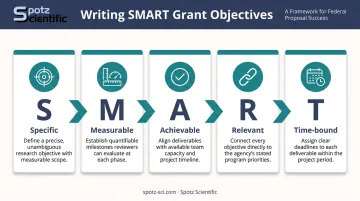
Distinguish between goals (broad aspirational outcomes) and objectives (specific, measurable, time-bound milestones). Every objective must be achievable within the proposed project period.
SMART criteria — Specific, Measurable, Achievable, Relevant, Time-bound — provide a practical test for each objective. If you cannot describe a concrete verification method for an objective, revise it before submission.
The methods section must justify why your chosen approach is the best-fit solution. Reference precedent from prior work or similar funded projects. The 2025 ASCR ERSS NOFO explicitly scored "appropriateness and feasibility of the approach" — reviewers are looking for evidence that the methodology is sound, not just ambitious.
Step 5: Include an Evaluation Plan and Success Metrics
Federal funders expect a credible framework for measuring whether the project achieved what it promised. Specify:
- What will be measured
- How it will be measured (and by what method)
- Who is responsible for evaluation
- When assessments will occur
For scientific computing proposals, relevant metrics include performance benchmarks, publication milestones, software deliverables, and reproducibility standards. These must align directly with the objectives from Step 4. Reviewers notice when metrics drift from stated goals.
Step 6: Outline Budget and Sustainability
Every line item needs justification tied to a specific deliverable or activity. Under 2 CFR 200, award costs must be necessary, reasonable, allocable, and adequately documented.
Key budget categories for NSF proposals include:
- Senior/key personnel and fringe benefits
- Equipment and travel
- Participant support costs
- Other direct costs and indirect costs
Indirect cost rates should reflect your institution's current negotiated agreement. Recipients without a negotiated rate may elect up to 15% of modified total direct costs under current federal rules.
Unrealistically low budgets raise red flags. Program managers who understand actual research costs will question whether the work is genuinely feasible at the proposed funding level.
For multi-year projects, briefly address sustainability beyond the grant period — whether through follow-on applications, institutional support, or other mechanisms.
What to Prepare Before You Write
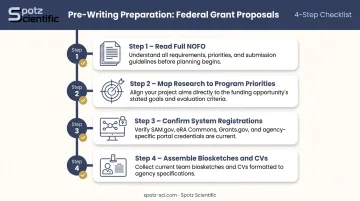
Starting to write before the foundational work is done is one of the most common causes of weak proposals. Before drafting anything:
- Read the full NOFO thoroughly — eligibility requirements, evaluation criteria, page limits, required sections, and any exclusions. Build your proposal architecture around those requirements.
- Map your research to the program's stated priorities — not science in general, but this specific program's current focus areas.
- Confirm all system registrations are active — federal proposals typically require SAM.gov, Research.gov, or Grants.gov registration that can take weeks to complete. Verify accounts and organizational credentials well before the deadline.
- Assemble biosketches and CVs — all key personnel should have current documents ready before writing begins.
Research Alignment and Funder Contacts
Once your preparation checklist is in order, contacting the relevant program manager before submitting is a logical next step — and one that both DOE and NSF explicitly encourage.
A brief email or call can confirm whether your project fits the current solicitation. The practical benefits are real:
- DOE ASCR directs applicants to email program staff listed in the NOFO with technical questions
- NSF encourages early contact with program officers to assess scope alignment
- Early contact can save weeks of effort if your project falls outside current program priorities
This is standard pre-submission practice, not an informal favor.
Key Factors That Determine Grant Proposal Success
Proposal quality reflects how well a researcher understands the reviewer's perspective. Many technically excellent proposals are passed over for reasons that have nothing to do with the underlying science.
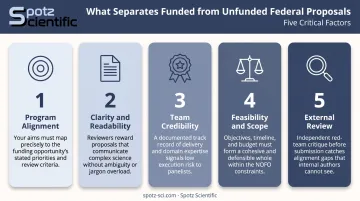
Five factors consistently separate funded proposals from those that fall short:
- Alignment with program priorities — Reviewers evaluate proposals against specific funding program goals. DOE's merit review criteria require relevance to Office of Science missions, not just abstract scientific merit. Using the agency's own language and directly addressing stated priorities signals serious preparation.
- Clarity and readability — Reviewers evaluate dozens of proposals per cycle. Clear headings, short paragraphs, active voice, and well-labeled figures create a more favorable impression than dense, jargon-heavy prose that makes reviewers work to understand the science.
- Team credibility — Reviewers assess whether the PI and team have the expertise, track record, and institutional resources to execute the work. Include key prior accomplishments and relevant publications, but avoid overstating credentials.
- Feasibility and scope — Proposing more work than can be completed in the project period is a common failure mode. Reviewers are skeptical of ambitious proposals that seem unlikely to deliver. A realistic, well-scoped proposal with achievable outcomes is more fundable than an overreaching one.
- External review before submission — Having someone outside your immediate research team read the proposal critically — ideally someone who understands how the target agency evaluates proposals — surfaces blind spots that are nearly invisible to the people who wrote it.
That last point is where Spotz Scientific comes in. Dr. Bill Spotz spent eight years as a program manager at DOE ASCR, managing over $264 million in scientific computing research. He provides red-team review of draft proposals and pre-proposals for researchers targeting DOE ASCR and NSF CISE programs. His reviews apply the same scrutiny proposals face from actual program managers, identifying gaps in merit, clarity, alignment, and strategic framing before they reach reviewers.
Common Grant Proposal Mistakes to Avoid
Many proposals fail not because of weak science, but due to presentation and process errors that experienced reviewers recognize immediately.
Misreading or ignoring the NOFO — Wrong page limits, missing required sections, or work outside program scope results in disqualification or poor scores. NSF may return proposals without review when they are not responsive to the solicitation; program managers cannot advocate for a non-compliant submission.
Objectives written as activities ("we will study X") rather than outcomes ("we will demonstrate X by Y date using Z metric") give reviewers nothing to evaluate. Both NSF and DOE require mechanisms for assessing success — this is a scored criterion, not a formality.
Weak budget justification — Every significant expense should connect to a specific deliverable in the methods section. Unexplained line items signal inexperience, and misapplied indirect cost rates raise compliance concerns with program offices.
Describing technical work in detail without explaining why it matters for the funder's mission is one of the most common scoring gaps. Broader impact must be made explicit — reviewers will not infer it from strong science alone.
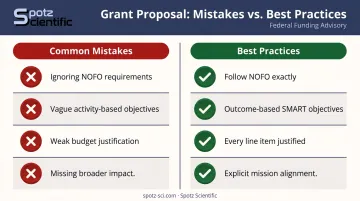
These mistakes share a common thread: they're avoidable with careful attention to the NOFO and an honest read of the proposal through a reviewer's eyes.
What to Do After You Submit
Submission is not the end of the process. After submitting, your immediate priorities are:
- Confirm your acknowledgment receipt from the agency
- Note the expected review timeline and any interim deadlines
- Prepare to respond to administrative or clarification questions
NSF proposal status is monitored through Research.gov, and the agency targets notification within six months of submission.
Handling Rejection and Resubmission
Most proposals are not funded on the first attempt — this is normal even for experienced researchers. Reviewer feedback, when provided, is a diagnostic tool. Read it systematically rather than defensively, and use it to address each concern in a resubmission.
For DOE Early Career and NSF CAREER programs, resubmission windows can be limited, which makes expert guidance especially valuable. These are among the most competitive award mechanisms in federal scientific computing funding — and the stakes of a second unsuccessful attempt are high.
Spotz Scientific provides specialized coaching for both DOE Early Career and NSF CAREER applicants, including red-team review and strategic advisory tailored to the specific dynamics of these programs. Dr. Spotz's eight years as a DOE program manager give him direct insight into how these submissions are evaluated — perspective that is hard to find elsewhere.
Engaging early, before deadline pressure narrows your options, allows for more thorough and iterative feedback. Inquiries can be directed to info@spotz-sci.com.
Frequently Asked Questions
What are common grant proposal mistakes?
The most frequent errors are ignoring NOFO requirements, writing vague or unmeasurable objectives, submitting an unjustified budget, and failing to connect the work to the funder's mission. Each is avoidable with adequate preparation.
How long should a grant proposal be?
Proposal length is dictated by the NOFO. NSF's general Project Description limit is 15 pages, but solicitation-specific exceptions apply. DOE ASCR limits are NOFO-specific — the 2025 ERSS solicitation used a 3-page pre-application and 10-page narrative. Going over the limit risks disqualification; going significantly under may suggest the work isn't well developed.
Should I contact a program manager before submitting?
For DOE ASCR and NSF CISE, yes — this is encouraged. A brief email to the program manager listed in the NOFO can confirm whether your project fits the current solicitation. If it doesn't fit, you'll know before investing weeks of writing time.
What do grant reviewers look for in a scientific proposal?
Standard review criteria cover scientific merit, innovation, feasibility, team qualifications, and alignment with program priorities. Clear writing and logical organization significantly affect reviewer scores — a dense, hard-to-navigate proposal can cost points regardless of the science behind it.
How do I write a strong problem statement?
Use data to establish the existence and significance of a specific gap, connect that gap to broader consequences for the field or agency mission, and position your proposed work as the most appropriate solution. The problem statement should be about the field's need — not about your interest in studying it or your need for funding.
How is a grant proposal different from a grant application?
A grant application is the full submission package — forms, certifications, attachments, and the narrative. The grant proposal is the narrative document within that package that describes the project. The terms are often used interchangeably, but technically the proposal is one component of the larger application.