Grant consulting services exist for scientific researchers just as they do for nonprofits, but how these services actually work — and when they matter most — is poorly understood by the researchers who need them most. The assumptions researchers bring to consulting often lead them to engage at the wrong stage, with the wrong type of consultant, for the wrong reasons.
This article unpacks five realities about scientific grant consulting that most researchers haven't encountered before, with a focus on federal funding opportunities at agencies like DOE's Office of Science and NSF.
Key Takeaways
- Grant consulting for federal scientific proposals is primarily strategic, not just editorial
- Program-side experience — having worked as a program manager — is a fundamentally different credential than high proposal volume
- The most impactful consulting happens before a solicitation is even released
- Specialization in your specific agency and program matters more than general grant experience
- Consulting is an investment in both a single submission and your longer funding trajectory
Reality #1: Scientific Research Grant Consulting Goes Well Beyond Proposal Writing
Most researchers assume a grant consultant is essentially a professional editor — someone who polishes prose, checks formatting, and catches citation errors. For scientific computing and federal research proposals, that assumption misses most of what actually matters.
What the Scope Actually Looks Like
A scientific grant consultant working on federal proposals may do any combination of the following:
- Evaluate fundability — determining whether a research idea fits what a specific program is actively trying to fund, not just what it nominally covers
- Identify the right mechanism — assessing whether a proposal belongs in the target solicitation or whether a different funding vehicle is the stronger match
- Shape technical framing — helping researchers communicate contributions clearly for review panels that often include non-specialists
- Calibrate scope — flagging when a proposal is too narrow, too broad, or misaligned with the program's current portfolio direction
- Red team the draft — stress-testing a proposal the way a skeptical reviewer or program manager would, surfacing weaknesses before submission rather than after rejection
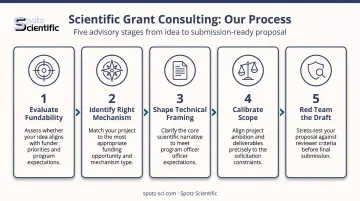
That last service is one of the most underused in the field. A genuine red team review isn't copy editing — it's a systematic challenge of the proposal's assumptions, structure, and framing from an adversarial perspective. Understanding that distinction matters: the strategic inputs — program alignment, framing decisions, scope calibration — are where the real consulting value lies.
Where the Real Value Is Created
For early-career programs like DOE's Early Career Research Program or NSF's CAREER award, consulting often involves helping researchers articulate a five-year research vision and understand the specific expectations of those programs.
NSF CAREER requirements include an integrated research and education plan, a required Departmental Letter, and a one-proposal-per-cycle limit — structural constraints where missteps eliminate candidates before merit review even begins.
Proposal writing is the visible output. The strategic inputs are where most researchers lack visibility into what reviewers and program managers are actually looking for.
Reality #2: The Most Valuable Asset Is Program-Side Perspective
There is a fundamental difference between a consultant who has studied how federal funding works and one who has actually made funding decisions from inside an agency.
How Program Managers Actually Shape Outcomes
NSF program officers don't just process paperwork. According to NSF's own overview of the award process, they recruit reviewers, analyze review input, consider portfolio balance and special program objectives, and recommend award or decline to the division director.
At DOE, selection also accounts for available funds, relevance to Office of Science priorities, and distribution across researchers at different career stages.
The scoring rubric, in other words, is only part of the picture. A consultant who has held that program manager role understands the gap between what a Notice of Funding Opportunity says and what the program is actually trying to build — something no amount of proposal writing experience can replicate.
What Program-Side Knowledge Changes
Program-side experience shapes concrete decisions:
- Reading a NOFO for its strategic intent, not just its stated requirements
- Recognizing technical language that signals misalignment with current portfolio direction
- Knowing which research areas a program has been actively expanding — and which are saturated
- Understanding when a proposal's framing will resonate with a program manager vs. confuse them
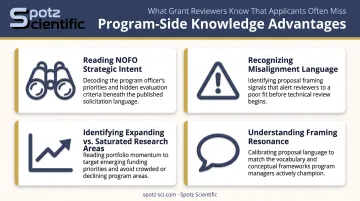
When evaluating consultants, the question to ask isn't "how many proposals have you written" — it's "have you ever sat on the other side of the table?"
That's the vantage point Bill Spotz brings to Spotz Scientific. He spent eight years as a program manager at DOE's Advanced Scientific Computing Research (ASCR) office, co-leading the applied mathematics program and overseeing more than $264 million in scientific computing research. Understanding how proposals are evaluated and selected from inside the agency is the core of how he approaches proposal review and strategy.
Reality #3: The Best Consulting Happens Before the Solicitation Even Drops
The most common pattern: a solicitation is announced, researchers scramble to adapt their existing research plans to fit, and they bring in a consultant with three weeks left before the deadline. This reactive approach limits success even with strong consulting support.
Why Timing Matters So Much
The most impactful consulting for federal scientific proposals happens at the pre-solicitation stage:
- Reviewing a researcher's broader agenda to identify which programs and mechanisms are the strongest fit
- Advising on how to build a fundable narrative over time
- Helping researchers make early contact with program managers in a way that is appropriate and bounded
NSF explicitly advises researchers to contact program officers "as early as possible" and to do their homework before reaching out. That guidance makes more sense when a consultant has helped a researcher understand which program is actually the right target before that conversation happens.
Strategic advice at the NOFO or pre-proposal stage can prevent a researcher from spending months on a proposal that misaligns with the program's current direction, a mistake most researchers only recognize after the fact.
The Cost of Late Engagement
Spotz Scientific's fee structure reflects this logic. Reviews conducted when materials arrive less than two weeks before a NOFO deadline carry a premium rate: compressed turnaround requires different resourcing, not a penalty for late arrival. Researchers who engage earlier get more thorough strategic input and pay the standard rate.
For multi-institution or collaborative proposals, early engagement matters even more. Team composition, sub-award structure, and partner roles all shape how reviewers perceive a project's feasibility and leadership clarity. Revisiting those decisions late in the development cycle is rarely feasible.
Key decisions that are hardest to change after late-stage engagement begins:
- Sub-award structure and budget split between institutions
- Lead PI designation and leadership narrative
- Partner scope of work and its alignment with program priorities
Reality #4: Specialization in Federal Scientific Funding Matters More Than General Grant Experience
"Grant consultant" covers an enormous range of backgrounds — nonprofit fundraising specialists, federal contracting experts, academic research administrators, and everything in between. Not all of them are equipped to advise on scientific computing proposals to DOE or NSF.
The Differences That Actually Matter
Federal scientific research proposals operate under fundamentally different rules than foundation grants or nonprofit funding:
| Factor | Federal Scientific Proposals | General Grant Writing |
|---|---|---|
| Review structure | Peer review by subject-matter experts | Often internal review by program staff |
| Technical depth | Scientific and computational rigor required | Programmatic narrative emphasis |
| Program officer role | Portfolio decisions, reviewer selection, discretionary judgment | Varies widely by funder |
| Budget compliance | 2 CFR 200, negotiated indirect-cost rates | Funder-specific policies |
| Merit criteria | Intellectual Merit + Broader Impacts at NSF; technical merit, methods, personnel at DOE | Varies by funder |
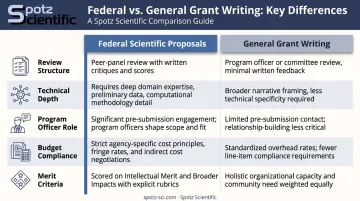
A consultant who primarily works with foundation grants or non-scientific federal programs won't recognize when a proposal's computational framing misses DOE ASCR's portfolio direction — or when an NSF CAREER's Broader Impacts section fails to meet the program's integrated expectations.
Why Domain Focus Is Non-Negotiable
Spotz Scientific focuses specifically on scientific computing proposals to DOE's ASCR program and NSF's CISE directorate, including targeted support for DOE Early Career and NSF CAREER applicants. That narrow scope reflects how specific the knowledge requirements actually are — program portfolio direction, reviewer expectations, and merit criteria differ meaningfully between agencies and even between programs within the same agency.
When evaluating any consultant, ask directly about their experience with the specific agency and program you are targeting, not just federal grants in general. Someone who knows DOE ASCR's applied mathematics portfolio will give you fundamentally different — and more useful — guidance than a generalist who works across dozens of federal programs. Breadth of experience is not a substitute for depth in the right area.
Reality #5: The ROI of Scientific Grant Consulting Goes Beyond a Single Award
The cost of consulting can feel like an added burden on already-constrained research budgets. But treating it purely as an expense ignores what's actually at stake on both sides of the ledger.
The True Cost of an Unguided Submission
NSF's own Paperwork Reduction Act estimate puts the burden for a single proposal response at approximately 120 hours. That is researcher time, graduate student time, and institutional staff time — none of which is recoverable after a rejection.
A failed proposal isn't free. It costs months of effort, delays research timelines, and often damages a researcher's confidence in federal funding at exactly the moment when that confidence should be building.
The Compounding Advantage
That cost framing only covers one cycle. The real return compounds over a researcher's entire funding career:
- Each submission cycle sharpens a researcher's ability to frame work for a specific agency's priorities
- Early strong proposals open direct relationships with program managers that persist across funding rounds
- A consistent research narrative positions a lab for follow-on and parallel funding over time
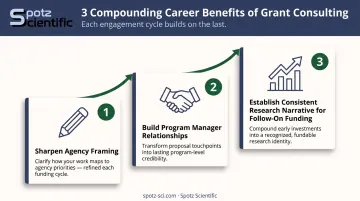
For early-career researchers specifically, the first successful federal award often unlocks follow-on funding, team-building opportunities, and institutional recognition. Measured against those downstream returns, the initial consulting investment looks modest.
A DOE Early Career award typically covers approximately $875,000 over five years. The consulting fee to make that submission competitive is a fraction of what's at stake.
Key Questions to Ask Before Hiring a Scientific Grant Consultant
Not all grant consultants bring the same value — and in scientific computing, the gap between generic advice and program-specific insight can determine whether your proposal advances or stalls. Before engaging anyone, get direct answers to these questions:
What is your specific experience with the agency and program I'm targeting? General federal grant experience is not sufficient. Ask about direct familiarity with the solicitation type, review process, and current portfolio direction.
How do you scope your services? Clarify whether they offer strategic advisory only, full proposal development support, red team review, or some combination — and confirm exactly what's included before you agree to anything.
Have you ever made funding decisions from inside an agency? This is a different kind of expertise from reviewing proposals as an applicant. A consultant who has managed a grant portfolio — and decided which proposals to fund — brings perspective that volume alone cannot replicate.
Frequently Asked Questions
What does a grant consultant do?
A grant consultant provides strategic guidance on funding opportunities, advises on proposal framing and program alignment, and reviews draft proposals for weaknesses before submission. For federal scientific research proposals, the work extends well beyond editing — covering NOFO interpretation, program fit assessment, and positioning advice grounded in how agencies actually evaluate submissions.
What is a typical fee for a grant consultant?
Fees vary widely by scope and expertise. The Grant Professionals Association has reported typical consultant rates around $80–$90 per hour for general grant work, though specialized federal scientific consulting reflects deeper program expertise. Spotz Scientific charges $250 per hour for standard engagements and $300 per hour for expedited reviews when materials arrive less than two weeks before a deadline.
How is scientific grant consulting different from nonprofit grant consulting?
Federal scientific proposals require technical depth, peer review by subject-matter experts, alignment with agency portfolio priorities, and navigation of program manager dynamics. These demands call for different expertise than nonprofit grant writing. Budget compliance rules, indirect cost regulations, and merit review criteria are also more complex in the federal scientific context.
Can a grant consultant guarantee I will win funding?
No ethical consultant guarantees outcomes, and the Grant Professionals Association's Code of Ethics explicitly prohibits commission or contingency fee arrangements based on award results. Good consulting measurably improves proposal competitiveness and strategic fit — it cannot override reviewer judgment or program priorities.
When is the right time to bring in a grant consultant?
Earlier is better — ideally before a solicitation is announced. Pre-solicitation consulting allows a consultant to assess program fit, shape research framing, and advise on whether a specific opportunity is worth pursuing before significant proposal investment begins. Waiting until a draft is nearly finished reduces consulting to copyediting.