The rules are specific, technical, and easy to misread — especially if you're used to general SBA contracting standards, which don't apply here.
This guide covers the four core eligibility criteria, how affiliation rules work, phase-specific requirements, mandatory registrations, and the mistakes most likely to derail a first-time applicant.
Key Takeaways
- Eligibility is assessed at the time of award, not proposal submission — ownership and size changes matter
- All four criteria must be met at once: for-profit status, U.S.-based operations, majority U.S. ownership (>50%), and ≤500 employees including affiliates
- Affiliation rules extend the employee cap to parent companies, subsidiaries, and investor-controlled entities
- SAM.gov registration can take several weeks, so begin the process well before your target submission date
- Phase III carries no small business eligibility requirements; Phase I/II compliance, however, protects your commercialization rights
What Is the SBIR Program and Who Is It Designed For?
SBIR — known as "America's Seed Fund" — is a federal initiative that channels R&D funding to small businesses to drive technological innovation in service of national priorities. It is not a general small business contracting program. The eligibility rules are specific to SBIR and STTR, and experience with other SBA programs does not carry over.
Eleven federal agencies participate in SBIR; six participate in the companion STTR program.
Current program participation:
| Program | Participating Agencies |
|---|---|
| SBIR | USDA, Commerce, Defense, Energy, Education, HHS, Homeland Security, Transportation, EPA, NASA, NSF (11 total) |
| STTR | USDA, Defense, Energy, HHS, NASA, NSF (6 total) |
The key distinction between SBIR and STTR: STTR requires a formal collaboration with a nonprofit research institution — a university or federally funded R&D center — where the small business performs at least 40% of the R&D and the research partner performs at least 30%. SBIR has no such requirement.
For applicants planning ahead: both programs were reauthorized through FY2031 by the Small Business Innovation and Economic Security Act (P.L. 119-83), enacted April 13, 2026, providing a stable funding horizon for multi-phase proposals.
The Four Core SBIR Eligibility Requirements
One of the most misunderstood aspects of SBIR: eligibility is assessed at the time of award, not at proposal submission. A company that qualifies when it applies may be disqualified by the time an award is made if its ownership, headcount, or affiliation status changes in the interim. This applies to both Phase I and Phase II.
All four criteria must be met simultaneously.
Requirement 1: For-Profit, U.S.-Based Business
The company must be organized for profit and have a physical place of business in the United States. It must operate primarily within the U.S. — or demonstrate a significant contribution to the U.S. economy through taxes or use of American products, materials, or labor.
Requirement 2: Eligible Legal Entity Form
Permitted business structures include:
- Individual proprietorship
- Partnership
- LLC or corporation
- Joint venture
- Association, trust, or cooperative
Joint ventures get extra scrutiny: each entity within a joint venture must independently satisfy all SBIR eligibility requirements. A 50/50 joint venture with a foreign firm, for example, is ineligible because the foreign party cannot meet the U.S. ownership and control test.
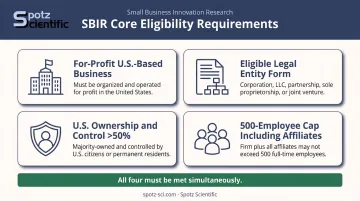
Requirement 3: U.S. Ownership and Control (>50%)
The company must be more than 50% directly owned and controlled by:
- U.S. citizens or permanent resident aliens
- Other qualifying small business concerns
- Indian tribes, Alaska Native Corporations, or Native Hawaiian Organizations
SBIR-only exception: Some agencies allow majority ownership by multiple venture capital operating companies (VCOCs), hedge funds, or private equity firms — provided no single entity exceeds 50% unless it independently qualifies as a small business. The investors must be U.S.-organized with a U.S. place of business. This exception does not apply to STTR.
Requirement 4: 500-Employee Cap Including Affiliates
The applicant company, combined with all affiliated entities, cannot exceed 500 employees. That headcount isn't limited to your own payroll — every affiliated entity counts toward the cap. Affiliation rules are complex enough that many otherwise-eligible companies trip on them, so the next section breaks down exactly what triggers affiliation status.
Understanding SBIR Affiliation Rules
Affiliation is where otherwise-eligible companies most often stumble. SBA counts affiliated entities' employees toward the 500-person cap, meaning a 30-person startup with a 600-person affiliated parent is disqualified. Getting this wrong can mean losing an award — or worse, exposure under the False Claims Act.
The core question SBA asks: does one concern control, or have the power to control, another? If yes, they're affiliated.
Common Bases for Affiliation
Ownership: Owning 50% or more of voting equity establishes control outright. Smaller blocks may still create affiliation based on the totality of circumstances — SBA considers affiliation less likely below 40%, but that's guidance, not a hard rule. Ownership is evaluated on a fully diluted basis, including options, warrants, convertible securities, and agreements to merge.
Management: Affiliation arises when a CEO, president, officer, managing member, or controlling board group of one company also controls another. One person running two companies simultaneously is the classic trigger.
Identity of interest:
- SBA may presume affiliation between close family members with overlapping business interests
- Economic dependence is presumed when a company receives 70% or more of receipts from a single other concern over the prior three fiscal years
Ostensible subcontractor rule: If a subcontractor performs the primary and vital work of the SBIR project — or if the prime applicant is unusually reliant on that subcontractor — SBA may treat the subcontractor as an affiliate. Companies planning to outsource a substantial portion of R&D should review subcontracting arrangements with legal counsel before applying.
VC and Private Equity Ownership: The Negative Control Risk
Even a minority investor can trigger an affiliation finding if their governance rights extend to ordinary business decisions. Effective January 16, 2025, SBA regulations permit minority investors to block only six specific "extraordinary" actions without creating a negative-control affiliation:
- Adding a new equity stakeholder or increasing an existing one's investment
- Dissolution of the company
- Sale of the company or all its assets
- Merger
- Bankruptcy
- Amending governance documents to remove the investor's blocking authority for items 1–5
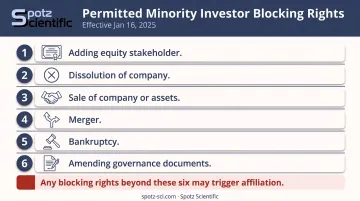
Any blocking rights beyond these six — including veto power over budgets, hiring, compensation, or contracts — can still create an affiliation finding. VC-backed companies should have counsel review investor term sheets against this list before certifying eligibility.
SBIR Program Phases and Phase-Specific Eligibility
Understanding eligibility by phase matters because the rules don't apply uniformly across all three.
| Phase | Benchmark Award Amount | Typical Duration | Eligibility Rule |
|---|---|---|---|
| Phase I | Up to ~$323,090 | 6–12 months | Assessed at time of award |
| Phase II | Up to ~$2,153,927 | ~24 months | Assessed at time of award |
| Phase III | No cap | No limit | Small business rules do not apply |
Amounts reflect SBA's April 2026 guidelines. Agencies may set lower limits or obtain waivers — always check the specific solicitation.
Phase I and Phase II: Eligibility at Time of Award
A company may submit a proposal before formally incorporating — most agencies allow this — but must meet all SBC eligibility requirements when the award is made. Plan your hiring, financing rounds, and any acquisitions with the expected award date in mind, not the submission date.
Recertification of small business status is required in two situations:
- Long-term awards: Recertify no more than 120 days before the fifth year ends, and before any option is exercised
- Mergers or acquisitions: Recertify within 30 days of the transaction closing
Phase III: No Small Business Eligibility Rules Apply
Phase III contracts draw on non-SBIR funds and are not subject to small business size requirements. They are intended to be awarded sole-source to the firm — or its successor-in-interest — that completed the Phase I and II work. Strong compliance throughout Phase I and II protects your commercialization rights and keeps those sole-source Phase III awards within reach.
Required Registrations Before You Apply
Registration delays are the most preventable reason SBIR applications miss deadlines. Start these processes well before any solicitation opens.
Mandatory registrations for all SBIR applicants:
SAM.gov: Required before any federal award. Provides your Unique Entity Identifier (UEI) and CAGE code. Allow up to 10 business days for SAM itself, but NIH advises beginning the full multi-system process 6 weeks or more before a deadline. Renew annually (every 365 days).
SBA Company Registry (SBIR.gov): Requires an active SAM registration and UEI to complete. Complete this as soon as your SAM registration confirms.
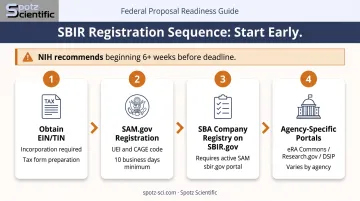
Agency-specific requirements (check your solicitation):
- NIH: eRA Commons registration (2+ weeks alone)
- NSF: Research.gov organization registration (up to one month)
- DoD: DSIP (Defense SBIR/STTR Innovation Portal), plus an active SBIR.gov control number
You need an EIN or other TIN to receive an award. Companies that have not yet incorporated must do so before they can obtain an EIN — confirm the full sequence of requirements directly with the relevant agency's grants or contracts officer.
Common SBIR Eligibility Mistakes to Avoid
Foreign Ownership and Research Location
Even well-intentioned structures can disqualify an applicant. A joint venture with a foreign partner typically fails because the foreign party cannot independently satisfy the U.S. ownership and control test. Phase I and Phase II R&D must be performed within the United States — agencies can approve work abroad only in rare circumstances.
Misunderstanding Affiliation
Many applicants calculate only their own headcount, forgetting that affiliated entities count toward the 500-employee cap. Co-founder overlap — one person with ownership stakes in two separate companies — frequently creates an affiliation issue that applicants never anticipated. Conduct a thorough affiliation analysis before submitting any proposal.
Timing Errors and Late Registration
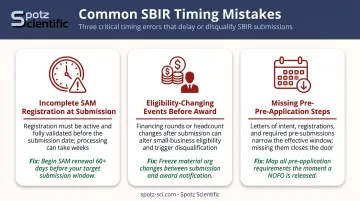
Three timing mistakes recur across agencies:
- Submitting a proposal before SAM.gov registration is complete and active
- Learning at the award stage that a financing round or new hire changed eligibility status
- Missing a pre-application step (such as a letter of intent) that narrows the submission window
Agency-specific requirements — particularly for DOE and NSF SBIR — reward early preparation. Small businesses targeting scientific computing opportunities can work with Spotz Scientific, whose founder spent eight years as a DOE program manager overseeing more than $264 million in research. That background helps applicants anticipate what reviewers look for before a proposal is ever submitted.
Frequently Asked Questions
Who is eligible for NASA SBIR?
NASA participates in both SBIR and STTR and applies the same SBA eligibility criteria: for-profit, U.S.-based, more than 50% U.S.-owned, and 500 employees or fewer including affiliates. Consult NASA's active solicitations on SBIR.gov for topic-specific requirements and deadlines.
Who is eligible for SBIR Phase III?
Phase III is not subject to small business size and eligibility requirements. It is open to the firm (or its successor-in-interest) that completed Phase I and II work, funded through non-SBIR sources, and agencies typically award it on a sole-source basis.
How long does it take to get an SBIR award?
Timelines vary significantly by agency and phase. Federal targets call for award notification within 90 days of solicitation close and award issuance within 180 days, though NIH and NSF have 15-month issuance targets. In practice, many agencies miss these benchmarks, so budget 6–12+ months from submission to funded award.
Can a nonprofit organization apply for SBIR funding?
No. Nonprofits cannot directly receive SBIR or STTR awards, though they may serve as minority investors or subcontractors. For STTR specifically, a qualifying nonprofit research institution must be a required subcontractor performing at least 30% of the R&D work.
Does my company need to be incorporated before applying for SBIR?
Most agencies allow proposal submission before formal incorporation, but the company must satisfy all small business concern eligibility requirements at the time of award, not at submission. Confirm this with the specific agency's grants or contracts officer before applying.