This guide cuts through that complexity. It covers DOE's major funding programs, how FOAs work in practice, what reviewers look for, and the most consequential mistakes to avoid before you submit.
Key Takeaways
- DOE's $8.25 billion Office of Science budget (FY2026) funds basic research — applied programs like EERE and ARPA-E have different mandates and need different proposal framing
- Concept papers are a strategic filtering step — not a formality
- Program manager alignment matters as much as peer reviewer scores
- Early Career awards are approximately $875,000 over five years for university researchers
- SAM.gov registration takes up to 10 business days — build that into your submission timeline
The DOE Funding Landscape: An Overview
DOE is one of the largest federal funders of scientific research in the United States. FY2026 enacted appropriations total $49.124 billion for the department overall, with the Office of Science alone receiving $8.25 billion — a figure that funds basic research across universities and national laboratories nationwide.
How DOE Structures Its Funding
The department's research funding flows through distinct offices, each with a different mandate:
- Office of Science — funds basic, curiosity-driven research at universities and national labs across six program offices, including the Advanced Scientific Computing Research (ASCR) program
- ARPA-E — funds high-risk, transformative energy technology research with aggressive technical targets and milestone-driven performance expectations
- Office of Energy Efficiency and Renewable Energy (EERE) — funds applied research and demonstrations in wind, solar, hydrogen, storage, and building efficiency
- Mission-specific offices — fund research tied to defense, nuclear, and other DOE mission areas
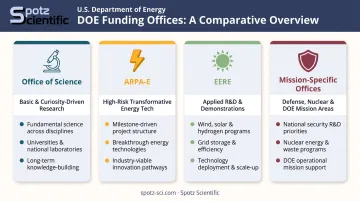
Matching your concept to the right office before drafting is essential. A proposal competitive under ASCR may be too exploratory for EERE, and a concept suited for ARPA-E needs transformative framing that many standard research proposals lack.
Who Can Apply
Eligibility varies by solicitation, but the FY2026 Office of Science annual NOFO reflects the general pattern:
| Applicant Type | Prime Award Status |
|---|---|
| U.S. universities | Eligible |
| Nonprofits | Eligible (with lobbying exclusions) |
| For-profit industry | Eligible for basic research proposals |
| DOE/NNSA national laboratories | Not eligible as primes under financial-assistance NOFOs |
| International entities | Permitted as subrecipients; prime eligibility requires additional justification |
Understanding DOE Award Instruments
DOE uses four distinct mechanisms, and choosing the right one matters:
- Grants — financial assistance for public-purpose research without substantial federal involvement in day-to-day work
- Cooperative agreements — financial assistance where DOE expects substantial involvement during performance (common for ARPA-E awards)
- Contracts — used when DOE is procuring specific deliverables for its own use
- SBIR/STTR awards — phased grant programs for eligible small businesses, with STTR requiring formal collaboration with a research institution
Major DOE Funding Programs for Scientific Researchers
Office of Science and ASCR
The Office of Science is the primary home for basic energy research at U.S. universities. Within it, the Advanced Scientific Computing Research (ASCR) program covers applied mathematics, high-performance computing, scientific machine learning, and data analysis.
Award sizes are solicitation-specific rather than uniform. The FY2026 annual NOFO, for example, caps one quantum error-detection topic at $600,000 across all institutions for two years — a topic-specific ceiling, not a program-wide benchmark. Researchers should check the individual NOFO for the topic that matches their work.
ARPA-E
ARPA-E funds research that aims to demonstrate substantial performance improvements over the current state of the art. The agency does not publish a universal percentage threshold — each focused solicitation defines its own aggressive technical targets and milestones.
ARPA-E proposals must argue for a step-change in capability, not incremental improvement, and that argument must be made against the specific targets in the controlling FOA. Cooperative agreements are the standard award mechanism, reflecting ARPA-E's active involvement in project oversight.
EERE
EERE FOAs cover wind, solar, hydrogen, building efficiency, and storage technologies — and most EERE projects require cost-share from non-federal sources. Under DOE statute, the baseline is at least 20% of total project cost for R&D and 50% for demonstration or commercial-application work, though specific NOFOs can modify these requirements. Before committing to an EERE application, confirm your institution can meet the cost-share obligation.
DOE Early Career Research Program
The Early Career Research Program is among the most consequential funding opportunities for junior researchers. The 2026 program terms are explicit:
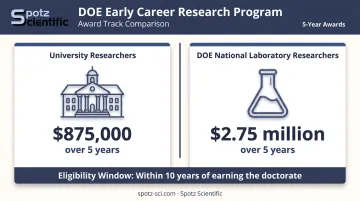
- University researchers: approximately $875,000 over five years
- DOE national laboratory researchers: approximately $2.75 million over five years
- Eligibility window: generally within 10 years of earning the doctorate, with extensions for documented career interruptions
In 2024, DOE selected 91 early-career scientists for $138 million — making the scale of the program significant, though no application denominator is published to derive a success rate.
SBIR/STTR
DOE's Small Business Innovation Research and Small Business Technology Transfer programs provide phased funding for eligible small businesses:
- Phase I: up to $200,000–$250,000 (depending on topic) for 6–12 months of feasibility work
- Phase II: up to $1.1M–$1.6M (depending on topic) for up to two years of development and demonstration
Opportunities are posted on the DOE SBIR/STTR funding page, with full applications submitted through Grants.gov.
How DOE Funding Opportunity Announcements (FOAs) Work
Reading the FOA — All of It
A FOA is not a summary document. It defines technical scope, evaluation criteria, cost-share obligations, eligibility restrictions, page limits, and attachment requirements. Program officers write FOAs to signal exactly what they want funded, and proposals that treat the FOA as background reading rather than a specification document pay for it in reviewer scores.
Merit review criteria for Office of Science proposals typically include:
- Scientific and technical merit
- Appropriateness and feasibility of the proposed approach
- Competence of personnel and adequacy of resources
- Reasonableness of the budget
- Data management adequacy
- Initial screening for relevance to mission and program priorities
That last item — relevance to program priorities — is applied before detailed review even begins. A proposal that doesn't clearly connect to the stated priorities can be returned without merit review.
The Concept Paper Stage
Many DOE FOAs require a concept paper (typically 2–5 pages) before a full application is invited. This is the most underestimated step in the process.
A weak concept paper rarely recovers. Program managers use this stage to filter for alignment with program priorities.
Researchers who treat the concept paper as a shorter version of their full proposal, rather than a targeted pitch to the FOA's specific technical questions, are often eliminated before a full proposal is ever reviewed.
Navigating the Submission Systems
| System | Purpose |
|---|---|
| science.osti.gov/grants/FOAs | Office of Science FOA listings |
| PAMS | Pre-applications, letters of intent, and review management |
| Grants.gov | Full application submission for most Office of Science FOAs |
| arpa-e-foa.energy.gov | ARPA-E concept papers, full applications, and Q&A |
| eere-exchange.energy.gov | EERE and related applied-energy opportunities |
SAM.gov registration is a prerequisite for all prime applicants — and activation can take up to 10 business days. Registration must also be renewed every 365 days. Do not treat this as a same-day task.
After Submission
Once your application is in, the process shifts to waiting — and the timeline is measured in months, not weeks. A few things to keep in mind during that period:
- Expect questions: Reviewers may route clarifying questions through the program office. Respond promptly.
- Watch for award notifications: These come through the program office, not automated systems.
- Avoid repeated follow-ups: Contacting the program office repeatedly signals impatience more than it advances your application.
What Program Managers Actually Look For
Program managers shape FOA priorities, help set technical targets in the solicitation, and carry real discretion in final funding decisions. A technically strong proposal that doesn't align with a program manager's current portfolio priorities is unlikely to be funded — regardless of how peer reviewers scored it.
Mirror the FOA's Language and Framing
Proposals that echo the vocabulary, technical framing, and stated priorities of the FOA itself score better. The goal is to demonstrate that you understand what the program is trying to accomplish and that your work advances it directly. Generic research descriptions that could apply to five different programs signal to reviewers that the researcher didn't engage seriously with the FOA.
Pre-Submission Engagement Matters
Before writing, experienced applicants:
- Attend DOE webinars on open FOAs (most programs host them)
- Submit clarifying questions through official channels before deadlines close
- Review the program's recent award portfolio to understand what's already been funded — and find the gaps
This preparation shapes proposal framing. Knowing what a program has already funded helps researchers position their work as complementary, not duplicative.
Where Spotz Scientific Fits
For researchers targeting DOE ASCR in particular, Spotz Scientific offers strategic FOA-level advisory and red team review for draft proposals. Dr. Bill Spotz spent eight years as a program manager at ASCR, co-leading the applied mathematics program and managing over $264 million in scientific computing research. He evaluated hundreds of proposals from the program manager's seat — which is exactly the perspective his advisory practice brings to your submission.
Reach out at info@spotz-sci.com to discuss how that experience applies to your proposal.
Common Mistakes to Avoid
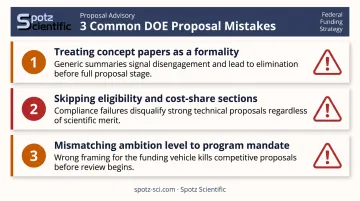
Three patterns eliminate otherwise competitive proposals before reviewers ever reach the science:
Treating the concept paper as a formality. For many programs, it's the most important document in the process. Submitting a generic research summary instead of directly answering the FOA's specific technical questions is the fastest path to elimination.
Skipping eligibility and cost-share sections. These are not boilerplate. Compliance problems disqualify strong proposals — for EERE submissions especially, confirm your institution can commit to cost-share before investing development time.
Mismatching ambition level to program mandate. Work that's too incremental for ARPA-E and too exploratory for EERE are both losing positions — not because the science is weak, but because the framing is wrong for the funding vehicle. Each office has a distinct bar: ARPA-E requires a transformative performance argument against specific technical targets; EERE requires a clear path to demonstrated application; Office of Science requires rigorous scientific merit with explicit connection to mission priorities.
Frequently Asked Questions
What is a DOE Funding Opportunity Announcement and where do I find open ones?
FOAs are official documents defining a program's technical scope, eligibility rules, evaluation criteria, and application requirements. Open opportunities are listed on the Office of Science funding page, the ARPA-E eXCHANGE, EERE Exchange, and Grants.gov.
Who is eligible to apply for Office of Science grants?
U.S. universities, nonprofits, and for-profit companies can apply as prime awardees under most Office of Science financial-assistance NOFOs. DOE and NNSA national laboratories are not eligible as primes under the standard financial-assistance mechanism; they apply through separate lab announcements.
What is the DOE Early Career Research Program and who should apply?
It funds five-year individual research programs for researchers generally within 10 years of their doctorate, at U.S. universities or DOE national laboratories across all Office of Science program areas including ASCR. University awards are approximately $875,000 over five years.
How do concept papers work in the DOE FOA process?
Many DOE FOAs require a 2–5 page concept paper before inviting full proposals. Program managers use these to filter for alignment with stated program priorities, so concept paper quality functions as a real gatekeeping step.
What are cost-share requirements and do all DOE grants require them?
Cost-share requires the applicant to contribute a percentage of total project cost from non-federal sources. The statutory baseline is 20% for R&D and 50% for demonstration work. Office of Science basic research grants generally don't require cost-share; EERE programs typically do.
How is ARPA-E different from other DOE funding programs?
ARPA-E targets high-risk, transformative technology breakthroughs with aggressive solicitation-specific technical targets and milestone-based performance requirements. The Office of Science focuses on peer-reviewed basic research. EERE funds applied development with cost-share obligations.