Budgets aren't one-size-fits-all. A DOE ASCR EXPRESS submission has different formatting rules than an NSF CISE proposal, and both differ sharply from NIH's modular approach. Cost categories, institutional rates, and agency-specific caps all shift depending on where you're submitting.
This article walks through building a sample research budget step-by-step: what to include, a realistic line-item example, and the mistakes that sink otherwise strong proposals.
Key Takeaways
- Align every direct and indirect cost with your funding opportunity's caps, format, and rules
- Personnel costs (salary, person-months, fringe) usually dominate your direct cost total
- F&A rates are institution-negotiated and must apply to the correct cost base
- Thin justifications and unrealistic estimates are the most common red flags for reviewers
- A second, experienced reviewer catches costly errors before submission, especially for first-time DOE or NSF applicants
How to Build a Sample Research Budget
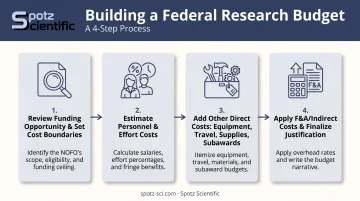
Step 1: Review the Funding Opportunity and Set Cost Boundaries
Before you type a single number, read the solicitation cover to cover for spending caps, unallowable cost types, and cost-share requirements. NSF's PAPPG 24-1 requires an annual, category-level budget plus a justification of up to five pages, not the modular shortcuts NIH allows.
DOE ASCR NOFOs can be even more specific. The Exploratory Research for Extreme-Scale Science solicitation sets a floor of $100,000 per year and ceilings of $250,000 (non-laboratory-led) or $500,000 (DOE-laboratory-led). Applications outside that range get declined without review: no negotiation, no exceptions.
Determine early whether your agency wants a detailed, itemized budget or a different format entirely. This decision drives how much line-item detail you'll need in every later step.
Step 2: Estimate Direct Costs for Personnel and Effort
Personnel almost always makes up the largest share of a research budget. List every person contributing effort (PI, co-PIs, postdocs, graduate students) along with their person-months and base salary, even for unfunded collaborators.
For each person, you'll need:
- Person-months of effort (calendar, academic, or summer)
- Current base salary
- Institution's approved fringe benefit rate
- Any agency-specific salary restrictions
NSF applies a two-month senior-personnel policy across all NSF-funded grants combined, so flag any effort that might trigger extra scrutiny. Federal cost principles under 2 CFR 200.430 require compensation to be reasonable and consistently applied, not capped at a specific dollar figure, contrary to some outdated guidance still floating around.
Step 3: Add Other Direct Costs (Equipment, Travel, Supplies, Subawards)
Once personnel is set, itemize everything else your project needs.
Equipment: Under the current federal definition, equipment is tangible property with a useful life over one year and a unit cost equal to or exceeding the lesser of your institution's capitalization level or $10,000. Below that, it's a supply — including most laptops and workstations.
Travel: Specify destination, traveler count, and dates, and tie each trip to a deliverable (a DOE/NSF PI meeting, a conference presentation, a field visit).
Consultants vs. subawards: These are not interchangeable line items. A consultant provides advisory work for a fixed fee with no F&A breakout. A subaward carries an independent scope of work, its own negotiated F&A rate, and requires a separate budget justification from the partner institution.
Step 4: Apply F&A/Indirect Costs and Finalize the Justification
Apply your institution's negotiated F&A rate to the correct base — usually Modified Total Direct Costs (MTDC). MTDC includes salaries, fringe, supplies, services, and travel, but excludes equipment, tuition remission, and any subaward amount above $50,000.
Finish with a line-by-line justification narrative. Every dollar you request should trace back to a specific research aim or method. Reviewers notice when it doesn't.
What to Include in a Research Budget
Personnel and Fringe Benefits
This line covers salary tied to person-months of effort, plus fringe benefits at your institution's current negotiated rate. There's no standard federal fringe percentage: it varies by employee class and institution, so pull the number from your sponsored programs office, not last year's proposal.
Equipment, Materials, and Supplies
Anything above the $10,000 (or lower institutional) threshold with a useful life over a year counts as equipment; list it individually with a description and cost. Itemize supplies (chemicals, computing hardware under threshold, software licenses) by category when the cost is significant.
Travel
Travel needs destination, traveler count, and dates, plus a clear link to a project deliverable. "Travel to present findings" is too vague; "travel for two researchers to the 2026 DOE ASCR PI Meeting" is not.
Consultants and Subawards
- Consultants: Advisory role, fixed fee, no independent F&A rate
- Subawards: Independent scope of work, own negotiated F&A rate, requires its own budget and justification
Mixing these up is a common reason budgets bounce back for revision.
Facilities & Administrative (Indirect) Costs
F&A recovers shared institutional costs, such as utilities, libraries, and administrative support, that aren't tied to one specific project. You calculate it by applying your negotiated F&A rate to the appropriate direct cost base, typically MTDC.
Sample Research Budget Example
Seeing these categories translated into an actual line-item table makes the process concrete. Below is a realistic one-year budget for a small scientific computing research project, similar in scale to university research office templates.
| Line Item | Description | Amount |
|---|---|---|
| PI Effort | 1.5 summer months + fringe | $19,800 |
| Graduate Student | 12 months stipend + fringe (tuition excluded) | $40,000 |
| Cloud/HPC Computing | Allocation for large-scale simulation runs | $15,000 |
| Travel | 2 travelers to DOE/NSF PI meeting, 3 days | $4,500 |
| Materials & Supplies | Software licenses, minor computing supplies | $3,700 |
| Subtotal (MTDC base) | $83,000 | |
| F&A (54% of MTDC) | Institution's negotiated rate | $44,820 |
| Total | $127,820 |
Every line still needs a short justification. Keep these standards in mind:
- Explain the specific simulation workload driving the Cloud/HPC Computing cost, not just "generic computing resources needed"
- Confirm the total fits inside the solicitation's stated ceiling before submission
- Benchmark against typical awards — NSF's computing-focused grants generally run $150,000-$250,000 annually, so this budget fits comfortably
Common Mistakes When Building a Research Budget
Reviewers see the same errors repeatedly, and each one raises doubts about the rest of your proposal.
- Skipping the solicitation's instructions and requesting cost categories or amounts the agency doesn't allow
- Misjudging personnel effort relative to the scope of work — either padding hours or underestimating what the project truly demands
- Writing thin justifications that list costs without explaining how they connect to research aims and methods
- Using outdated fringe or F&A rates instead of pulling the institution's current negotiated agreement
The effort-estimation problem deserves extra attention. If your budget shows a postdoc at 20% effort but your technical narrative describes work that needs full-time attention, reviewers notice the mismatch immediately. That inconsistency undermines confidence in the entire proposal, not just the budget page.
When to Get Expert Help Building Your Budget
DOE and NSF reviewers evaluate budgets for realism and alignment with the proposed aims. A technically excellent proposal can still lose points, or get flagged for revision, because the budget doesn't hold up under scrutiny.
Programs with added review layers, such as the DOE Early Career Research Program and NSF CAREER awards, often benefit from a second, expert set of eyes on both technical strategy and budget structure. These programs draw intense competition, and small budget inconsistencies get noticed more often at that level.
Spotz Scientific offers red-team review of draft proposals and budgets, along with strategic advice tied to specific Notices of Funding Opportunities. That guidance draws on Bill Spotz's eight years managing over $264 million in DOE scientific computing research as a program manager. He's reviewed budgets from the other side of the table, not just written them.

Frequently Asked Questions
What should a research budget include?
A research budget includes direct costs: personnel, equipment, travel, supplies, and subawards — plus applicable indirect/F&A costs. Every cost needs a written justification tied to the project's aims.
What's the difference between a modular and detailed budget?
Modular budgets request funds in set increments (like NIH's $25,000 modules) without full line-item detail. Detailed budgets, required by NSF and DOE, itemize every cost category individually.
How do I determine my institution's F&A rate?
Contact your institution's sponsored programs office for the current negotiated rate agreement with the cognizant federal agency. Rates change periodically, so always confirm you're using the active agreement.
Can I include cost-sharing in my research budget?
Only include cost-sharing when the funding opportunity specifically requires it. Voluntary committed sharing is discouraged and shouldn't be added without confirming your institution's policy first.
How detailed should a budget justification be?
Every significant cost line needs a short explanation connecting it to specific project activities and deliverables. Vague entries like "supplies as needed" invite reviewer pushback.
What happens if my proposed budget exceeds the funding cap?
Exceeding a stated cap can lead to automatic rejection or forced cuts before review even begins. Always check your numbers against the solicitation's limits before submission.