Introduction
The NSF Graduate Research Fellowship Program is one of the most competitive early-career funding opportunities in American science. For the 2026 cycle, NSF made 2,500 fellowship offers from nearly 14,000 applicants, each receiving a $37,000 annual stipend plus a $16,000 Cost of Education allowance across three funded years. That financial backing — combined with the fellowship's reputation — can define the trajectory of a scientific career.
The Graduate Research Plan Statement is where most strong applications fall apart. Two pages. No exceptions. Every figure, citation, and reference counts against that limit.
Most applicants struggle not with the science itself, but with translating strong research ideas into the structured, reviewer-ready format NSF expects. This guide covers what reviewers actually evaluate, how to structure your statement for maximum clarity, and the mistakes that consistently sink otherwise competitive proposals. The analysis draws on NSF's official solicitation criteria and direct experience managing federal research portfolios at the program level.
Key Takeaways
- NSF GRFP funds the person, not the project — your scientific potential matters more than your specific idea
- Reviewers are broad-field scientists, not subfield specialists — clarity and comprehension matter more than technical depth
- Both Intellectual Merit and Broader Impacts require explicit, labeled sections in the Research Plan
- Each aim should stand independently; interdependent aims create structural risk if one falls short
- Getting outside feedback before submission can catch fatal problems while revision is still possible
What NSF Reviewers Actually Look For
The Foundational Principle: You Are the Product
GRFP funds the individual, not the project. Reviewers are asking whether you have the scientific instincts, discipline, and potential to become a productive STEM researcher — not whether your proposed experiment will succeed. This distinction shapes everything about how you should write.
NSF evaluates every application against five official criteria from the current solicitation (NSF 25-547):
- Potential to advance knowledge within or across fields, and to benefit society
- Creativity and originality — whether the work explores transformative concepts
- Sound, well-reasoned plan with a mechanism for assessing success
- Individual qualifications to conduct the proposed activities
- Adequate resources available at the home institution or through collaborations
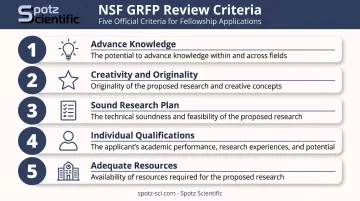
Most applicants write as if only criteria 1 and 2 exist. Criteria 3, 4, and 5 are equally weighted — and they're where technically strong proposals often fail.
Who Is Reading Your Proposal
NSF assigns applications based on a broad Major Field (such as Biology or Physics) and a designated subfield. But as MIT's Communication Lab and NSF's own guidance make clear, panelists may not share your narrow specialty. Your reviewer could be a biochemist reading a computational neuroscience proposal, or a materials scientist evaluating an atmospheric modeling project.
Design your proposal around that reality. Write for the thoughtful generalist in your broad discipline who has read 25 other proposals today and needs to understand yours quickly.
What "Demonstrated Potential" Looks Like
From a reviewer's perspective, demonstrated potential means showing that you:
- Understand the scientific problem at a fundamental level
- Have thought through your experimental logic, not just your research question
- Anticipate where things might go wrong — and have a plan
- Can connect your specific work to a larger scientific or societal context
Citing papers is not enough. What reviewers want to see is how you think — your ability to move from a gap in the literature to a reasoned experimental approach, not just proof that you've read widely.
How to Structure Your Graduate Research Plan Statement
Two pages forces hard choices. A clear structure — introduction, aims, broader impacts — gives fatigued reviewers a map so they can follow your logic rather than reconstruct it. Every sentence needs to earn its place.
The Introduction (~½ to 1 page)
Open with the broad scientific context: why does this area of research matter? Then narrow toward the specific gap your proposal addresses. Close with a clear, direct statement of your hypothesis or central objective.
This funnel structure (wide → focused) earns reader buy-in before you make specific claims. It also creates the right moment to establish novelty explicitly. Don't assume reviewers will infer that your project is original — state directly what has not been done and why that gap matters scientifically.
Research Aims (~1 page)
Design 2–3 aims, each testing a distinct component of your central hypothesis. The cardinal rule: aims should be as independent as possible. If Aim 2 cannot proceed until Aim 1 succeeds, you've created a single point of failure — reviewers will notice, and they'll penalize it.
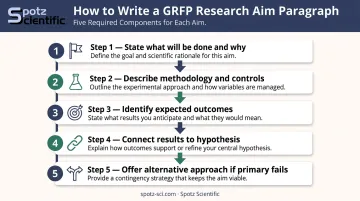
Each aim paragraph should accomplish five things:
- State what will be done and why
- Describe the methodology and controls
- Identify the expected outcomes
- Explain how results — including unexpected ones — connect back to the hypothesis
- Offer an alternative approach if the primary method fails
One figure is recommended. Not two, not zero — one well-chosen diagram that orients reviewers to the overall research framework. Given the two-page constraint, one figure is the practical ceiling — any more crowds out the text your aims require. Figures count against your page limit, so choose the visual that does the most work.
Broader Impacts (~1 paragraph)
Close with a concise Broader Impacts paragraph. Per NSF's solicitation, this section must have its own explicitly labeled header — burying broader impacts in running text is a formatting error that reviewers will flag.
Connect your research to at least one of NSF's eight recognized Broader Impacts outcome areas — STEM education, public engagement, workforce development, and national economic competitiveness among them. Use NSF's own language and criteria; reviewers apply the official framework, not your interpretation of it.
Writing for a Non-Specialist Panel
Technical depth is not your friend here. The goal is for every panel member to understand your proposal — not to impress the one specialist who happens to share your subfield.
Practical rules for non-specialist clarity:
- Define every acronym on first use, without exception
- Avoid field-specific jargon — if you'd only encounter the term at a specialized conference, explain it
- Write in active voice — passive academic prose makes reviewers work harder than they should, and short paragraphs keep them moving forward
- Signpost your logic explicitly — phrases like "The goal of this aim is to…" help readers follow your argument without losing the thread
Your proposal should not read like a journal article. Heavy citation, elaborate methodological appendices, and dense passive prose all cost you clarity — the one thing reviewers outside your subfield need most. Demonstrate your reasoning; don't just document your reading list.
Addressing Intellectual Merit and Broader Impacts
Required Structure: Labeled Sections Are Mandatory
NSF is explicit on this point: the Graduate Research Plan Statement must contain separately labeled sections for Intellectual Merit and Broader Impacts, with headers set apart by a line break. This is not optional. Applications that omit these headers or embed these discussions in continuous prose have a concrete formatting deficiency that reviewers are required to flag.
Formatting compliance is the baseline. Once that's in place, the real challenge is writing each section well — particularly Broader Impacts, which applicants consistently underestimate.
Getting Broader Impacts Right
Broader Impacts in NSF's framework is not about the scientific implications of your research. It encompasses:
- Contributions to STEM diversity and inclusion
- Public engagement with science
- Educational outreach and workforce development
- U.S. economic competitiveness
- Partnerships between academia and industry
The proposals that score highest on this criterion don't treat Broader Impacts as an afterthought. They build it into the proposal from the start — connecting personal background, existing outreach activities, and research goals into a coherent story about how the applicant's work and presence in science create value beyond the lab.
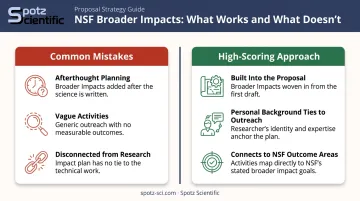
Reviewers can tell immediately when Broader Impacts was written last. Treat it as a core section, not a closing formality — and draft it with the same specificity you bring to your research design.
Common Mistakes That Sink Otherwise Strong Proposals
Over-Specialization
Writing at subfield depth is one of the most consistent ways to lose reviewers. Test for this before submission: ask a friend in a different subfield to read your proposal and tell you where they lost the thread. If they can't explain your hypothesis back to you in plain terms, the proposal needs revision.
Interdependent Aims
If your proposal structure requires Aim 1 to succeed before Aim 2 can begin, you've created a liability. Reviewers recognize this fragility and treat it as a sign of insufficient planning. Each aim should contribute independent scientific value — even if the others fail.
Neglecting the Person
Two pages spent entirely on the research and none of it on the applicant misses the program's core criterion. Briefly name key mentors, institutional resources, or collaborative access that position you to actually complete this work. NSF is funding you — give them reason to believe you're equipped.
Skipping the Outside Review
Getting a structured critical review from someone outside your immediate research group before submission is one of the highest-return investments an applicant can make. The problems described above are invisible from inside the document — they become obvious to a knowledgeable external reader in minutes.
The most useful external reviewer is someone who knows how federal program managers evaluate proposals — not just how to write them. Spotz Scientific offers red team reviews grounded in that perspective. Dr. Bill Spotz spent eight years as a DOE program manager overseeing more than $264 million in research, which means he knows precisely where proposals lose reviewers and why. GRFP applicants can reach out to info@spotz-sci.com to discuss whether this type of review fits their needs.
Frequently Asked Questions
How long is the NSF GRFP Graduate Research Plan Statement?
The Graduate Research Plan Statement has a strict two-page limit. All references, citations, figures, charts, and images count toward that limit — there is no separate page allowance for references.
Does my GRFP research proposal commit me to a specific project?
No. NSF funds the individual, not the project. During the first fellowship year, you must remain in the Major Field and degree program named in the application, but you are not bound to pursue the exact research described. After year one, you may request field or program changes with appropriate approval.
What should I include in the Broader Impacts section of my research proposal?
Draw from NSF's official Broader Impacts guidance, which recognizes eight outcome areas including STEM education, public engagement, workforce development, and U.S. economic competitiveness. Use NSF's framework directly, and tie each activity you describe to one of its recognized outcome areas.
Should I include figures in my NSF GRFP research proposal?
One well-chosen figure is recommended — something that orients reviewers to your research design or overarching model. Keep it to one; figures count against your two-page limit and additional figures rarely add proportional value.
How technical should the NSF GRFP research proposal be?
Write for a scientist in your broad field who is not in your specific subfield. Include enough technical detail to demonstrate scientific rigor, but avoid jargon or methodological specificity that would only be meaningful to a specialist in your exact niche.
When should I start writing my NSF GRFP research proposal?
Start early — brainstorm topics over the summer, have draft aims ready by early October, and build in time for at least one round of mentor review before the deadline (FY2026 deadlines ran November 10–14, depending on field). Read the current solicitation before you begin writing.