Here's the reality: many unfunded proposals contain genuinely strong science. What separates funded from unfunded submissions is often strategic preparation, explicit alignment with reviewer criteria, and avoiding execution errors that are entirely within the applicant's control.
This guide covers what to do before you write, how to structure a winning proposal, what reviewers actually evaluate, and how to strengthen your submission before it goes out the door.
Key Takeaways
- Align your proposal explicitly to the NOFO's language and the agency's programmatic priorities, not just your own research interests.
- Contact the program officer before submitting — this is standard practice for DOE ASCR and NSF CISE submissions.
- Write directly to the review criteria — reviewers will not infer your alignment.
- Vague aims, compliance failures, and undercosted budgets are preventable reasons proposals fail.
- A red team review before submission is one of the highest-leverage steps you can take.
Before You Write: Research the Opportunity and Your Audience
Submitting to the wrong opportunity — or the right one without understanding its specific scope — is one of the most common ways strong science fails to get funded. Preparation before you write is as important as the writing itself.
Read the NOFO in Full (Every Page)
Every Notice of Funding Opportunity contains specific language about research priorities, eligibility, scope, and review criteria. Funded applicants align their proposals explicitly to this language. Generic proposals that happen to be scientifically sound don't make the cut.
Pay attention to whether the opportunity requires a pre-application, letter of intent, or neither. Requirements vary significantly:
| Opportunity | Pre-Application | Full Narrative Limit |
|---|---|---|
| ASCR EXPRESS 2025 (DE-FOA-0003545) | Required, 2 pages | 10 pages |
| FY 2025 SC Open Call (DE-FOA-0003432) | Optional, 3 pages | 25 pages |
| NSF Future CoRe (NSF 25-543) | None required | Standard PAPPG (15 pages) |
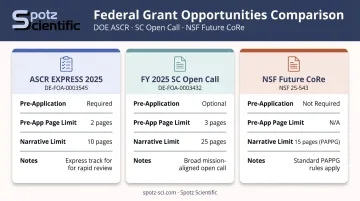
The pre-proposal stage isn't a formality — for DOE programs especially, it's a high-stakes filtering step that shapes your full proposal strategy.
Understand What the Agency Is Actually Funding
Agencies like DOE ASCR and NSF CISE operate from multi-year strategic plans with active, evolving portfolios. Knowing what they've funded recently tells you far more than any single NOFO can.
Current priority areas by agency:
- DOE ASCR: Applied mathematics, AI and scientific machine learning, quantum information science, advanced computing technology
- NSF CISE: AI, cybersecurity, quantum computing, next-generation communications
Reach out to the program officer before you submit. For DOE Office of Science programs, this is actively encouraged. A brief email gauging fit can reveal unstated priorities that won't appear anywhere in the NOFO. NSF similarly advises early contact to discuss fit. Neither agency will edit proposals or preview funding decisions, but the conversation is often worth more than another pass through the solicitation.
How to Write a Winning Scientific Grant Proposal
Strong proposals share a recognizable logic: each section builds credibly on the last. Reviewers read quickly and form impressions early — so structure, discipline, and clarity matter from the first page. Formatting requirements vary by agency, but the five steps below apply broadly.
Step 1: Write Focused, Testable Objectives
The objectives section (called "Specific Aims" in NIH terminology, but DOE uses objectives and NSF uses the Project Description) is the most important page you'll write. Reviewers often form strong initial impressions before they finish it.
Your objectives must be:
- Specific and independently meaningful
- Grounded in a clear hypothesis or central research question
- Logically connected to each other — not a list of loosely related ideas
Vague or overambitious aims are among the most frequently cited reasons for poor review scores. Scope discipline signals experience; overambitious aims signal that the team hasn't pressure-tested its plan.
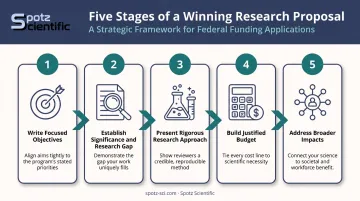
Step 2: Establish Significance and Frame the Research Gap
Reviewers need to understand not just what you propose, but why it matters now. This section should establish a clear gap in current knowledge or capability, then connect that gap directly to the agency's mission.
For DOE ASCR, that means tying your work to advancing computational and networking capabilities for scientific modeling, simulation, and analysis. For NSF CISE, it means addressing the Intellectual Merit criterion — the potential to advance knowledge within the field.
Ground this section in evidence:
- Relevant literature that defines the gap
- Prior approaches that fell short and why
- Preliminary data from your own work that validates the direction
Step 3: Present a Rigorous and Feasible Research Approach
The approach section must convince reviewers that your methodology is sound, your design will produce meaningful results, and your team can actually execute within the project period and budget. Feasibility is as important as ambition.
Structure this section to include:
- Detailed methods with justification for why they're the right choice
- How you'll mitigate likely obstacles (reviewers respect honesty about risks)
- A clear project timeline that makes execution credible
Prioritize depth on your core methods over comprehensive coverage of peripheral ones. Reviewers need to trust your approach — not audit it.
Step 4: Build a Justified, Accurate Budget
Every budget line item should trace directly to a specific activity in the research plan. Both DOE and NSF operate under 2 CFR Part 200 cost principles, which require that costs be necessary, reasonable, allocable, and adequately documented.
Two common mistakes undermine otherwise strong budgets: undercosting signals inexperience and contradicts your feasibility argument, while overcosting raises stewardship concerns that can tank reviewer confidence.
DOE applies 2 CFR Part 200 through 2 CFR Part 910. NSF adds agency-specific rules in the PAPPG. Know which rules apply to your submission before you build the budget.
Step 5: Address Broader Impacts and Sustainability
NSF treats Broader Impacts as a formal, scored review criterion — the potential for the work to benefit society and contribute to desired societal outcomes. DOE doesn't label it the same way, but reviewers consider mission relevance and program alignment just as carefully.
Beyond immediate impact, address sustainability:
- How will results be disseminated?
- What happens to data and code after the grant ends?
- How might this work generate follow-on research or future funding?
A proposal that answers these questions signals maturity — and gives reviewers reason to believe the work will outlast the grant period.
What Reviewers Are Really Evaluating
Peer review panels score proposals against defined criteria. Applicants who write explicitly to those criteria outperform those who leave reviewers to infer alignment on their own.
| Agency | Core Review Criteria |
|---|---|
| DOE Office of Science | Scientific/technical merit; appropriateness of approach; competency of personnel and resources; budget reasonableness; mission relevance; NOFO-specific criteria |
| NSF | Intellectual Merit; Broader Impacts (considered through five standard PAPPG elements) |
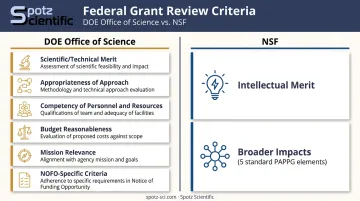
DOE uses mail review, panel review, site visits, or reverse site visits depending on the program. NSF uses ad hoc expert review, panels, or a combination.
Know Your Reviewer Profile
Review panels typically include deep specialists in your subfield and generalists in the broader discipline. Your proposal has to satisfy both. That means avoiding unexplained jargon while still demonstrating genuine technical depth — and most proposals fail on one side or the other.
Early Career Programs Weight the Applicant
Both DOE and NSF early career programs explicitly evaluate the applicant, not just the research:
- DOE Early Career: Review criteria include Potential for Leadership Within the Scientific Community, assessing creative vision and the proposed work's contribution to the PI's standing in the field.
- NSF CAREER: Career potential and research-education integration are core requirements — reviewers expect an integrated research and education plan alongside the scientific narrative.
If you're applying to either program, your positioning within the field deserves as much attention as the research plan itself.
Common Mistakes That Sink Scientific Grant Proposals
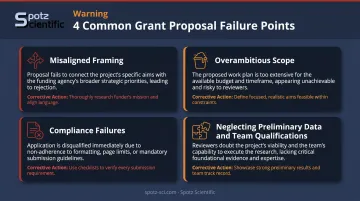
Even technically strong proposals fail when execution breaks down. These are the mistakes that most commonly eliminate otherwise competitive submissions:
- Misaligned framing: Proposals that read as internally motivated research agendas rather than responses to the specific opportunity. If your proposal doesn't mirror the agency's language and programmatic priorities, reviewers infer poor fit — regardless of the science.
- Overambitious scope: Proposing more work than can reasonably be accomplished within the project period and budget is a feasibility red flag, not an ambition signal.
- Compliance failures: Page limit violations, non-compliant fonts or margins, missing required sections, or late submission can trigger rejection before scientific review begins. NSF may return proposals without review for format or timing violations; DOE submissions through Grants.gov must pass validation before the deadline.
- Neglecting preliminary data and team qualifications: For competitive programs, reviewers expect evidence that the applicant is positioned to succeed. Prior publications, relevant experience, letters of collaboration, and pilot results all de-risk the proposal from a reviewer's perspective.
How to Strengthen Your Proposal Before You Submit
The revision stage is where strong proposals become winning ones.
After completing a draft, set it aside. Return with fresh eyes and ask:
- Is the narrative clear to a non-specialist reviewer?
- Does each section explicitly address the stated review criteria?
- Is the budget fully justified and internally consistent?
Get external feedback from colleagues inside and outside your subfield. People unfamiliar with your niche will surface jargon, logic gaps, and unclear framing that you can no longer see after months of writing. This mirrors the actual panel composition — the same mix of specialists and generalists who will evaluate your submission.
A formal red team review takes this a step further: independent reviewers evaluate your draft against the actual review criteria as if they were the funding panel. Because it replicates the real evaluation process, it surfaces weaknesses that standard peer feedback rarely catches.
This is a core service at Spotz Scientific. Dr. Bill Spotz brings eight years of DOE ASCR program management experience and oversight of more than $264M in scientific computing research to every review. Having sat on the program management side of hundreds of proposal evaluations, he spots the gaps that colleagues inside your field tend to overlook. Standard rate is $200–$250/hour; expedited reviews (materials submitted less than two weeks before the deadline) are $250–$300/hour. Reach out at info@spotz-sci.com.
Frequently Asked Questions
How long should a scientific grant proposal be?
Length is dictated by the specific NOFO — there is no universal limit. Recent ASCR examples range from 10-page narratives (EXPRESS 2025) to 25-page narratives (FY 2025 Open Call). The standard NSF Project Description is 15 pages. Exceeding stated limits will disqualify your submission.
What is the difference between a pre-proposal and a full proposal?
Many DOE programs require a pre-proposal as an initial screening step — only invited applicants proceed to a full submission. The pre-proposal is its own high-stakes document and should not be treated as a formality. It often sets the framing expectations for the full proposal.
How important is it to contact a program officer before submitting?
For DOE Office of Science programs, it's strongly recommended — a brief outreach helps you gauge fit, clarify scope, and occasionally surface unpublished priorities. NSF similarly encourages early contact to confirm program fit, though neither agency will preview funding decisions.
What makes DOE Early Career or NSF CAREER proposals different from standard grants?
Both programs are designed for early-stage investigators and weight long-term potential heavily. The narrative must balance a strong scientific plan with a compelling argument for why this specific researcher is positioned to lead a productive career in the area. Reviewers are evaluating the person as much as the project.
How should I handle a rejected grant proposal?
Read the reviewer summary statements carefully to understand where your proposal fell short, then address every critique substantively before resubmitting. NSF requires substantial revision for declined proposals — contact the program officer to confirm whether resubmission is appropriate and what timing the program allows.
Do I need preliminary data to submit a competitive federal grant proposal?
Preliminary data is rarely a hard requirement, but it strengthens feasibility arguments considerably. For competitive programs like DOE ASCR core funding, reviewers typically expect some evidence the approach is viable. If data is limited, adjacent publications and team qualifications can help compensate.