Introduction
Competing for NSF SBIR funding is not simply a matter of describing good science. NSF's America's Seed Fund program uses a two-gate structure — a mandatory Project Pitch followed by a full proposal — and evaluates every submission against three distinct criteria: Intellectual Merit, Broader Impacts, and Commercial Impact. Miss any one of them, and an otherwise strong application can fail.
This guide is written for startup founders, scientific computing teams, university spinouts, and early-stage research companies navigating that process.
NSF SBIR stands apart from other agency programs in three ways:
- It's open-topic — you propose your own innovation, rather than responding to a defined research area
- It funds high-risk deep tech that other programs won't touch
- It requires demonstrable commercial potential alongside scientific rigor
This guide walks through the full preparation process step by step — from confirming eligibility through building a proposal that scores well across all three review criteria. Where specific numbers or deadlines appear, verify them against the current NSF 26-510 solicitation before submitting.
Key Takeaways
- NSF SBIR provides non-dilutive funding up to $305,000 (Phase I) and $1,250,000 (Phase II) — no equity given up
- A mandatory Project Pitch must receive an official NSF invitation before any full proposal is accepted
- NSF limits applicants to two pitches per 12-month period — each submission is a strategic decision
- All three review criteria — Intellectual Merit, Broader Impacts, and Commercial Impact — must be addressed with specificity
- NSF preparation guidance spans both the PDF solicitation and the America's Seed Fund website — consult both
What Is the NSF SBIR Proposal Process?
NSF SBIR is a multi-stage federal funding program designed to turn early-stage technical research into commercially viable products. Unlike most agency SBIR programs that respond to specific government topics, NSF is open-topic — applicants propose their own innovations across nearly all technical areas and market sectors. That openness means reviewers bring no preexisting context — you must justify both the technical approach and the commercial opportunity from scratch.
Funding Structure at a Glance
| Phase | Funding Ceiling | Project Period | Purpose |
|---|---|---|---|
| Phase I | $305,000 | 6–18 months | Establish technical feasibility |
| Phase II | $1,250,000 | Typically 24 months | Advance commercialization |
| Fast-Track | $1,555,555 total | Phase I (6–12 mo) + Phase II (18–24 mo) | Combined submission for mature teams |
All ceilings are inclusive of direct costs, indirect costs, fee, TABA, and any optional I-Corps allocation. Verify current amounts at the NSF America's Seed Fund website before publishing any budget assumptions in your proposal.
NSF takes zero equity. Awardees retain full ownership of their company and intellectual property, which is not the case with most private financing arrangements.
How the NSF SBIR Proposal Process Works
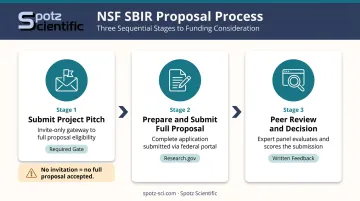
The process has three sequential stages. Skipping or rushing Stage 1 blocks Stage 2 entirely.
- Submit a Project Pitch and receive an NSF invitation
- Prepare and submit a full proposal through Research.gov within valid submission windows
- Undergo peer review and receive written feedback regardless of outcome
Step 1: Submit the NSF Project Pitch
The Project Pitch is not a preview or optional pre-screen. It is a required gate. Without an official NSF invitation, Research.gov will not accept a full proposal.
Pitches are submitted through the NSF Seed Fund website, and NSF typically responds within 1–2 months. However, be aware of two hard limits in the current solicitation:
- Maximum two pitches per 12-month period
- Maximum three submissions for the same project or technology
With a two-pitch annual cap, a poorly positioned submission doesn't just fail — it consumes one of your two attempts for the year.
The four pitch elements and current character limits:
| Element | Character Limit |
|---|---|
| Technology Innovation | 3,500 |
| Technical Objectives and Challenges | 3,500 |
| Market Opportunity | 1,750 |
| Company and Team | 1,750 |
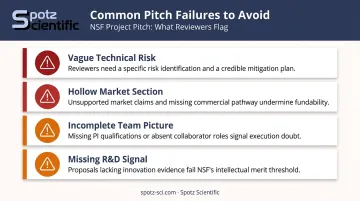
All four must be addressed concisely. The most common pitch failures:
- Vague technical risk — describing a build project or product feature, not genuine R&D with unresolved scientific questions
- Hollow market section — citing a large industry (e.g., "the $500B healthcare market") with no named buyer or customer pathway
- Incomplete team picture — ignoring gaps in execution roles or business development capacity
- Missing the R&D signal — a pitch that reads like a product roadmap, not a research plan
NSF must see genuine scientific uncertainty. If the answer is already known, the work isn't fundable.
Step 2: Prepare and Submit the Full Proposal
A Phase I invitation is valid for the next two full-proposal deadlines after the invitation date. An expired invitation means restarting the Pitch process. Fast-Track proposals must be submitted within four months of the invitation.
All proposals are due at 5:00 p.m. local time through Research.gov. There is no grace period — Research.gov stops accepting submissions at 5:00 p.m. and late applicants must wait for the next deadline. Submit at least 48 hours early.
Meeting the deadline is only part of the compliance challenge. NSF's preparation guidance is split between the PDF solicitation (currently NSF 26-510) and the live America's Seed Fund website. The Critical Information page can be updated mid-cycle, so a one-time PDF review is not sufficient — check the online guidance regularly throughout your preparation window.
Step 3: Peer Review and Decision
Submitted proposals are reviewed by panels of 3–10 outside technical and commercialization experts, each scoring independently against the three NSF criteria. All applicants receive written feedback, win or lose.
If declined, NSF requires a new Project Pitch invitation before resubmission. That requirement is deliberate: NSF expects you to revisit and revise your core framing, not simply resubmit the same approach.
Key Components of a Winning NSF SBIR Proposal
Project Summary (1 Page Maximum)
The Project Summary must be written in the third person and contain three labeled sections, each on its own line:
- Overview
- Intellectual Merit
- Broader Impacts
The Intellectual Merit section must open with the exact phrase: "This Small Business Innovation Research (or Small Business Technology Transfer) Phase I project…"
Missing or malformed headers can trigger administrative return without review. Get the format right. One page, correct headers, exact opening phrase — no exceptions.
Project Description (10–15 Pages for Phase I)
This is the core of the proposal. It must cover:
- The technical innovation and what makes it genuinely new
- R&D objectives with a measurable work plan
- Specific milestones with numerical success criteria (not vague intent statements)
- A commercialization strategy
- The competitive landscape with honest comparisons
Milestones must be quantifiable. "We will optimize the system" tells reviewers nothing. "We will achieve X% reduction in computational error at Y resolution with a target threshold of Z" gives them something to evaluate.
Allocate at least 3–4 pages to commercial impact. Reviewers notice when commercialization is an afterthought crammed into the final page.
Commercialization Plan
This is where most proposals underperform. A strong commercialization section:
- Names specific customer segments — not just broad industry categories
- Describes realistic revenue pathways with a Phase III funding path beyond NSF
- Identifies key competitors with honest comparisons (not just "our solution is better")
- Includes Letters of Support from potential customers or partners
Current Phase I requirements call for at least 1 letter, maximum 3. Phase II requires 3–5 letters. These are no longer optional; verify exact requirements in the current NSF solicitation. A letter from a named potential customer carries far more weight than a generic endorsement.
Budget Requirements
| Category | Notes |
|---|---|
| Personnel | PI must be ≥51% employed by small business at award |
| Materials & Supplies | Standard direct cost |
| Travel | Allowable direct cost |
| Subawards/Consultants | Allowable; STTR requires a research-institution subaward |
| Indirect Costs | Included within total ceiling |
| Fee | Included within total ceiling |
| TABA | Up to $6,500 within Phase I ceiling |
| I-Corps | $25,000 optional allocation within Phase I ceiling |
The Budget Justification has a five-page limit (confirm in current Research.gov instructions; the 2026 consolidated solicitation should be treated as authoritative). Every line item must be justified clearly; vague justifications draw reviewer scrutiny.
Senior/Key Personnel Documentation
All PI and Senior/Key Personnel must use SciENcv to generate:
- Biographical Sketches
- Current and Pending (Other) Support
The Synergistic Activities document is a separate one-page PDF listing up to five examples per person, and it is not generated by SciENcv.
The PI employment requirement is absolute: at least 51% employed by the small business at the time of award and throughout the award period. This is a hard eligibility rule, not a soft guideline.
What NSF Reviewers Actually Look For
The Three Criteria, Plainly Stated
- Intellectual Merit: Does the proposed R&D advance knowledge? Is the technical approach scientifically sound? Is genuine risk present?
- Broader Impacts: Does the project benefit society, education, or the broader scientific community beyond the direct commercial application?
- Commercial Impact: Is there a credible, specific path from this R&D to a real product with paying customers?
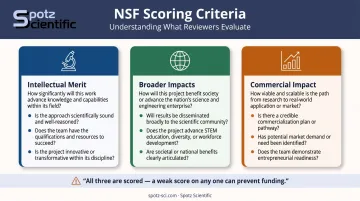
All three are scored. A weak score on any single criterion can prevent funding even when the other two are strong.
What Reviewers Are Actually Reading For
Reviewers score each proposal independently against the criteria — not against competitors in the pool. The goal is to score high on every criterion, not simply to be better than the average submission.
Specificity is the primary marker of a credible proposal. Reviewers flag vague language as a signal of weak preparation:
❌ "We will optimize the system"
✅ "We will reduce computational latency below 50ms at 10x current throughput under conditions X and Y"
❌ "We are targeting the healthcare market"
✅ "We have identified three hospital systems in the Southwest currently paying $X per test for the incumbent solution"
Preliminary data isn't formally required for Phase I, but it helps. Computational models, bench-level results, or adapted published methods all strengthen the Intellectual Merit score by showing the approach is plausible before full validation.
Front-load the innovation. State what is technically new and why it hasn't been solved before in the first paragraph. Proposals that build to the key insight on page eight risk losing the reviewer's interest before they get there. Your first paragraph signals whether the rest is worth close attention — make the technical contribution unmistakable from the start.
Common NSF SBIR Proposal Mistakes to Avoid
Content Mistakes That Cause Low Scores
- Failing to identify the genuine technical novelty. Reviewers cannot fund an innovation they cannot find. If what's new isn't explicit in the first two paragraphs, assume it's buried.
- A commercialization plan built on market statistics. Citing industry market size numbers without naming a single buyer or describing a real customer pathway tells reviewers the team hasn't done commercial discovery.
- Ignoring technical risks. Every genuinely novel technical approach carries risk. Proposals that don't acknowledge this — and present contingency plans — read as either naive or evasive.
Administrative Mistakes That Cause Return Without Review
NSF identifies these as triggers for return without review:
- No valid Project Pitch invitation on file
- Project Description requiring major content revisions to be compliant
- Noncompliance with page limits or budget ceilings
- Failure to meet statutory eligibility requirements
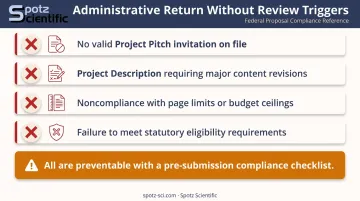
Missing Project Summary headers or the required Intellectual Merit opening phrase falls into the compliance category. These are mechanical errors, all preventable with a careful pre-submission checklist.
The Guidance Monitoring Problem
A persistent mistake among first-time applicants: treating the PDF solicitation as the complete instruction set and never returning to it. NSF has moved substantial guidance to the America's Seed Fund website, and the Critical Information page can change mid-cycle. Teams that verify requirements only at the start of preparation risk submitting against outdated rules.
For first-time federal applicants, a structured red team review can surface gaps in technical clarity, commercialization logic, and compliance while revisions are still possible. Spotz Scientific offers this kind of expert pre-submission critique, with standard rates applying to engagements that begin at least two weeks before the deadline.
Frequently Asked Questions
What is the difference between NSF SBIR and NSF STTR?
SBIR requires at least two-thirds of Phase I research to be performed by the small business, with the PI employed at least 51% by the company. STTR requires a formal research-institution partner performing at least 30% of the work, with a co-PI from that institution, but the PI must still be employed primarily by the small business under current NSF rules.
What happens if my NSF Project Pitch is not accepted?
NSF provides feedback when a pitch does not result in an invitation. You can revise and submit a new pitch, subject to the two-per-year limit and three-submissions-per-project cap. An invitation is not a funding commitment — it only opens the gate to submit a full proposal.
How long does the full NSF SBIR Phase I process take from pitch to award decision?
NSF typically responds to pitches within 1–2 months. After a full proposal is submitted, peer review runs 1–3 months, due diligence takes 3–5 months, and final notification typically arrives 5–7 months after the proposal deadline. Verify current timelines at the NSF America's Seed Fund website.
What are the most important things to include in the NSF SBIR Project Description?
Reviewers expect a specific, measurable technical work plan with quantified success criteria, a commercialization strategy naming real customer targets, and explicit coverage of all three NSF review criteria, all within the 15-page limit. The two most consistent weaknesses: milestones without numerical thresholds and market sections without named buyers.
Can a company submit an NSF SBIR proposal without commercialization experience?
NSF does not require prior commercialization history, but does require a credible forward-looking strategy. Companies without business development experience should take three steps before submitting: conduct I-Corps-style customer discovery, engage experienced advisors, and secure letters of support from potential users or partners.
Is preliminary data required for an NSF SBIR Phase I proposal?
Preliminary data is not formally required, but it strengthens the Intellectual Merit score by demonstrating the approach is plausible. Even computational models, bench-level results, or adapted published methods can serve this purpose if framed around the specific Phase I research question.