Here's the thing: many proposals that fall short aren't scientifically weak. They're strategically misaligned. The science is solid, but the proposal fails to connect with what the program office is actually building, what the NOFO is actually asking for, or what non-specialist reviewers can actually follow.
This article walks through a practical strategy for federal scientific grant proposals — from identifying the right opportunity to conducting a red team review to coming back stronger after rejection.
Key Takeaways
- Start with program fit, not writing — submitting to the wrong office wastes months of effort
- Treat the NOFO as a scoring rubric — every section of your proposal should map directly to its stated priorities
- Non-specialist reviewers score your proposal too — clarity is not optional
- Red team review is the single most underused high-impact step before submission
- Rejection is normal; strategic resubmission with targeted revisions is how funded researchers operate
How to Develop a Winning Grant Proposal Strategy
Step 1: Define Your Research Vision and Identify the Right Funding Opportunity
Before you open a single NOFO, write one paragraph that captures your research question, your approach, and your expected outcomes. This paragraph is your filter. Vague research questions produce vague proposals, and vague proposals rarely survive competitive review.
Once you have that paragraph, use it to match your work to the right agency and program office. For scientific computing, the distinction matters enormously:
| Program | Scope | Best Fit For |
|---|---|---|
| DOE ASCR Applied Mathematics | Mathematical foundations of HPC, scientific ML, data analysis | Numerical methods, algorithms, multiphysics |
| DOE ASCR Computer Science | Extreme-scale computing, networking, data at scale | HPC software, systems, AI for scientific computing |
| NSF CCF | Theory, algorithms, software and hardware foundations | Foundational computing research |
| NSF CNS | Systems, networks, security, distributed infrastructure | Systems-level and network research |
| NSF IIS | AI, data, human-centered computing | Intelligent systems, data science |
| NSF OAC | Research cyberinfrastructure and services | Scientific software, data infrastructure |
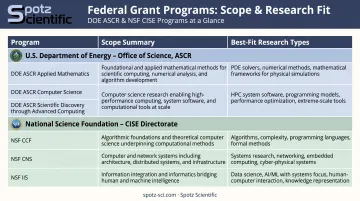
Submitting an applied mathematics proposal to IIS — or a systems proposal to OAC — is a common and costly mistake. The same computing idea faces a 15% funding rate at IIS versus 33% at OAC depending on how it's framed. Program fit is a strategic decision, not an administrative one.
Step 2: Analyze the Notice of Funding Opportunity (NOFO) in Depth
A NOFO is not background reading. It's your scoring rubric.
Every NOFO contains the program priorities, eligibility requirements, and merit review criteria that reviewers will apply to your proposal. For NSF proposals, that means two National Science Board-approved criteria: Intellectual Merit and Broader Impacts.
For DOE Office of Science proposals, review criteria are listed in descending order of importance — scientific/technical merit, approach, personnel and resources, budget reasonableness, and program-specific requirements.
Read the NOFO as a compliance matrix. Map every section of your proposal against:
- The program's stated strategic goals
- The review criteria and their relative weight
- Any mandatory elements (data management plans, collaboration requirements, page limits)
Proposals that reflect the NOFO's own language — not just its topics — score better. Explicit alignment is visible to reviewers, and it shows. For example, ASCR's LAB 26-3601 announcement explicitly targets "single-faceted, computer-science-driven thrusts" integrating embodied robotics with advanced computing. A proposal that echoes that framing signals program fit immediately.
If you're unsure whether your work fits the current portfolio, contact the program manager directly before submitting. Most program managers at DOE and NSF will respond to brief pre-submission inquiries.
Step 3: Build the Right Team and Establish Collaborations Early
For larger federal grants, reviewers treat team composition as core evidence of feasibility. They assess whether the combination of expertise, institutional resources, and collaborators makes the proposed work credible.
What strong team assembly looks like:
- Each co-investigator fills a specific capability gap the PI cannot cover alone
- Letters of collaboration document access, role, and schedule — not just support
- Institutional resources (compute infrastructure, datasets, facilities) are named and tied to specific research tasks
DOE ASCR makes this explicit. LAB 26-3601 requires that each proposed testbed thrust include at least one external collaborator from outside the DOE laboratory complex. A weak collaboration letter says "we support this project." A strong one explains why that collaborator is necessary to achieve a specific deliverable.
Assemble your team and letters early — not as submission afterthoughts. Strong partnerships can differentiate proposals in competitive panels where scientific merit scores are close.
Step 4: Draft a Compelling Scientific Narrative
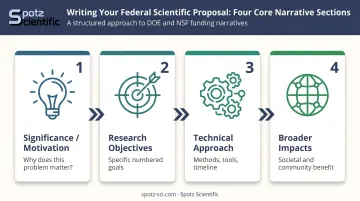
Most federal scientific proposals share a common structure, though the exact format should always follow the specific NOFO:
- Significance/Motivation — Why does this problem matter now? What gap exists in current knowledge or capability?
- Research Objectives — Specific, numbered goals that can be scored against the review criteria
- Technical Approach — Methods, tools, expected results, and a realistic timeline
- Broader Impacts (NSF) — How does the work benefit society? For CISE proposals, this means getting specific: reproducible software, workforce development, trustworthy AI, accessible infrastructure
Write for the non-specialist reviewer. Review panels at DOE and NSF include scientists from adjacent subfields who are not experts in your exact area. A proposal that requires deep subject-matter expertise to follow will lose scores from reviewers who can't assess what they can't understand.
Practical strategies:
- Use diagrams, workflow figures, and timelines to communicate your approach visually
- Keep technical jargon to the minimum needed for precision
- Number your objectives so reviewers can score them directly
- Keep paragraphs short; use section headers to make the proposal easy to scan
For computational science proposals, the strongest Broader Impacts sections connect directly to the research itself — open-source software releases, training workshops, reproducible benchmarks, or improved infrastructure for the broader scientific community.
Step 5: Develop a Realistic and Justified Budget
Budgets are scrutinized for two things: reasonableness and direct alignment with the proposed work. Under 2 CFR Part 200, every cost must be necessary, reasonable, allocable, and documented in detail.
Know your program's budget parameters before you build:
- DOE ASCR LAB 26-3601: $3M–$5M per year over 3 years (2–3 awards expected)
- DOE Early Career Research Program (2026): $875,000 over 5 years for higher education institutions; $2.75M for DOE labs and user facilities
- NSF CAREER: Minimum $400,000 over 5 years for CISE proposals
Every budget line item should have a direct scientific justification tied to a specific research task. "Postdoc salary" is not a justification. "Postdoc salary to develop and validate the parallel solver described in Objective 2" is.
Common budget red flags:
- Vague personnel descriptions with no connection to specific tasks
- Equipment purchases without explaining why existing resources are insufficient
- Indirect cost rates that don't match institutional negotiated rates
- Cost-sharing where it isn't permitted or expected
Step 6: Conduct a Red Team Review Before Submission
A red team review puts your draft in front of knowledgeable colleagues who evaluate it using the same criteria a review panel would apply.
The most effective red teams include at least one person with proposal review or program management experience. They bring something most subject-matter experts can't: familiarity with how reviewers actually score proposals, what language triggers concern, and which gaps in feasibility or alignment will cost points.
This is exactly the service Spotz Scientific provides. Bill Spotz spent eight years as a DOE program manager, reading and scoring hundreds of proposals from the other side of the table. His red team review service evaluates draft proposals and pre-proposals against the specific NOFO criteria — drawing on direct experience with DOE ASCR's applied mathematics and computer science programs, where he managed over $264 million in scientific computing research. The same insider perspective applies to NSF CISE proposals, where he advises on early-career programs including NSF CAREER.
Red team review is one of the most underused steps in the process. Most researchers submit the proposal they wrote — not the one a reviewer would fund.
What You Need Before You Start Writing
Preparation determines proposal quality. Researchers who begin writing before doing the strategic groundwork often produce technically strong proposals that still miss the mark with reviewers.
Institutional Requirements and Systems Access
Federal submission systems require registration that can take weeks. Confirm the following before your deadline:
- Grants.gov registration (required for most federal submissions)
- DOE's PAMS (Portfolio Analysis and Management System) for DOE Office of Science submissions
- NSF Research.gov for NSF proposals
- Your institution's Sponsored Research Office approval process and internal deadlines
These systems routinely derail strong proposals when addressed at the last minute. Build in at least four to six weeks for institutional clearance and system setup.
Research Readiness and Preliminary Results
Federal agencies — particularly for larger grants — expect evidence that the proposed work is technically feasible. What that looks like depends on where you are in your career:
- Established teams: Prior publications and preliminary data are the standard expectation
- New investigators: Proof-of-concept evidence demonstrating the core approach is credible, even without full-scale results
Check whether your target program explicitly requires preliminary results. Early-career programs like DOE ECRP and NSF CAREER place more weight on the PI's research trajectory and vision, but even there, some proof-of-concept evidence strengthens the feasibility argument.
Key Factors That Determine Whether Your Proposal Gets Funded
Alignment with Program Priorities
Program managers at DOE ASCR and NSF CISE are building research portfolios — not just funding individual projects. A proposal that clearly advances the program's current strategic direction is more fundable than a technically excellent proposal that doesn't fit what the office is trying to build right now.
Use public databases to understand what's already funded:
- NSF Award Search — searchable database of NSF-funded projects since 1989
- USASpending.gov — federal spending data including DOE grants by agency, program, and recipient
Search for recently funded awards in your target program and read the abstracts. The language, scope, and methodology of funded projects tells you more about what a program manager will fund than the NOFO alone.
Scientific Merit and Innovation
In federal review, scientific merit means the novelty of the research question, the soundness of the technical approach, and the expected contribution to the field. Reviewers assess both whether the work is important and whether the proposed method is the right one.
Funding rates vary more than the headline number suggests:
| NSF CISE Division | FY 2024 Funding Rate |
|---|---|
| Overall CISE | 22% |
| IIS (Information & Intelligent Systems) | 15% |
| OAC (Office of Advanced Cyberinfrastructure) | 33% |
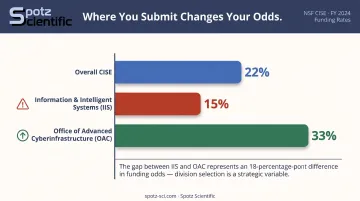
The same technical contribution can be positioned for different divisions depending on which one's priorities it best addresses. How you frame the work is a strategic decision, not just a writing choice.
Feasibility and Team Qualifications
Reviewers ask whether the proposed work is achievable within the proposed timeframe and budget. Overpromising scope is one of the most common reasons technically strong proposals receive low feasibility scores — it signals poor planning judgment, not ambition.
For early-career programs, the PI's own trajectory carries extra weight. The proposal must demonstrate not just a good project, but that the PI is on a path to become a field leader. This is the dimension Spotz Scientific focuses on for DOE Early Career and NSF CAREER applicants: building the research vision and PI narrative that reviewers are actually looking for in these programs.
Clarity and Accessibility
A review panel may include scientists from adjacent subfields who can't follow dense technical jargon. Those reviewers still score your proposal. A technically perfect proposal that's hard to follow loses points from the non-specialists who make up most panels.
Use structured formatting to make scoring easy:
- Numbered objectives that map to review criteria
- Short paragraphs with clear section headers
- Labeled figures with informative captions
- Explicit statements linking your work to the NOFO's stated goals
Common Mistakes in Federal Scientific Grant Proposals
Even strong science can lose funding to avoidable errors. These four mistakes show up repeatedly in unsuccessful proposals:
Wrong program fit. Even within a single agency, different program offices have distinct priorities and portfolios. A misfiled proposal rarely survives triage — DOE's merit review system screens for mission relevance before formal review even begins.
Overloaded scope. Proposals that promise too much, especially from smaller teams, signal poor planning to reviewers. The goal is a well-scoped project that can demonstrably succeed within the period of performance, not the most ambitious vision.
Writing only for specialists. Most researchers write for the expert in their exact subfield. Most review panels aren't. Non-specialist reviewers will score your proposal regardless of whether they can follow every technical detail.
Vague budget justification. A thin budget narrative signals the researcher hasn't thought the project through. Every cost should tie directly to a named research activity, not just a general category.
When to Resubmit — and How to Come Back Stronger
Rejection is a normal part of the federal grant cycle. Even strong proposals score below the funding threshold in competitive cycles. NSF policy permits resubmission, but only after substantial revision. Recycling a declined proposal without meaningful changes wastes a submission slot.
The right resubmission approach:
- Use the summary statement as your revision roadmap. Every substantive reviewer concern is a specific target — work through them systematically.
- Resolve reviewer concerns, don't work around them. If a reviewer flagged feasibility, revise the scope or add supporting evidence. If they questioned team qualifications, strengthen the personnel section.
- Document your revisions for the reader. Where allowed, use the cover letter or introduction to show exactly how the proposal changed in response to each concern.
- Reassess program fit before resubmitting. If multiple reviewers questioned relevance, that's likely a targeting problem — not just a writing problem.
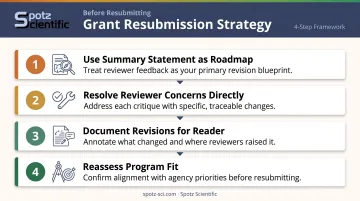
One of the harder resubmission skills is distinguishing reviewer comments that reflect individual preferences from those that identify genuine proposal weaknesses. A former program manager reads those comments differently than a researcher does — recognizing which concerns carry real weight in the funding decision.
Spotz Scientific advises researchers on resubmission strategy, bringing Bill Spotz's eight years of DOE program management experience directly to that analysis.
Frequently Asked Questions
How should a grant proposal be structured?
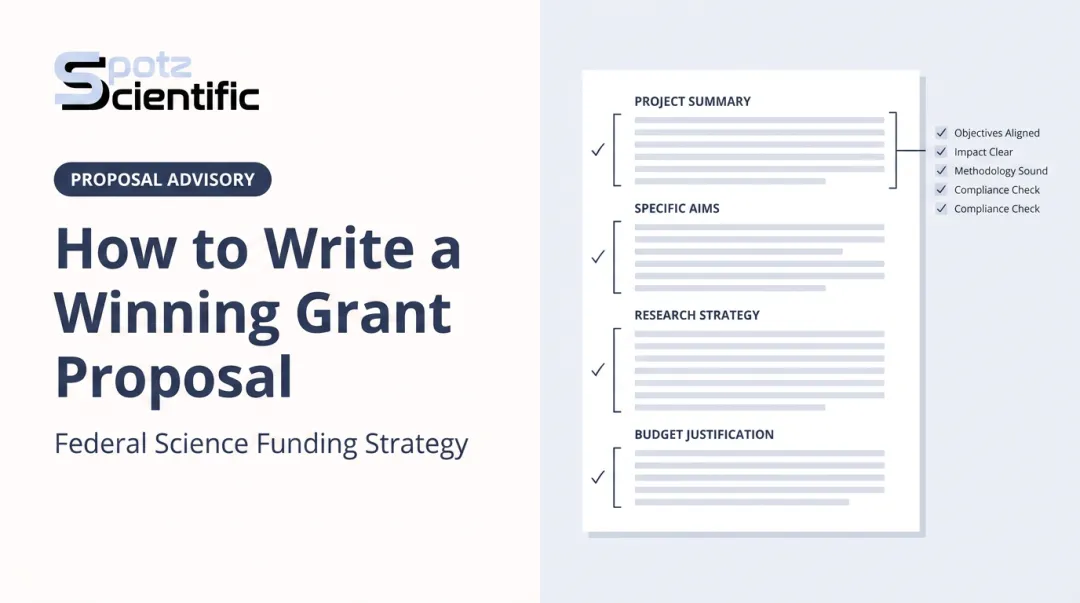
Most federal scientific proposals include an abstract, significance/motivation section, numbered research objectives, technical approach, team qualifications, and budget justification. Always follow the specific NOFO instructions — the required structure varies by agency, program, and solicitation type.
What are the most effective strategies for writing successful grant proposals?
Analyze the NOFO before you write a single word, map every section to the program's stated priorities, write for both specialist and non-specialist reviewers, and conduct a red team review before submission. Reviewers evaluate fit first — a technically strong proposal that misses the program's priorities rarely succeeds.
What are the 5 R's of grant writing?
For federal scientific proposals: Research the fit, Read the NOFO, Recruit the team, Refine the narrative and budget, and Revise for resubmission. Each stage builds directly on the last, so early steps aren't optional.
How do you align a scientific proposal with DOE or NSF program priorities?
Read the NOFO carefully for priority language and review criteria. Search recently funded awards in your target program using NSF Award Search or USASpending.gov. Contact the program manager before submission to confirm your work fits the current portfolio.
What should you do if your federal grant proposal is rejected?
Review the summary statement carefully and treat each reviewer concern as a specific revision target. Resubmit in the next cycle with clear documentation — in the cover letter or introduction — of how the proposal has been strengthened in response to feedback. Reviewers notice when revisions are superficial; address every substantive concern directly.