The Trump administration's FY2027 budget request proposes cutting NSF's total budget by 54.7%, dropping it from $8.75 billion to roughly $3.96 billion. Even the more moderate House Republican counter-proposal — a 20% cut to $7 billion — would represent a meaningful setback for the research community.
This post answers the questions that matter most: How deep are the proposed cuts? Which directorates are hardest hit? What will Congress likely do? And what should researchers do right now?
Key Takeaways
- The Trump administration proposes cutting NSF from $8.75B to $3.96B — a 54.7% reduction.
- NSF's research grant funding rate could drop from 18% to 7%, reducing funded awards from ~5,800 to ~2,100 per year.
- CISE, MPS, GEO, and STEM Education face cuts of 58–67%; the SBE directorate would be eliminated entirely.
- House Republicans propose a 20% cut to $7 billion, a far less drastic alternative.
- A final budget resolution is unlikely before 2027, though the October 1, 2026 deadline applies.
The Trump Administration's FY2027 NSF Budget Proposal: By the Numbers
The Top-Line Figures
According to the NSF FY2027 Budget Request to Congress, the administration proposes:
- NSF total budget: $8.750B (FY2026) → $3.963B (FY2027), a 54.7% cut
- Research and Related Activities (R&RA): $7.177B → $3.409B, a 52.5% cut — directly reducing the number of research grants NSF can fund
- STEM Education (EDU) directorate: proposed at $427.68M, down 64.3% from the restated FY2025 figure of $1.197B; the administration again proposes folding EDU into R&RA, which Congress rejected last year
This is not a one-time adjustment. The FY2026 request followed the same pattern — signaling a sustained policy direction that researchers and institutions should plan around.
The Human Impact
NSF's own budget documents project stark consequences for the scientific workforce:
| Measure | FY2025 | FY2027 Request |
|---|---|---|
| Research grant awards | 5,800 | 2,100 |
| Research grant funding rate | 18% | 7% |
| Total people supported | 305,400 | 94,100 |
| Graduate students | 40,200 | 13,000 |
| Postdoctoral associates | 4,500 | 1,000 |
| Undergraduate students | 30,700 | 8,300 |
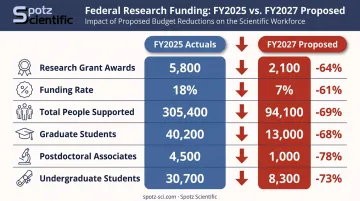
That means over 211,000 fewer people would receive NSF support under the proposed budget. These numbers reflect cuts felt across every career stage — from graduate students losing stipends to postdocs losing lab positions.
The SBE Elimination
The proposed SBE (Social, Behavioral, and Economic Sciences) Directorate would go from $150 million to zero. The impact extends well beyond social science. Fields that depend on SBE-funded foundations include:
- Cybersecurity (human factors and behavioral threat modeling)
- Human-computer interaction research
- AI ethics and fairness frameworks
- Cognitive science and decision-making research
The CISE community would feel these cuts indirectly, losing research infrastructure it relies on. Separately, the FY2026 joint explanatory statement requires 15-day advance notice before any reprogramming that eliminates a program, project, or activity. The administration's current approach appears to test the boundaries of that constraint — a development worth tracking for any institution with active NSF funding.
Which NSF Directorates Are Hit Hardest
The cuts are not distributed evenly. Using NSF's restated FY2025 figures for comparability:
| Directorate | FY2025 | FY2027 Request | Cut |
|---|---|---|---|
| CISE | $932.72M | $346.27M | -62.9% |
| MPS | $1,548.25M | $515.28M | -66.7% |
| GEO | $1,020.61M | $426.32M | -58.2% |
| EDU | $1,197.00M | $427.68M | -64.3% |
| SBE | $150.00M | $0 | -100% |
CISE: A Fundamental Shift for Academic Computer Science
CISE is the primary funder of academic computer science research. A 62.9% reduction — from $933M to $346M — reshapes what's fundable across the full spectrum of computational research. Fields directly affected include:
- Algorithms and combinatorics
- Data infrastructure and cyberinfrastructure
- Parallel and high-performance computing
- Human-computer interaction
- Networking and distributed systems
Researchers in these areas will face a fundamentally different funding environment starting in FY2027.
AI and Quantum: A Real Paradox
The administration lists AI as a national priority, yet NSF-wide AI funding is still proposed to fall from $965M to $655M (a 32% reduction). Quantum information science (QIS) would drop from $365M to $231M. The budget mentions preserving the National AI Research Resource (NAIRR) and transitioning it beyond the pilot phase, but no dedicated dollar amount is specified for it.
MPS: Two-Thirds Gone
MPS, which funds physics, mathematics, materials science, and chemistry research, faces a 66.7% cut — the steepest of any surviving directorate. For researchers in computational mathematics and physics, this compounds the CISE reduction.
The House Republicans' Counter-Proposal: A Middle Ground?
The House Appropriations Committee approved its FY2027 Commerce, Justice, Science bill 32-28 on May 13, 2026, proposing a markedly different set of numbers:
| NSF Account | FY2026 Enacted | House FY2027 | Change |
|---|---|---|---|
| NSF total | $8.750B | $7.000B | -20.0% |
| R&RA | $7.177B | $6.440B | -10.3% |
| MREFC | $251.00M | $172.95M | -31.1% |
A 20% cut is painful — but it's a fundamentally different problem than a 55% cut. Most programs survive at that level; competition intensifies, but the funding structure doesn't collapse.
Science advocacy organizations aren't satisfied with any version of a cut. The Coalition for National Science Funding is calling for at least $9.9 billion — enough to restore NSF to FY2023 levels.
Their core argument is competitive: China's R&D spending reached 96% of U.S. GERD in 2023, per OECD data. Ceding more ground now makes the gap harder to close later.
The House bill does include one substantive protection worth noting. Section 542 requires NSF to apply indirect cost rates consistent with FY2024 levels, blocking any attempt to reduce those rates. This provision — carried over from last year's bill — offers real budget stability for research institutions managing overhead costs.
What This Means for Researchers and Institutions
The Competition Math Gets Brutal
Under the administration's proposal, funded research grants drop from ~5,800 to ~2,100 per year. That's a funding rate of 7% — meaning 93 out of every 100 submitted proposals would be rejected. Even under the House version, the rate would decline significantly from today's 18%.
At 7%, strong proposals from productive researchers with established track records will go unfunded — not because the science is weak, but because the math leaves no room.
Early-Career Researchers Face Disproportionate Risk
The proposed cuts hit career-development programs especially hard:
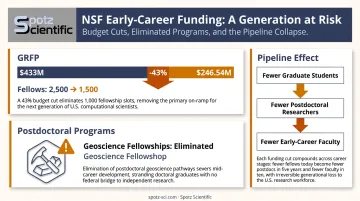
- GRFP: Budget drops from $433M to $246.54M — a 43% cut, with NSF projecting 1,500 new fellows in FY2027 versus 2,500 announced for 2026-2027
- Postdoctoral programs: NSF has already eliminated geoscience postdoctoral fellowship funding in FY2026 operational decisions; the FY2027 request provides limited visibility into which named postdoctoral programs survive
- The pipeline damage compounds: fewer graduate students, fewer postdocs, and fewer early-career faculty awards create generational gaps in the scientific workforce
The Scientific Computing Community Specifically
Researchers in computational methods, algorithm development, climate modeling, and high-performance computing are facing simultaneous cuts from multiple directions:
- CISE down 63%
- MPS down 67%
- SBE eliminated entirely, cutting indirect support for computationally intensive social and behavioral research
Many currently viable NSF research directions will have no available funding path — not reduced support, but no path at all.
The Congressional Budget Timeline and What Comes Next
Congress has until October 1, 2026 to pass FY2027 appropriations. Based on historical patterns — CRS data shows at least one continuing resolution was enacted in all but three of the 49 fiscal years from FY1977 through FY2025 — an on-time resolution is unlikely. Reporting from The Hill in May 2026 indicates a CR is widely expected before the midterm election, with Democrats likely to push for an extension into January 2027.
The precedent from FY2026 is encouraging: Congress funded NSF at the full $8.75B, explicitly rejecting the administration's proposed cuts. The Senate Appropriations Committee described that package as rejecting a 57% NSF cut.
Past outcomes don't guarantee future ones. The political environment introduces real uncertainty on several fronts:
- Midterm election pressures shifting budget priorities
- Ongoing budget reconciliation negotiations
- A narrower House margin reducing room for consensus
Researchers and institutions should treat FY2027 as its own funding cycle — build contingency timelines and identify which funding lines face the most exposure if a CR extends deep into FY2027.
What Researchers Should Do Right Now
Diversify Your Funding Targets
Researchers who have relied primarily on NSF should actively explore DOE Office of Science programs. For scientific computing specifically, DOE ASCR is the most natural alternative. ASCR's FY2027 request is $1.104B — down just $11.9M from FY2026 — making it meaningfully more stable than NSF in the current environment.
ASCR funds research in applied mathematics, HPC, scientific machine learning, quantum information science, and advanced computing infrastructure — areas with substantial overlap with CISE and MPS priorities. The DOE ASCR funding opportunities page and the DOE Office of Science Early Career Research Program are the most relevant entry points.
One critical caveat: each agency has a distinct funding culture, review criteria, and proposal expectations. A strong NSF CISE proposal and a competitive DOE ASCR proposal are not the same document — and submitting one where the other is expected is one of the most common reasons reviewers pass.
Prioritize Proposal Quality Above All Else
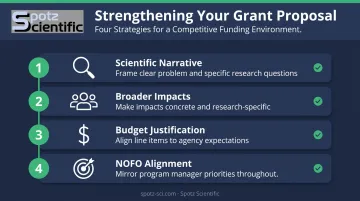
At a 7% funding rate, there is essentially no margin for a proposal that's merely good. Every element needs to be as strong as possible:
- Frame the scientific narrative around a clear problem and specific research questions — reviewers spot vague framing immediately
- Make broader impacts concrete and tied to the research itself, not a generic paragraph appended at the end
- Justify the budget precisely, with line items that match what the agency expects to fund
- Align every section to the NOFO — if the program manager wouldn't recognize their priorities in your proposal, revise it
This is the moment to get expert eyes on draft proposals before submission. Working with someone who has sat on the other side of the table — a former program manager who has actually made funding decisions — provides feedback peer review can't replicate.
Bill Spotz of Spotz Scientific spent eight years as a program manager at DOE ASCR, where he co-led the applied mathematics program and managed over $264 million in scientific computing research. His red team review service is specifically designed for draft proposals and pre-proposals submitted to DOE ASCR and NSF CISE — identifying weaknesses the way a review panel would, before submission. He also advises researchers on strategic approaches to specific NOFOs and offers seminars on proposal practices for DOE and NSF CAREER programs.
Consulting is available at $200–$250/hour (standard rate) or $250–$300/hour for materials submitted within two weeks of a deadline. Contact: info@spotz-sci.com.
Engage in Science Advocacy
Individual voices matter in appropriations decisions, particularly where both Republican and Democratic appropriators have expressed support for science funding in committee. Organizations actively coordinating advocacy efforts include:
- APS (American Physical Society)
- AAU (Association of American Universities)
- CRA (Computing Research Association)
- CNSF (Coalition for National Science Funding)
Contacting your Congressional representatives directly — especially those on the Appropriations Committee — can influence appropriations outcomes during the markup and negotiation phases.
Frequently Asked Questions
How much is NSF's budget being cut in the FY2027 proposal?
The Trump administration proposes cutting NSF from $8.75B to $3.96B — a 54.7% reduction. The House Republican counter-proposal cuts it to $7B, a 20% reduction. Neither has been enacted; Congress has until October 1, 2026 to finalize appropriations.
Which NSF directorates face the largest cuts under the FY2027 proposal?
MPS faces the steepest cut at 66.7%, followed by EDU at 64.3%, CISE at 62.9%, and GEO at 58.2%. SBE is proposed for complete elimination. All figures compare restated FY2025 levels to the FY2027 request.
Will Congress actually approve these NSF budget cuts?
Congress rejected comparable cuts in FY2026, funding NSF at the full $8.75B. The FY2027 process is expected to be prolonged, with a continuing resolution likely and final legislation unlikely before late 2026 or into 2027. The outcome remains genuinely uncertain.
How will proposed NSF cuts affect graduate students and early-career researchers?
The GRFP budget would fall 43%, with NSF projecting 1,500 new fellows versus the 2,500 announced for 2026-2027. Total graduate student support would drop from ~40,200 to ~13,000. Postdoctoral programs face additional operational cuts already underway in FY2026.
What happens to NSF grant funding rates if the proposed cuts go through?
The research grant funding rate would fall from 18% in FY2025 to 7% under the administration's proposal — meaning funded awards drop from ~5,800 to ~2,100 per year. Most proposals, including competitive ones, would not be funded.
Are there alternative federal funding sources for scientific computing researchers if NSF cuts are severe?
DOE ASCR is the most relevant alternative, with a relatively stable budget near $1.1B and research priorities that overlap closely with NSF CISE and MPS. ASCR's review criteria and funding culture differ meaningfully from NSF's, so understanding those distinctions is essential for a competitive application.