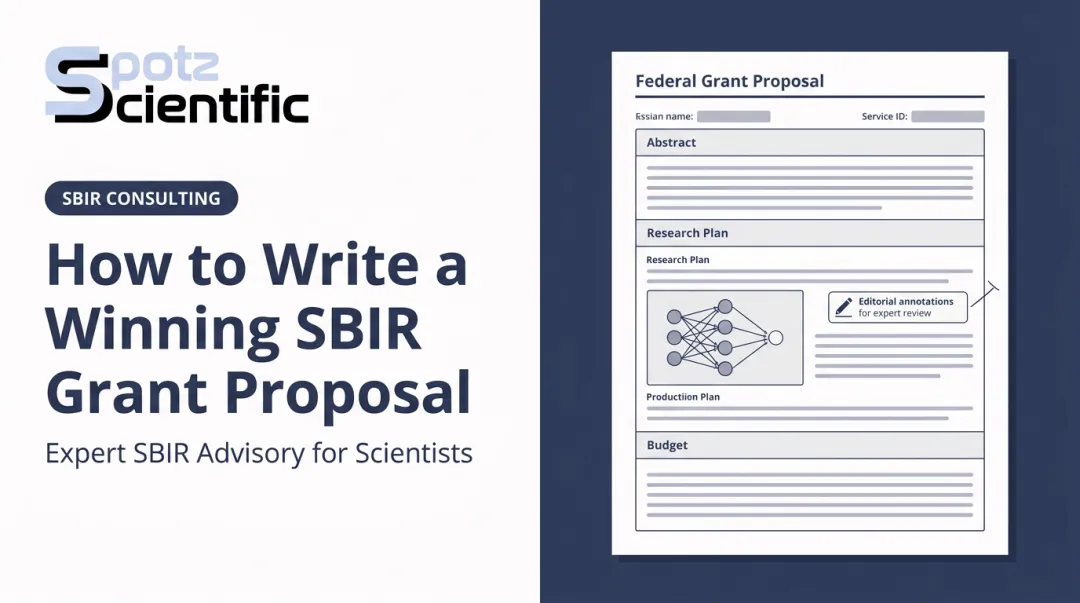
But the funding is competitive. In FY2022, the overall SBIR Phase I selection rate was just 16%, and NIH's 2025 Phase I rate dropped to 8%. The proposal itself is where most applications are won or lost.
This guide walks through how the SBIR proposal process works, what every competitive proposal must contain, what reviewers actually evaluate, and which mistakes eliminate otherwise strong candidates.
Key Takeaways
- SBIR proposals must address four core criteria: technical innovation, feasibility, commercial potential, and team qualifications.
- Registration requirements — including SAM.gov — can take 4–6 weeks; start before writing anything.
- DOE, NSF, and NIH each have distinct section formats, review criteria, and submission portals — tailor every proposal to the specific agency.
- Measurable milestones, honest risk acknowledgment, and a credible commercialization path are non-negotiable.
- Most rejections stem from avoidable mistakes: misread solicitations, missing sections, and failure to explicitly address reviewer criteria.
What Is an SBIR Proposal?
An SBIR proposal is a formal application from a U.S.-based small business requesting federal funding to conduct R&D on an innovative concept with clear commercialization potential. It's distinct from a basic research grant — the program explicitly requires a path to market, not just scientific output.
11 federal agencies participate in the SBIR program, including DOE, NSF, NIH, NASA, and USDA. Each issues its own solicitations — called Funding Opportunity Announcements (FOAs) or Notices of Funding Opportunity (NOFOs) — with different topic areas, formats, and evaluation criteria.
The Three Grant Pathways
| Phase | Purpose | Typical Award | Duration |
|---|---|---|---|
| Phase I | Feasibility and proof of concept | Up to $323,090 (SBA guideline) | 6–18 months |
| Phase II | Full R&D and commercialization prep | Up to $2,153,927 (SBA guideline) | 1–3 years |
| Fast Track / Direct-to-Phase II | Simultaneous or skipped Phase I | Varies by agency | Varies |
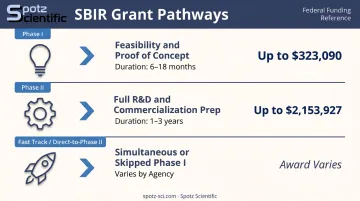
First-time applicants should start with Phase I. Phase II applications are typically only available to Phase I awardees, unless applying through a Direct-to-Phase II pathway. Understanding which phase fits your project is the first step before opening the solicitation.
How the SBIR Proposal Process Works
The process follows the same sequence across agencies: eligibility confirmation → system registration → solicitation review → pre-submission steps → proposal drafting → submission → peer review → award decision.
Step 1: Confirm Eligibility and Complete Required Registrations
Before writing a single word, verify that your company meets core eligibility requirements:
- U.S.-based, for-profit entity
- Fewer than 500 employees
- Majority owned and controlled by U.S. citizens or permanent residents
Then complete mandatory system registrations — and start early. SAM.gov registration alone can take 4–6 weeks, and it must be active before submission. SAM.gov assigns your Unique Entity Identifier (UEI) and CAGE code and must be renewed annually.
Additional registrations vary by agency:
- NIH: eRA Commons (2+ weeks to process)
- NSF: Research.gov (up to 48 hours for company registration)
- DOE: Grants.gov and PAMS (combined, up to 6 weeks)
- All agencies: SBA Company Registry (1–2 business days)
Incomplete registrations are one of the most common — and entirely preventable — causes of disqualification.
Step 2: Read the Solicitation and Select a Topic
The agency solicitation is the definitive guide for your proposal. Treating any requirement as optional is one of the top reasons proposals are rejected without review.
Match your R&D concept to a specific solicitation topic before writing anything. Two agencies have notable pre-submission requirements worth planning around:
- NSF requires a mandatory Project Pitch before you can submit a full proposal. It must address four elements — Technology Innovation, Technical Objectives and Challenges, Market Opportunity, and Company and Team. NSF's response typically takes 1–2 months.
- DOE allows (and encourages) contact with Topic Managers before submission to confirm whether your approach is responsive to a specific subtopic.
Step 3: Draft, Review, and Submit
The drafting phase assembles all required components:
- Technical narrative
- Budget and justification
- Team qualifications (Senior/Key Person profiles, biosketches)
- Commercialization plan
- Supporting documents (letters of intent, letters of support)
Submission portals differ by agency:
- NSF: Research.gov
- DOE: PAMS and Grants.gov
- NIH: ASSIST
Finalize proposals well ahead of deadlines. System errors and upload failures are common under pressure, and agencies rarely grant extensions for technical problems on the submitter's end.
What Must Be in a Winning SBIR Proposal
Problem and Solution Framing
Strong proposals open by articulating a significant, clearly defined problem — not just a product feature. Reviewers need to understand why this work matters before evaluating the technical details. The proposed innovation should be the most compelling answer to that problem.
Technical Approach
This section establishes feasibility, innovation, and R&D methodology. It must include:
- Specific aims or objectives
- A detailed experimental or development plan
- Honest identification of technical risks
- Measurable go/no-go milestones
Milestones are a common weakness. They should be neither overconfident nor vague — reviewers look for criteria that would genuinely stop the project if unmet.
Commercialization Plan
SBIR is an innovation grant, not a pure research grant. This section must:
- Identify a specific target customer
- Acknowledge existing competing solutions and explain why your approach is superior
- Estimate market size
- Demonstrate that someone would pay for the product
Requirements scale with phase: Phase I proposals must at minimum describe commercial potential, while Phase II commercialization plans at DOE and NSF run up to 15 pages and require a value proposition, business model, milestone-driven roadmap, and five-year cash flow projection.
Team Qualifications
Reviewers assess whether the team can execute the proposed work, not just design it. Detail relevant credentials, prior R&D achievements, and business experience. If expertise gaps exist, fill them explicitly with subcontractors, consultants, or named advisors. A team that acknowledges gaps and addresses them scores better than one that glosses over them.
Budget and Justification
Budgets must be justified line by line and stay within agency phase limits. Note that DOE, NSF, and NIH handle budget structure and indirect cost negotiations differently:
- NIH: Follows SBA guideline amounts ($323,090 for Phase I)
- DOE: Phase I awards are $200,000–$250,000 depending on topic
- NSF: Phase I awards up to $305,000 under current solicitation NSF 26-510
Always follow agency-specific budget guidance — generic budget formats are a red flag to reviewers.
Critical Factors That Determine SBIR Proposal Success
Know Your Agency's Review Criteria
Review criteria vary meaningfully by agency, and proposals must address each one explicitly — not assume reviewers will infer alignment.
| Agency | Review Criteria |
|---|---|
| NSF | Intellectual Merit, Broader Impacts, Commercial Impact |
| NIH | Importance of Research (Significance + Innovation), Rigor and Feasibility (Approach), Expertise and Resources |
| DOE | Scientific/Technical Merit, Technical Approach and Feasibility, Team/Resources/Management |
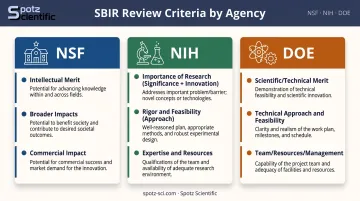
Every section of your proposal should map visibly to at least one of these criteria. If a reviewer has to infer the connection, the proposal is underperforming.
Contact the Program Manager Before Submission
This step is consistently underutilized. Program managers can confirm whether your concept fits a solicitation topic, identify the right division or institute to target, and provide informal guidance that meaningfully improves alignment with agency priorities.
At DOE and NSF, pre-submission communication is not only acceptable — it's expected. At NIH, the recommended practice is to contact the Program Official after receiving a summary statement for resubmission guidance.
For scientific computing proposals targeting DOE ASCR or NSF CISE, working with an advisor who has direct program management experience can sharpen alignment with agency priorities. Spotz Scientific's Dr. Bill Spotz spent eight years as a DOE ASCR program manager overseeing $264M in scientific computing research — context that informs both proposal strategy and program manager outreach.
Secure Credible Letters of Support
A letter from a potential customer validating market need, or from an industry expert validating technical methodology, signals real-world relevance beyond the proposal document. Reviewers notice when letters are generic — specificity matters. A letter that names the technology, confirms a concrete application, or states a customer's willingness to pay carries far more weight than a general endorsement.
Common SBIR Proposal Mistakes to Avoid
The Most Common Rejection Triggers
Across agencies, reviewers consistently cite these as the most preventable failure points:
- Failing to demonstrate novelty or uniqueness of the innovation
- Insufficient technical detail in the R&D plan
- No measurable success criteria or go/no-go milestones
- Ignoring existing competing solutions
- Missing required sections entirely
- Not directly addressing solicitation requirements
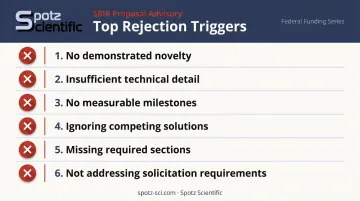
A single omission can result in administrative rejection before a reviewer ever evaluates the science.
The Mixed Sections Problem
Applicants frequently blur distinct required sections — embedding commercialization content inside the technical narrative, or folding eligibility claims into the R&D plan. Each section must stand on its own and address only what it was designed to cover. Conflating sections leaves both arguments underdeveloped and signals to reviewers that the applicant didn't read the solicitation carefully.
Run a Pre-Submission Red Team Review
Before submitting, have a trusted colleague, co-investigator, or experienced proposal consultant read the draft to check:
- Can they answer the 3Ws and 1H — who, what, why, and how — after reading each section?
- Are all solicitation requirements met?
- Does the narrative read coherently to someone outside the research team?
Spotz Scientific provides red team reviews for SBIR and scientific computing proposals, drawing on Dr. Spotz's eight years as a DOE program manager — the same perspective your reviewers bring to the evaluation panel.
Frequently Asked Questions
What is the difference between SBIR and STTR?
STTR requires a formal partnership with a nonprofit research institution — typically a university or federal lab — with at least 30% of work performed by that institution. SBIR has no such requirement, making it more flexible for small businesses that want to retain control of IP and project direction. Only six agencies operate STTR programs, compared to 11 for SBIR.
What is the difference between SBIR Phase I and Phase II?
Phase I is a feasibility study — typically 6–18 months — designed to establish technical merit and proof of concept. Phase II is a larger, longer award focused on full R&D development and commercialization preparation. Phase II applications are generally only open to Phase I awardees, with limited exceptions for Direct-to-Phase II.
Do I need to contact the program manager before submitting?
Contact the program manager before submitting, especially at DOE and NSF. Program managers can confirm topic fit, suggest the right division, and provide guidance that directly affects how your proposal is scored against agency priorities.
How competitive is the SBIR application process?
In FY2022, the overall Phase I selection rate was 16%, with significant variation by agency — NSF's Phase I rate was 11%, while DOE's was 19%. NIH's 2025 rate dropped to 8%. Proposals with strong commercial potential, clear innovation, and a well-credentialed team consistently outperform regardless of overall volume.
How long does it take to prepare an SBIR proposal?
First-time applicants should plan for several months. SAM.gov registration alone can take 4–6 weeks, and that's before solicitation review, concept development, full proposal drafting, budget preparation, and internal review. Starting early is not optional.
What are the most common reasons SBIR proposals are rejected?
The most frequently cited reasons include:
- Failure to demonstrate novelty
- Insufficient technical detail
- No measurable success criteria
- Lack of commercialization vision
- Inadequate team qualifications
- Not directly addressing solicitation requirements