Introduction
Staring at a blank page before writing a research proposal creates its own kind of paralysis. Many researchers search for a sample proposal just to picture what a winning submission looks like on paper, especially before committing weeks to a competitive federal program.
Here's the catch: most downloadable templates were built for a general audience, not for agencies like the DOE Office of Science or NSF CISE. They cover the basics fine but skip the compliance details that actually decide a federal review outcome, such as budget justification formats or NOFO responsiveness checks.
That gap between "generic" and "fundable" trips up a lot of otherwise strong applicants.
This guide covers the seven components every proposal needs, real examples across disciplines, where to find dependable templates, and how to adapt one specifically for DOE or NSF scientific computing funding.
Key Takeaways
- Every strong research proposal shares the same seven structural components, regardless of discipline
- Study examples for structure and logic — never copy language word-for-word
- Sample proposals vary across lab science, PhD/thesis, institutional grant, and federal computing formats
- DOE and NSF apply review criteria that generic academic templates rarely address
- Expert review of a draft catches agency-specific gaps public templates simply cannot
The 7 Main Components of a Research Proposal
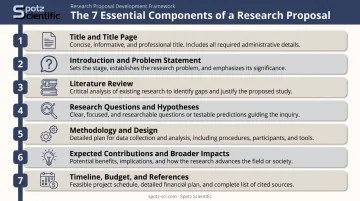
Every proposal, regardless of field or funder, builds on the same seven-part scaffold. Federal agencies repackage these parts into their own document structure, but the underlying logic stays the same.
- Title and title page - A focused, descriptive title plus standard front matter: name, institution, department, submission date. Federal packages swap this for a Cover Sheet, but clarity still matters just as much.
- Introduction and problem statement - Hooks the reader, provides background, and defines the specific gap your work fills. Reviewers often decide here whether to keep reading closely.
- Literature review - Demonstrates command of existing research and justifies why the work matters now. NSF separates this into a References Cited section; DOE expects prior work woven directly into the narrative.
- Research questions, objectives, and hypotheses - Narrows the problem statement into testable, specific aims. Vague objectives are one of the fastest ways to lose a reviewer's confidence.
- Methodology and research design - Details data collection, analysis plans, and feasibility. This section needs to be concrete enough that a reviewer could picture the work actually happening.
- Expected contributions and broader impacts - Academic templates often bury this under "significance." NSF requires a distinct, explicitly headed Broader Impacts section in the Project Description. Skipping it can mean the proposal isn't even accepted for review, per NSF's proposal preparation guidance.
- Timeline, budget, and reference list - A realistic schedule, itemized costs, and properly formatted citations. Federal submissions add budget justifications and biosketches that most academic templates never mention.
Sample Research Proposal Examples by Type
Not every proposal type carries the same weight in the same places. Here's how structure and emphasis shift across four common categories.
Scientific and Lab-Based Research Proposal Example
Lab-based proposals put hypothesis testing front and center. A strong sample in this category typically includes:
- A clearly stated hypothesis with control-group design
- Measurable, operationalized variables
- Step-by-step experimental protocols, often with diagrams or flowcharts
- A detailed data analysis plan showing specific statistical methods
Reviewers in this space want to see feasibility demonstrated on the page.
PhD or Thesis Proposal Example
Thesis proposals layer in a deeper literature review, an explicit theoretical framework, and a multi-phase methodology. They also typically add a risk or limitations section that undergraduate-level templates skip entirely. Committees want proof you've already anticipated what could go wrong before it derails the project.
Grant Proposal Example for Institutions
Institutional grant proposals foreground real-world impact, team qualifications, and itemized budgets tied to the funder's stated priorities. A reviewer here is evaluating organizational capacity almost as much as the idea itself. Expect sections on evaluation plans and sustainability that a pure academic sample rarely includes.
Federal Scientific Computing Proposal Example (DOE/NSF)
DOE ASCR and NSF CISE proposals follow the structure of the specific Notice of Funding Opportunity rather than a generic academic template. A standard package includes:
- A project narrative outlining objectives and methodology
- A budget justification tied to the funder's priorities
- Biographical sketches for all named investigators
- Current and pending support documentation
These sections rarely appear in a general proposal sample bank.
Publicly available examples of DOE or NSF scientific computing proposals are also far scarcer than academic samples. That scarcity is precisely why applicants need agency-specific guidance rather than a downloaded PDF built for a different kind of committee.
Where to Find Reliable Templates and Sample Downloads
University writing centers and academic resource sites offer solid generic templates for practicing structure and formatting. They're genuinely useful for learning how a proposal argument is built.
The catch: these generic templates rarely map onto a specific agency's exact NOFO or solicitation requirements. A well-formatted academic sample skips:
- A mandatory Data Management and Sharing Plan
- A page limit buried in a solicitation appendix
- Agency-specific formatting rules
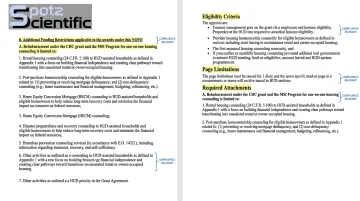
The actual solicitation document should always be your starting template for DOE and NSF submissions, not a generic research proposal PDF pulled from a search engine. The NOFO defines required sections, page limits, and review criteria — everything else is a drafting aid, not a source of truth. Spotz Scientific's NOFO advisory service helps pinpoint agency-specific requirements before you start drafting.
How to Adapt a Sample Proposal for DOE and NSF Scientific Computing Funding
DOE Office of Science ASCR and NSF CISE proposals must align tightly with solicitation-specific language and review criteria. Generic templates simply aren't built to satisfy either one.
The review lenses themselves are different enough that adapting a sample proposal often means rewriting entire sections from scratch:
| Review Focus | NSF CISE | DOE Office of Science |
|---|---|---|
| Primary criteria | Intellectual Merit and Broader Impacts | Scientific/technical merit, approach, personnel, and budget |
| Mission alignment | Advances knowledge broadly | Must connect explicitly to SC/ASCR mission relevance |
| Extra layer | Creativity, plan quality, resources | Program policy factors, duplication, funds available |
Specialized programs add another layer entirely, one that standard sample proposals never account for:
- NSF CAREER requires an integrated, five-year research-and-education plan plus a Departmental Letter; omit either and the proposal gets returned without review.
- DOE Early Career Research Program requires its own pre-application and follows DOE's mission-centered structure throughout.
Catching these hidden requirements takes more than careful reading of a solicitation; it takes someone who has sat on the other side of the review table. Spotz Scientific founder Bill Spotz reviewed proposals from the funding side for years, including co-leading DOE ASCR's applied mathematics program covering the mathematical foundations of high-performance computing and scientific machine learning.
That experience offers a vantage point no template can replicate. Program managers read for mission fit and technical rigor first, formatting second.
Spotz Scientific fills that gap. The firm provides red-team review of draft or pre-proposals, plus strategic advice tailored to a specific NOFO, helping researchers close gaps that no public template was designed to catch.
Standard review runs $200-250/hour; an expedited rate of $250-300/hour applies when materials arrive inside two weeks of a submission deadline.
Common Mistakes When Using Proposal Examples and Templates
Even strong researchers stumble on the same few pitfalls when leaning too hard on samples:
- Copying structure or language verbatim instead of adapting the underlying reasoning to their own research question and funder
- Ignoring page limits, formatting rules, or required sections spelled out in the agency's NOFO, which can end a proposal before review even starts
- Overlooking mandatory statements, such as data management plans, broader impacts sections, or mentoring plans required by early-career funding programs
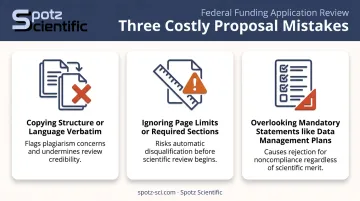
Each of these mistakes can trigger non-acceptance or a return-without-review outcome at the federal level.
Frequently Asked Questions
What are the 7 main components of a research proposal?
Title page, introduction and problem statement, literature review, research questions and methodology, expected contributions, timeline and budget, and a reference list. Federal proposals repackage these into agency-specific documents.
How long should a research proposal be?
It varies widely: thesis proposals often run 10-15 pages, while NSF Project Descriptions are typically capped at 15 pages and DOE limits depend entirely on the specific NOFO.
Can I copy a sample research proposal for my own submission?
No. Examples should inspire structure and reasoning, not be copied directly, since your research question, data, and target funder will always differ from the sample's.
What's the difference between a research plan and a research proposal?
A research plan organizes your own work internally. A proposal is written to persuade a funder, supervisor, or committee to approve and support that work.
How are DOE and NSF proposal requirements different from generic academic templates?
Federal agencies follow specific NOFO structures and review criteria (like NSF's Broader Impacts requirement or DOE's mission-relevance standard) that generic templates simply don't reflect.
How can I get expert feedback on my draft proposal before submission?
A red-team review from someone with agency program management experience, like the services offered through Spotz Scientific, can catch gaps that public templates and sample PDFs never surface.