Introduction
NSF returns proposals that fail compliance checks before a single reviewer evaluates the science. Research.gov runs automated compliance checks at submission, and proposals that trigger errors are classified as "Not Accepted" and rejected outright. Even proposals that clear automated checks can be returned without review at a program officer's discretion.
This guide is written for PIs, co-PIs, and research administrators at universities and national laboratories preparing standard NSF research proposals under the current governing document: PAPPG 24-1 (NSF 24-1), effective May 20, 2024. Every major checklist section is covered here — what NSF requires, why it exists, and where researchers most often go wrong.
Key Takeaways
- NSF's automated system blocks non-compliant proposals before they reach reviewers — the checklist is a compliance requirement, not a formality.
- PAPPG 24-1 removed the Biographical Sketch page limit, expanded the Mentoring Plan to graduate students, and added Tribal Nation impact provisions.
- Intellectual Merit and Broader Impacts must appear as separately labeled sections in both the Project Summary and Project Description — missing labels is a compliance error.
- Solicitation-specific requirements override PAPPG defaults — always read both documents.
- Start the checklist process 8–12 weeks before the NSF deadline to avoid last-minute compliance failures.
What Is NSF Proposal Preparation and Why Does the Checklist Matter?
NSF proposal preparation is the structured process of assembling all required documents, narrative content, and administrative certifications into a submission-ready package that complies with the PAPPG — NSF's official rulebook for proposal preparation and award management.
The PAPPG Exhibit II-1 Proposal Preparation Checklist is NSF's own summary of critical compliance items. It is a high-level reference — it doesn't replace Chapter II or any applicable solicitation. Think of it as your pre-flight checklist, not the flight manual.
Two Compliance Gates You Must Clear
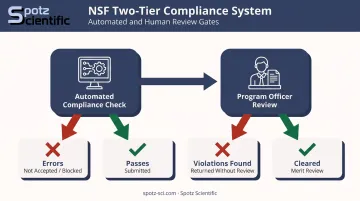
Research.gov operates a two-tier compliance system:
- Errors block submission entirely — the proposal is classified as "Not Accepted" and cannot be submitted
- Warnings permit submission but signal potential issues that may trigger a return without review
Passing automated checks does not guarantee your proposal reaches merit review. Under Chapter IV.B of PAPPG 24-1, NSF may still return a submitted proposal without review if it contains formatting violations, missing required sections, duplicate submissions, or an insufficiently revised resubmission.
Each of those triggers falls under the checklist's domain: structure, format, and completeness. Merit review evaluates scientific quality. Both gates must be cleared, and failing the first eliminates any chance at the second.
The NSF Proposal Preparation Checklist: A Section-by-Section Breakdown
Pre-Submission and General Requirements
Before drafting begins, verify these organizational prerequisites:
- Active SAM registration with a valid Unique Entity Identifier (UEI) — a UEI-only record is not equivalent to full SAM registration
- No duplicate submissions — proposals substantially similar to one already under NSF consideration may be returned without review; the narrow exception for concurrent consideration by another federal agency applies only in specific beginning-investigator situations
- Solicitation eligibility confirmed — if submitting to a specific program solicitation, verify your institution and project meet all stated eligibility criteria
For previously declined proposals, NSF's Chapter IV.B requires substantive revision that visibly addresses prior review panel comments. Resubmitting an essentially unchanged proposal is a costly, avoidable mistake in NSF proposal preparation.
Cover Sheet
The Cover Sheet is the administrative face of your proposal. Key requirements:
- Program identification: Select all relevant NSF programs; interdisciplinary proposals must identify every applicable program
- Title format: Include any required prefix — "Collaborative Research:" is required by Chapter II.E.3 for separately submitted collaborative proposals; "CAREER:" is required by the CAREER solicitation; verify "RUI:" against the current RUI solicitation
- Renewal proposals: Must include the prior award number
- Compliance indicators: Check applicable boxes for human subjects, live vertebrate animals, off-campus research, international activities, potential Tribal Nation impacts, and proprietary information — these are conditional, not universal
Core Narrative Documents: Project Summary and Project Description
These are the two documents reviewers read most carefully, and both have strict structural requirements that directly affect merit review scoring.
Project Summary (maximum 1 page):
- Written in third person
- Must contain three explicitly labeled sections: Overview, Intellectual Merit, and Broader Impacts
- Must be self-contained and comprehensible to a scientifically literate non-specialist
- Should not read as an abstract of the methodology — NSF is explicit that the Project Summary is not simply a condensed version of the Project Description
Project Description (maximum 15 pages):
- Includes all visual materials within the page limit
- Must contain a separately labeled "Broader Impacts" section with the heading on its own line
- No embedded URLs — PAPPG explicitly prohibits links because they can circumvent page limits and linked content can change or disappear
- Must include Results from Prior NSF Support for any PI or co-PI with NSF funding active or ended within the past five years; this section is limited to 5 pages within the 15-page description and must separately address Intellectual Merit and Broader Impacts results
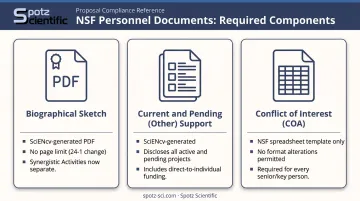
Personnel Documents: Biographical Sketches, Current and Pending Support, and COA
All three documents are required for each senior/key person and carry specific formatting rules:
| Document | Key Requirements Under PAPPG 24-1 |
|---|---|
| Biographical Sketch | SciENcv-generated PDF; no overall page limit (3-page limit removed in 24-1); Synergistic Activities is now a separate document |
| Current and Pending (Other) Support | SciENcv-generated; discloses all active and pending projects regardless of funding source or whether funding flows through the institution or directly to the individual |
| COA | Submitted using NSF's spreadsheet template without format alterations; required for every senior/key person |
One practical note on SciENcv: ORCID integration is supported but not mandatory under PAPPG 24-1. The mandatory requirement is generating documents through SciENcv itself. Researchers who treat optional ORCID linking as a compliance requirement sometimes create unnecessary delays at submission.
Budget, Cost Sharing, and Facilities
Budget Justification: Maximum 5 pages for the proposing organization. Each subaward requires its own separate justification, also limited to 5 pages. Every line item must be documented and justified.
Senior personnel compensation: NSF's general policy limits requested salary to two months of regular salary per year per person across NSF-funded grants. Compensation exceeding two months must be disclosed and justified in the budget — this is a disclosure and justification threshold, not an outright ban.
Cost sharing — a critical trap: Voluntary committed cost sharing is prohibited unless a specific solicitation explicitly requires it. Budget Line M is locked under the default policy. Including cost-sharing commitments in a budget justification — even inadvertently — signals non-compliance to reviewers. Voluntary uncommitted resources are allowed but must not appear as quantified financial commitments.
Facilities, Equipment and Other Resources: Must provide a narrative description of physical and personnel resources available to the project. No quantifiable financial data may appear here. If no resources exist, upload a statement to that effect — omitting the section entirely is not permitted.
Supplementary Documentation
Data Management and Sharing Plan (DMSP): Required for all standard proposals, limited to 2 pages. Must address:
- Data types and products to be generated
- Data and metadata formats and standards
- Access, sharing, and privacy policies
- Reuse and redistribution provisions
- Archiving and preservation plans
Mentoring Plan (maximum 1 page): Required when funding is requested for postdoctoral researchers or graduate students, including covered personnel at subrecipients. Key details:
- PAPPG 24-1 expanded coverage beyond postdocs to include graduate students (a change from 23-1)
- Upload a separate plan for each covered personnel category if applicable
Letters of Collaboration: Strictly limited to statements of intent to collaborate or commit resources. NSF prohibits endorsements, testimonials, or evaluations of the PI's qualifications — submitting them can trigger return without review.
Common NSF Proposal Mistakes and Misconceptions
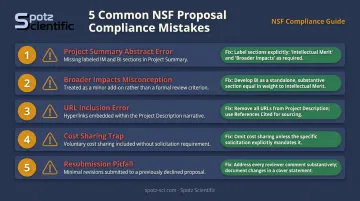
The Project Summary Abstract Error
The single most common formatting violation: treating the Project Summary as a condensed abstract. Summarizing methodology without labeling and addressing Intellectual Merit and Broader Impacts as distinct sections creates two problems at once: it's a compliance error, and it removes the structured inputs reviewers use for merit scoring.
The Broader Impacts Misconception
Broader Impacts is one of two formal NSF merit review criteria established by the National Science Board — not a paragraph tacked onto the end of a proposal. Panels evaluate it alongside Intellectual Merit, and proposals that treat it as a minor add-on consistently underperform. A substantive Broader Impacts plan describes concrete, credible benefits to society. Vague statements about potential future applications won't satisfy reviewers.
The URL Inclusion Error
Researchers frequently embed hyperlinks in the Project Description to point to datasets, software repositories, or lab websites. PAPPG explicitly prohibits this. NSF may return proposals containing URLs in the Project Description without review, regardless of how strong the science is.
The Cost Sharing Trap
Volunteering cost sharing in your budget or justification when no solicitation requires it is a compliance error, not a competitive advantage. It signals unfamiliarity with PAPPG rules and can result in a return without review.
The Resubmission Pitfall
A declined proposal resubmitted with minimal changes is grounds for return under Chapter IV.B. Reviewer comments are not optional feedback — they are the roadmap for what a substantive revision must address.
Before resubmitting, have a knowledgeable reviewer evaluate your revised draft against prior panel comments. Spotz Scientific's red team review service provides this type of critical assessment, drawing on Dr. Bill Spotz's direct experience evaluating proposals as a program manager.
Key Factors That Shape NSF Proposal Compliance
Solicitation Requirements Override PAPPG Defaults
This is the most frequently overlooked compliance principle. When a specific program solicitation modifies any PAPPG default — page limits, required sections, budget caps, eligibility criteria, title format — the solicitation governs. Reading only the PAPPG without checking solicitation-specific requirements is a direct path to return without review.
Internal Institutional Deadlines
Most sponsored programs offices require proposal packages well before the NSF deadline — Stanford, for example, requires 5 full business days. Missing internal deadlines can make NSF deadlines impossible to meet. That's because NSF enforces a hard cutoff of 5:00 p.m. submitting organization's local time on the deadline date, with zero exceptions.
SciENcv Processing Time
Biographical Sketches and Current and Pending Support documents must be generated through SciENcv. Researchers who wait until the final week frequently hit processing bottlenecks that compress an already tight timeline:
- Account setup and verification delays
- ORCID linking (optional, but time-consuming if pursued)
- PDF generation queues during peak submission periods
Strategic Tips Beyond the Checklist
Compliance gets your proposal into review. Strategy determines how it scores.
Read recently funded awards first. NSF's public award search makes funded projects searchable by program. Reading 2–3 recent awards in your target program reveals how successful projects framed their Intellectual Merit and Broader Impacts, and signals current directorate priorities — information no checklist can provide.
Write the Project Summary and Broader Impacts for non-specialists. Review panels include researchers from adjacent fields. Clarity, accessibility, and a compelling societal narrative move scores even when technical content is strong. These sections should communicate, not just describe.
Schedule a pre-submission red team review. Someone with program management experience — ideally someone who has sat on the reviewer or program officer side — can evaluate not just compliance but strategic framing and reviewer-readiness.
Spotz Scientific, led by Dr. Bill Spotz — a former DOE program manager who oversaw $264M in scientific computing research — offers this kind of insider-perspective review for NSF CISE and CAREER proposals. Engagements run $200–$250/hour (standard) or $250–$300/hour when materials are provided less than two weeks before the deadline.
Frequently Asked Questions
What is the PAPPG and do I need to read the whole thing?
The PAPPG (Proposal and Award Policies and Procedures Guide) is NSF's official rulebook for proposal preparation and award management. You don't need to read every chapter. Focus on Chapter II (Proposal Preparation Instructions), Exhibit II-1 (the checklist), and any solicitation-specific guidance that overrides PAPPG defaults.
What happens if my NSF proposal is returned without review?
NSF returns proposals that fail automated compliance checks or contain formatting and content violations — without sending them to merit review. The proposal can typically be revised and resubmitted, but missing a funding cycle can delay research timelines by six months to a year.
How is PAPPG 24-1 different from PAPPG 23-1?
The key changes in PAPPG 24-1 (effective May 20, 2024): the Biographical Sketch no longer has a page limit (the 3-page limit was removed), the Mentoring Plan now covers both postdoctoral researchers and graduate students supported on the project, Synergistic Activities became a separate document, and new provisions were added for proposals affecting Tribal Nation resources or interests.
Do I need a Data Management Plan for every NSF proposal?
Yes — a Data Management and Sharing Plan (up to 2 pages) is required for all standard NSF proposals. It must address data types, access and sharing policies, and preservation plans. A generic plan can raise concerns with reviewers; tailor it to your specific research.
What is the difference between Intellectual Merit and Broader Impacts?
Intellectual Merit addresses the proposed work's potential to advance knowledge within and across scientific fields. Broader Impacts addresses its potential to benefit society. Both are formal NSF merit review criteria and must appear as separately labeled sections in the Project Summary and Project Description.
How early should I start preparing my NSF proposal?
Start at least 8–12 weeks before the deadline to allow time for institutional review, SciENcv document generation, collaboration letters, budget development, and at least one round of external narrative review. First-time submitters and competitive solicitations benefit from starting even earlier.