Introduction
A research proposal has one job: convince someone else that your project deserves their time, resources, or money. That someone might be a thesis committee, a department chair, or a federal program officer deciding between hundreds of applications.
Many researchers struggle with this document because they don't understand what reviewers are actually scoring, even when the underlying science is solid. NSF's own data shows the stakes: the agency funded just 27% of research proposals in FY2023, according to its Merit Review Digest.
Despite these odds, the basic structure of a proposal is fairly standard across disciplines and agencies. What separates a funded proposal from a rejected one is clarity, feasibility, and how well it aligns with what the reader wants to see.
This guide walks through the exact steps for writing one, what makes proposals succeed, and common pitfalls to avoid. It also covers how a research proposal differs from related documents like a research plan or grant application.
Key Takeaways
- A proposal needs five core sections: title, introduction, literature review, methodology, and references
- Strong proposals balance relevance, methodology, and feasibility within budget and timeline
- Most rejections stem from unclear questions or unrealistic scope, not weak ideas
- Format requirements vary by institution and agency, so check the call for proposals first
How to Write a Research Proposal: Step-by-Step
Every proposal, whether it's a two-page thesis outline or a federal grant application, follows a similar backbone. Here's how to build each section.
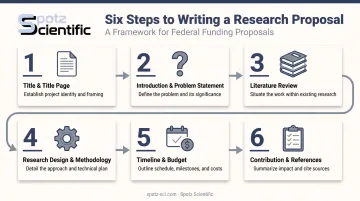
Step 1: Craft a Clear Title and Title Page
Your title should be concise, roughly 10 to 15 words, descriptive, and free of jargon or acronyms. A reviewer skimming dozens of titles in one sitting should understand your project's focus without decoding abbreviations.
Standard title page elements include:
- Proposed title of the research
- Your name and affiliation
- Supervisor or institution name
- Department
- Date of submission
Step 2: Write the Introduction and Problem Statement
This section introduces your topic, provides background context, and ends with a clear problem statement and research question. Move quickly from the broad subject to your specific focus. Don't wander.
Your introduction should answer four questions:
- Who cares about this topic, and why?
- What's currently known about it?
- What's missing from that knowledge?
- Why does this research matter now?
A strong research question is clear, focused, and complex enough to require real analysis, not a simple yes-or-no answer.
Step 3: Build the Literature Review
The literature review demonstrates that you know the field and shows the specific gap your project will fill. This isn't a book report. Summarizing sources one after another tells a reviewer you've read the literature but haven't thought about it.
Instead, compare and contrast key studies, methods, and theoretical approaches. Group sources by argument or methodology, not by publication date. The goal is synthesis: showing how the existing research connects, where it disagrees, and where your project picks up the thread.
Step 4: Detail the Research Design and Methodology
This is often the section reviewers scrutinize most closely, because it proves feasibility and technical competence. Specify:
- Research type (qualitative, quantitative, or mixed methods)
- Data collection methods
- Sample or population being studied
- Analysis approach
For federal proposals, methodology carries extra weight. DOE's Office of Science merit review guidance directs reviewers to assess a project's significance, approach, and feasibility together, not in isolation. A brilliant idea with a vague or unproven method rarely survives review.
Step 5: Outline the Timeline and Budget
If required, a research schedule breaks your project into phases with realistic deadlines. A budget itemizes each cost, its justification, and its funding source.
Funding bodies weigh feasibility heavily. Overly optimistic timelines are one of the fastest ways to lose reviewer confidence, even when the science itself is sound. Build in buffer time for setbacks like equipment delays or IRB approval lags.
Step 6: Finish with Contribution to Knowledge and References
Close by restating the significance and potential impact of your findings, whether that's informing policy, advancing theory, or filling a documented gap. Then attach a complete, correctly formatted reference list.
Reviewers often check whether you've cited landmark studies in your field. A missing foundational citation raises doubts about how well you actually know the literature you're claiming to build on.
Key Elements That Make a Research Proposal Successful
Structure alone doesn't win funding. Reviewers are also weighing relevance, methodological rigor, feasibility, and realism, often against a stack of competing applications.
Clarity and Focus of the Research Question
A vague or overly broad question signals to reviewers that the project isn't fully thought through. If you can't state your question in one clear sentence, it probably needs narrowing.
Alignment with Funder or Program Priorities
Your proposal has to speak directly to what a specific funding opportunity is looking for, not just to the broader field. This is where many strong ideas fail: they're scientifically sound but misaligned with the program's stated goals.
Specialized guidance can bridge that gap. Spotz Scientific offers strategic advice on DOE and NSF Notices of Funding Opportunities, drawing on Bill Spotz's eight years as a DOE program manager. That insider perspective helps researchers understand how a specific program office actually reads and scores submissions.
Demonstrated Feasibility
Reviewers check whether your proposed timeline, budget, and methods are realistic given your resources and stated expertise. NSF's review elements ask whether the plan is well-reasoned, organized, and includes a mechanism for assessing success, according to its Chapter III proposal review guidance.
Strong Grounding in Prior Work
Failing to cite landmark studies, or misrepresenting what other researchers found, is a common reason proposals lose credibility fast. Reviewers in specialized fields often know the literature better than the applicant expects.
Logical Flow and Writing Quality
A well-organized argument with tight transitions matters nearly as much as the underlying idea. Sloppy writing makes reviewers question whether the research itself will be executed carefully.
When You Need a Research Proposal (and How It Differs From Similar Documents)
"Research proposal" covers several related but distinct use cases. Common scenarios include:
- Graduate school applications
- Thesis or dissertation proposals
- Funding applications to agencies like DOE or NSF
Research proposals are often confused with similar documents, though each serves a different purpose:
| Document | Purpose | Audience |
|---|---|---|
| Research proposal | Convinces others a specific study deserves support | Committee, advisor, or funder |
| Research plan | Organizes your own thinking around a multi-project agenda | Yourself, or a hiring committee |
| Grant application | Requests specific funding, often includes the proposal plus forms | Funding agency |
| Cover letter | Connects you personally to the work and position | Hiring committee |
A research proposal justifies one study, while a grant application wraps that same proposal inside administrative forms, budget documents, and certifications. A cover letter, by contrast, introduces you as a person, not your project design. Spotz Scientific reviews the proposal itself: the case for your study, not the surrounding grant paperwork.
Common Mistakes to Avoid When Writing a Research Proposal
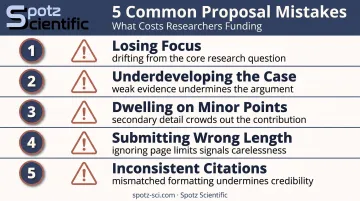
Even strong researchers stumble on execution. The most frequent errors include:
- Losing focus on the core research question by over-explaining tangential background that doesn't serve the argument
- Underdeveloping the persuasive case for why the research matters
- Dwelling on minor points while rushing through the significance section
- Submitting the wrong length, either too short to seem credible or too long to hold a reviewer's attention
- Inconsistent or incorrect citations, which undermine confidence in your attention to detail
The Chronicle of Higher Education's review of common grant-writing mistakes points to a related pattern. Proposals that force a project into a mismatched funding opportunity, or that leave collaborator roles vague, are written in a rush rather than tailored to their audience. A red team review before submission catches these problems while there's still time to fix them.
Conclusion
A strong research proposal follows a clear structure: title, introduction, literature review, methodology, and references. But structure alone rarely decides the outcome. Proposals succeed or fail based on focus, feasibility, and how well they align with the reader's priorities.
For high-stakes federal scientific computing proposals, that alignment is harder to gauge from the outside. Working with someone who has sat on the other side of the review process can help researchers propose their work with confidence rather than guesswork. Spotz Scientific's Bill Spotz, a former DOE program manager who managed over $264 million in scientific computing research, brings that insider perspective.
Frequently Asked Questions
What is a scientific proposal?
A scientific proposal is a document that outlines a planned study's research question, rationale, and methodology to convince a reader it's worth pursuing or funding. It applies to academic, thesis, and federal funding contexts alike.
What are the main components of a scientific proposal?
The core components are the title, introduction or problem statement, literature review, methodology, budget and timeline where applicable, and a references list. Format details vary by institution or agency.
What are examples of research proposals?
Examples range from a few-page thesis proposal for a master's program to detailed, multi-page federal grant proposals submitted to agencies like DOE or NSF. Check your university's graduate school site or the specific agency's website for sample templates.
How long should a research proposal be?
Length varies widely. Coursework and thesis proposals often run a few pages, while PhD dissertation proposals commonly reach 25-30 pages, and federal funding proposals can run much longer. Always check institutional or agency guidelines first.
What's the difference between a research proposal and a grant proposal?
A research proposal states your intent to answer a specific research question, while a grant proposal is a formal funding request that packages that plan with budgets and administrative forms. The two overlap heavily in content.
Can I use AI tools to help write a research proposal?
AI tools can help with brainstorming and outlining, but use them carefully. NSF permits AI-assisted preparation while holding proposers fully responsible for accuracy and originality, and many institutions screen submissions for AI-generated content.