Key Takeaways
- Federal early career grants range from $120,000 to over $2.3 million depending on the agency and program structure
- Eligibility windows differ significantly — from 5 years post-PhD (some DoD programs) to 10 years (DOE, NIH)
- The DOE pre-application stage is a genuine competitive filter where program-agency alignment can matter as much as research quality
- NSF CAREER requires a fully integrated research-and-education plan as a core program requirement, not a Broader Impacts add-on
- Scientific computing researchers should evaluate both DOE ASCR and NSF CISE tracks, since each frames similar research differently
What Are Early Career Research Grants?
Early career research grants are competitive federal awards designed to help junior scientists — assistant professors and postdoctoral researchers moving into faculty roles — establish independent research programs.
Building a research portfolio from scratch is one of the hardest transitions in academia. These programs give junior researchers stable, sustained support at exactly that inflection point. Federal agencies benefit too — investing early in researchers whose work aligns with national priorities pays long-term dividends.
Key characteristics that distinguish early career awards from standard investigator grants:
- Longer award periods — typically 3–5 years of stable support
- Mentoring or training expectations — many programs require documented institutional support
- Education integration — NSF CAREER specifically requires a plan where research and education inform each other
- Independence requirements — most programs prohibit co-PIs and target researchers without prior major awards from the same agency
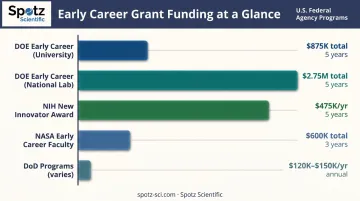
The funding scale varies widely across agencies. DOE Early Career awards run approximately $875,000 over five years for university researchers. NIH's New Innovator Award offers up to $475,000 per year for five years. DoD programs are more modest, ranging from $120,000 to $150,000 annually.
Who Qualifies as an Early Career Researcher?
There is no single federal definition of "early career." Each program defines it differently — by years since degree, appointment type, citizenship, or some combination. Always verify eligibility against each program's current Notice of Funding Opportunity (NOFO) before applying.
Eligibility Compared Across Programs
| Program | Degree Window | Citizenship | Appointment Requirement |
|---|---|---|---|
| DOE ECRP (FY 2026) | Doctorate on or after Jan. 1, 2015 | None stated | Untenured tenure-track; or permanent non-postdoctoral DOE lab employee |
| NSF CAREER | No post-PhD year cap | None stated | Untenured assistant professor; ≥50% tenure-track appointment |
| AFOSR YIP (FY 2026) | PhD received Apr. 1, 2018 or later | U.S. citizen, national, or permanent resident | Full-time at a U.S. institution |
| ONR YIP (FY 2026) | Doctorate within past 7 years | U.S. citizen, national, or permanent resident | First or second full-time tenure-track appointment |
| Army ECP (Jan. 2025) | Fewer than 5 years in tenure-track position | U.S. citizen, national, or LPR | Tenure-track at a U.S. institution |
| DARPA YFA (2026) | Nonprofits without tenure: within 12 years of doctorate | Citizens, residents, and foreign nationals may participate | Tenure-track or qualifying nonprofit equivalent |
| NIH New Innovator | Terminal degree within past 10 years | None stated | Independent research position at domestic institution |
| NASA ECF25 | Not specified in solicitation | U.S. citizen or LPR | Untenured tenure-track assistant professor |
Three eligibility details that catch applicants off guard:
- NIH ESI status must be entered in eRA Commons and is calculated automatically — researchers should confirm their status is accurately recorded before applying
- NSF CAREER has no post-PhD year cap, but applicants must hold an untenured position, making it practically limited to assistant professors
- DoD programs are not uniform — AFOSR, ONR, Army, and DARPA each apply different degree windows, citizenship rules, and appointment requirements
Major Federal Early Career Funding Programs
Department of Energy (DOE) Early Career Research Program
The DOE Early Career Research Program is among the most prestigious early career awards in science. For FY 2026:
- University awards: approximately $875,000 total over 5 years
- DOE national laboratory awards: approximately $2.75 million total over 5 years
- Supported program offices: ASCR, Basic Energy Sciences, Biological and Environmental Research, Fusion Energy Sciences, High Energy Physics, Nuclear Physics, and Isotope R&D and Production
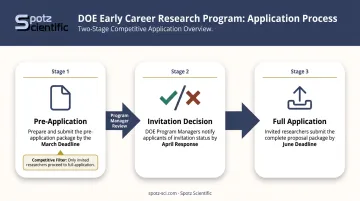
The application is a two-stage process. For FY 2026, a required pre-application was due March 24, with DOE responses scheduled for April 21. Only researchers specifically encouraged by program managers could submit a full application, due June 2. The pre-application is a genuine competitive filter, not an administrative formality.
DOE selected 91 researchers for $138 million in 2024. DOE doesn't publish application counts, so no reliable acceptance rate exists — but the program is highly selective.
NSF CAREER Award
NSF's Faculty Early Career Development (CAREER) Award is NSF's most prestigious early career honor. Award minimums:
- Most directorates: $400,000 over 5 years
- BIO, ENG, and OPP: $500,000 over 5 years
The CAREER award has three requirements that set it apart from other programs:
- An integrated research-and-education plan (not just a research plan with education tacked on)
- A departmental letter documenting institutional commitment and mentoring support
- Individual PI only — no co-investigators
NSF estimates approximately 500 CAREER awards annually, totaling roughly $250 million. No proposal denominator is published, so acceptance rates cannot be precisely stated.
NSF CRII (Research Initiation Initiative) is a separate, often overlooked opportunity for CISE researchers. It offers up to $175,000 over 24 months and targets researchers in the first 3 years of their primary academic position who are no more than 6 years post-PhD and have not received prior federal PI-level grants.
Available at eligible non-R1 institutions, CRII serves as an effective stepping stone before a CAREER application.
DoD Young Investigator Programs
The DoD programs are distinct; they should not be treated as a uniform system:
| Program | Amount | Degree Window |
|---|---|---|
| AFOSR YIP | Up to $150K/year for 3 years ($450K total) | PhD received Apr. 1, 2018 or later |
| ONR YIP | Typical $750K over 36 months | Doctorate within past 7 years |
| Army ECP | Up to $120K/year for 3 years | <5 years in tenure-track position |
| DARPA YFA | Max $500K over 24-month base | Rank/tenure timing governs most applicants |
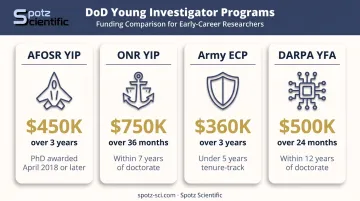
DARPA's Young Faculty Award is a distinct mechanism, higher risk and higher reward, targeting untenured faculty willing to engage with defense-specific research priorities. Foreign nationals may participate, making it more accessible than some other DoD programs.
NIH and NASA Early Career Programs
NIH New Innovator Award: Supports creative early-stage investigators proposing bold, high-impact projects. Current award: up to $475,000 per year for 5 years ($2.375 million in direct costs), nonrenewable, requiring at least 25% research effort. Applicants must be within 10 years of their terminal degree with no prior substantial independent NIH award.
NASA Early Career Faculty (ECF): Maximum $600,000 over 3 years (capped at $200,000 annually), targeting untenured tenure-track assistant professors whose research advances science, space travel, or exploration technology. Requires U.S. citizenship or lawful permanent residency.
DOE and NSF Programs for Scientific Computing Researchers
Scientific computing researchers — applied mathematicians, HPC scientists, scientific machine learning researchers, and data analysis specialists — have specific opportunities worth understanding in depth.
DOE ASCR Priorities
The ASCR Applied Mathematics program focuses on three core areas that have historically anchored early career awards:
- Mathematical foundations of high-performance computing — algorithms, numerical methods, and computational breakthroughs supporting DOE missions
- Scientific machine learning and AI — large-scale applications of ML to scientific problems, explicitly included in the FY 2025 Congressional Justification
- Data analysis methods — mathematical and computational approaches to extracting insight from large-scale scientific datasets
At the pre-application stage, program managers are assessing whether a proposal clearly fits within ASCR's active portfolio — not just whether the science is sound. A pre-application that reads as general applied mathematics without connecting to HPC, scientific computing infrastructure, or DOE mission areas is unlikely to receive an invitation to submit.
Understanding how program managers read pre-applications — what signals fit and what reads as outside the portfolio — is where advisory from someone inside the process pays off. Bill Spotz spent eight years as a program manager at DOE ASCR, co-leading the applied mathematics program and managing over $264 million in scientific computing research.
NSF CISE Framing Decisions
Within NSF, scientific computing researchers often qualify for both CISE and the Mathematical and Physical Sciences (MPS) directorate. The framing choice matters:
- CISE emphasizes advances in computer and information science at a fundamental level — algorithms, systems, and the computational aspects of the work
- MPS is better suited when the mathematical foundations are central and the computing is the vehicle, not the contribution
Getting this framing wrong doesn't disqualify a proposal, but poorly matched reviewers are a real cost. Beyond directorate fit, CISE CAREER proposals carry a specific expectation for the education component:
- The educational plan must be integrated with the research — not generic or templated
- Program managers actively look for evidence that the two are connected, not running in parallel
Tips for Building a Competitive Early Career Research Proposal
Read the NOFO First, Then Write
Map your research goals explicitly to the agency's stated programmatic priorities before drafting a single sentence. Reviewers reward proposals that advance the agency's mission — not just interesting science that happens to fit the eligibility criteria.
Study Recent Award Recipients
Most federal agencies publish award announcements. Reviewing who received funding in recent cycles gives you:
- The types of projects that succeed (not just the science, but the framing)
- Calibration on scope, ambition, and specificity
- Program manager names and their current portfolio focus
Treat the Pre-Application as a Competitive Document
For DOE Early Career applicants, the pre-application determines whether you submit a full proposal. A weak pre-application ends the process at March; there is no opportunity to recover. Every sentence should demonstrate alignment with the relevant program office's current priorities.
Don't Underweight Education and Broader Impacts
These components are not afterthoughts:
- NSF CAREER: The integrated research-and-education plan is a program requirement, evaluated under Intellectual Merit and Broader Impacts criteria separately
- DOE Early Career: The Education/Workforce Development component is weighted by reviewers — vague commitments are a common reason strong science proposals fail to receive funding

Specific, credible commitments outperform ambitious but hollow ones. One concrete curriculum plan or mentoring structure beats three generic statements about training the next generation.
Run a Red Team Review Before Submitting
Have colleagues unfamiliar with your specific research read your proposal for clarity and persuasiveness. If they cannot explain your contribution and its significance after one read, reviewers may not be able to either.
For DOE ASCR and NSF CISE proposals specifically, Spotz Scientific offers red team reviews and NOFO-specific strategic advisory sessions at $250/hour (standard rate) or $300/hour for materials submitted less than two weeks before a deadline. Because Dr. Spotz has sat on the program manager side of this process, the feedback targets exactly the gaps that lead to rejections: not just writing quality, but strategic alignment and reviewer expectations.
Frequently Asked Questions
What are early career research grants?
Early career research grants are federal awards that help junior scientists — typically within 5–10 years of their doctorate — establish independent research programs. Unlike standard investigator grants, they feature longer award periods, education integration requirements, and restrictions on prior major funding from the same agency.
Who qualifies as an early career researcher?
Most programs use years since the terminal degree as the primary threshold, but the window varies by agency — DOE uses a fixed calendar date (FY 2026: doctorate on or after January 1, 2015), NIH uses a 10-year window, and some DoD programs count years in a tenure-track position. Always confirm eligibility in each program's current NOFO.
Who is eligible for the DOE Early Career Research Program?
Applicants must hold a doctorate awarded on or after January 1, 2015 (for FY 2026), hold a full-time appointment at a U.S. university or DOE national laboratory, and conduct research in one of the DOE Office of Science program areas: ASCR, BES, BER, FES, HEP, NP, or Isotope R&D.
Can I apply to both the DOE Early Career Program and the NSF CAREER award?
Yes. Researchers can pursue both, but each requires a tailored application — the programmatic priorities, review criteria, and proposal structures differ substantially. Be transparent with both agencies about concurrent submissions, and do not submit the same document to both programs.
How competitive is the DOE Early Career Research Program?
DOE selected 91 researchers for $138 million in 2024, but because DOE does not publish the number of applications received, a precise acceptance rate cannot be stated. The pre-application stage is the primary filter — proposals without strong alignment to the relevant program office's priorities rarely advance to a full application invitation.