That changed with the Small Business Innovation and Economic Security Act, which reauthorizes both programs through fiscal year 2031. For thousands of small businesses and research institutions, the lapse wasn't abstract. Agencies including DOE and NSF couldn't issue new solicitations or make new awards, which stalled active scientific computing projects mid-stream and left Phase III transitions in limbo.
This article breaks down what actually changed in the new law, what "renewal" means in practical terms for your next proposal, and how to position yourself for success now that solicitations are reopening.
Key Takeaways
- SBIR and STTR are reauthorized through FY2031, ending a lapse that began September 30, 2025.
- A new Strategic Breakthrough Award provides up to $30 million to bridge Phase II's "valley of death."
- Agencies must now cap how many proposals a single business can submit, starting in FY2027.
- Foreign ownership and financial-ties disclosure requirements are now stricter.
- DOE, NSF, and other agencies are already reopening FY2026 solicitations.
What Are the SBIR and STTR Programs?
SBIR (established 1982) and STTR (established 1992) are collectively branded "America's Seed Fund." Together, they distribute more than $4 billion annually across 11 participating federal agencies to help small businesses commercialize research and development. Per CRS data, SBIR obligated $4.4 billion in FY2022, while STTR added another $662.3 million.
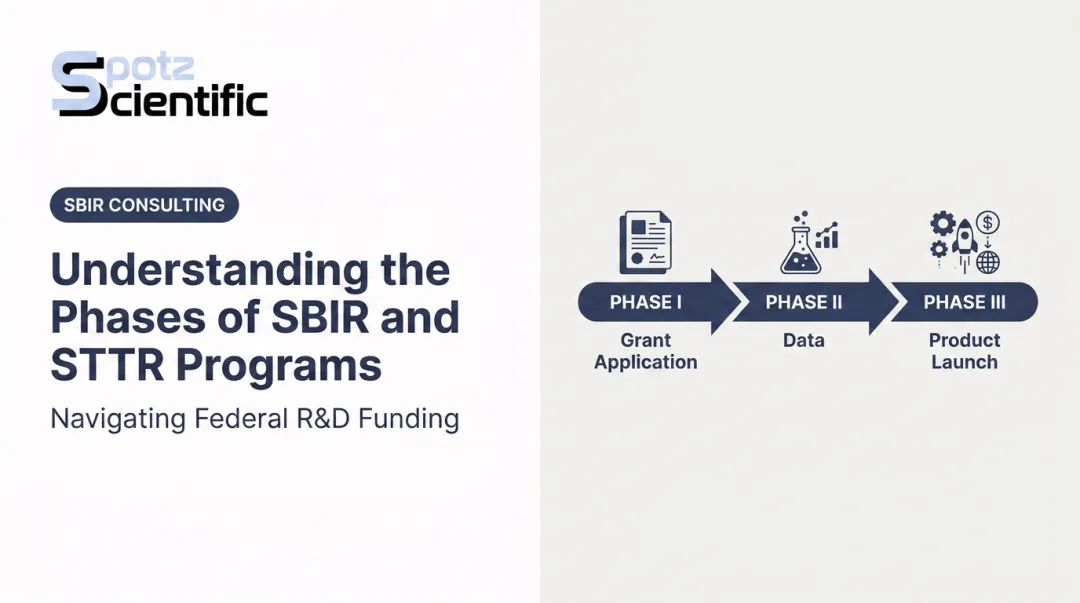
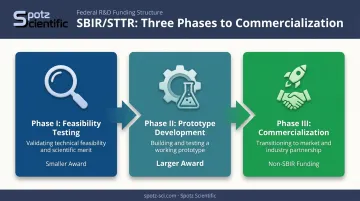
Both programs use the same three-phase structure:
- Phase I: Tests technical merit, feasibility, and commercial potential (typically a smaller feasibility award).
- Phase II: Continues R&D based on Phase I results, funding prototype development.
- Phase III: Commercializes the technology using non-SBIR/STTR funding, whether through private investment or government contracts.
Who Actually Qualifies
Eligibility rules haven't changed:
- For-profit U.S. business
- 500 or fewer employees, including affiliates
- At least 51% owned and controlled by U.S. citizens or permanent residents (with some statutory exceptions)
Meeting these criteria only gets you in the door. Which agency you target matters just as much.
DOE and NSF both participate in SBIR and STTR, making these programs directly relevant to scientific computing researchers, not just traditional startups. If your work touches high-performance computing, scientific machine learning, or computational modeling, these programs deserve a serious look, even if you've never thought of yourself as a "small business."
How Did We Get Here? Timeline of the Lapse and Reauthorization Fight
Congressional authorization for SBIR and STTR expired on September 30, 2025. The House had already passed a one-year "clean" extension, H.R. 5100, but the Senate blocked a unanimous consent request to pass it that same day. The Congressional Research Service (CRS) later described the interruption as a six-month lapse, one of the longest in the programs' history.
Behind the blockage sat two competing visions for reform:
| Bill | Sponsor(s) | Duration | Key Provisions |
|---|---|---|---|
| INNOVATE Act | Sen. Ernst | Through 2028 | Numeric proposal caps; reduced STTR set-aside |
| SBIR/STTR Reauthorization Act | Sen. Markey & Rep. Velázquez | Permanent | Set-asides rising to 7% (SBIR) and 1% (STTR) by FY2032 |
Then a separate 43-day federal government shutdown hit in October and November 2025, further delaying floor action and negotiations among the committees involved. Neither side had the votes to force the other's version through.
The breakthrough finally came in early 2026:
- The Senate passed the compromise bill, S. 3971, by unanimous consent on March 3, 2026.
- The House followed on March 17, 2026.
- After a delay tied to an unrelated presidential standoff over other legislation, the bill was signed into law on April 13, 2026, as Public Law 119-83.
The six-plus month gap wasn't just a paperwork problem. It disrupted new solicitations, created real cash flow gaps for firms waiting on award decisions, and stalled Phase III transitions across healthcare, defense, and research sectors alike.
What Changed? Key Reforms in the New Law
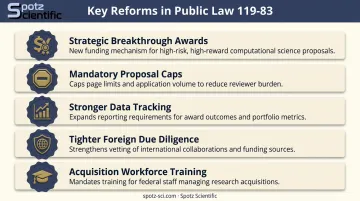
The enacted law lands as a moderate reform package rather than the sweeping overhaul either side originally wanted. Here's what actually made it into Public Law 119-83:
- Strategic Breakthrough Awards: Agencies can now allocate up to 0.50% of extramural R&D funding toward awards as large as $30 million over 48 months, helping Phase II companies transition into defense or commercial markets. Recipients need at least one prior Phase II award and 100% matching funds from non-SBIR/STTR sources.
- Mandatory proposal caps: Starting in FY2027, every agency must limit how many proposals a company can submit, whether structured by fiscal year, solicitation, or topic — directly addressing "SBIR mill" concerns. There's no single nationwide cap; agencies set their own limits.
- Stronger data tracking: Agencies must distinguish between direct-to-Phase-II awards, subsequent Phase II awards, Strategic Breakthrough awards, and Phase III contracts, linking follow-on awards back to original SBIR/STTR contract identifiers.
- Tighter foreign due diligence: Reviews must now explicitly cover foreign ownership, equity and debt obligations, key-personnel affiliations, and business relationships in countries of concern.
- Acquisition workforce training: SBA must train federal procurement staff on Phase III authority and sole-source award mechanisms, reducing the friction small businesses face when converting SBIR/STTR results into real contracts.
What didn't survive negotiations: the INNOVATE Act's steep STTR set-aside cut, its proposed $40,000 Phase IA awards, and its "emerging states" outreach provisions. The Markey-Velázquez bill's permanent authorization and escalating set-asides were also dropped. The final SBIR set-aside stays at 3.2%, and STTR stays at 0.45%.
What This Means for Renewal: Impact on Businesses and Research Institutions
"Renewal" here means something specific: agencies including DOE, NSF, DOD, and NIH can now resume issuing new solicitations after the multi-month freeze, effectively restarting FY2026 and FY2027 funding cycles.
DOE has already moved program management to its Office of Technology Commercialization and opened its FY2026 Phase I opportunity. NSF posted solicitation NSF 26-510 in May 2026, with deadlines running through the fall. NIH confirmed noncompeting continuation awards could resume in April 2026.
With these solicitations reopening, if you're holding a pending or expired Phase I or II award, watch closely for:
- Agency-specific guidance on resubmission windows
- Treatment of legacy contracts and pending decisions
- New proposal-cap rules that apply to your specific agency
Applicants should also prepare for the stricter foreign due diligence disclosures now baked into every solicitation. These disclosures function as a compliance checkpoint that can delay or derail an otherwise strong proposal.
Beyond compliance, firms nearing commercialization have a new option to evaluate: Strategic Breakthrough Awards. If you've already landed a Phase II award and can secure matching funds, this mechanism offers real money to bridge the gap toward Phase III, something the programs haven't historically funded well.
The most underrated part of this law is its length. A five-year authorization horizon through FY2031 gives businesses and research institutions actual planning certainty for multi-year R&D roadmaps, a welcome change after the pattern of short-term extensions that defined 2025.
Remaining Challenges for Small Business Innovation
Reauthorization solves the authority problem. It doesn't solve the harder structural problems that have dogged these programs for years.
The valley of death is still there. Strategic Breakthrough Awards help, but scaling from prototype to production still requires manufacturing capacity, workforce training, and long-term procurement commitments that no SBIR/STTR mechanism fully covers.
The "SBIR mills" concern may be overstated. A 2024 GAO review found that companies with 50 or more Phase II awards represented under 1% of all Phase II awardees between FY2011 and FY2020.
Yet those firms captured roughly 11% of Phase II awards and 10% of Phase II dollars. That's a real concentration issue, but a narrow one—the new proposal caps are a fairly blunt instrument aimed at a fairly small problem.
Political risk hasn't disappeared. The same disagreements that caused this lapse could resurface before FY2031. Smart businesses should:
- Build contingency plans that don't assume uninterrupted funding
- Diversify revenue beyond a single agency's SBIR/STTR cycle where possible
- Track legislative developments annually, not just at reauthorization deadlines
How to Prepare Your Next SBIR/STTR or Federal Research Proposal
Solicitations are reopening now, and competition will be fierce given the backlog of delayed proposals. For researchers and small businesses in scientific computing, that means aligning proposals tightly with DOE ASCR and NSF CISE priorities under the reformed programs, not just resubmitting what you had ready in September 2025.
A few things matter more now than they did before the lapse:
- Compliance first. New proposal-cap rules and due-diligence disclosures aren't afterthoughts anymore. Build them into your submission checklist from day one.
- Commercialization clarity. With Strategic Breakthrough Awards raising the bar for what "transition-ready" looks like, your commercialization plan needs to be concrete, not aspirational.
- Technical credibility. Program managers evaluating a more competitive pool will scrutinize technical narratives harder than in a normal year.
This is where an outside, program-manager-level perspective becomes invaluable. Spotz Scientific offers red-team reviews of draft proposals, drawing on founder Bill Spotz's eight years managing over $264 million in research as a DOE ASCR program manager.
That insider view of how proposals are evaluated—not just how they're written—helps catch weaknesses before a reviewer does. If you're preparing a submission for the reopened FY2026 or FY2027 cycles, an expert review provides time to fix problems instead of scrambling against a deadline.
Frequently Asked Questions
Did the SBIR program get renewed?
Yes. The Senate passed reauthorization on March 3, 2026, the House followed on March 17, 2026, and the bill was signed into law by mid-April 2026. SBIR and STTR are now authorized through FY2031.
What caused the SBIR/STTR lapse in 2025?
Authorization expired September 30, 2025, after the Senate blocked the House's one-year clean extension amid disagreement over structural reforms like proposal caps and set-aside changes.
How long is the SBIR/STTR program authorized now?
The program is authorized through fiscal year 2031, giving roughly five years of stability compared to the short-term extensions that preceded this reauthorization.
What is a Strategic Breakthrough Award?
It's a new award type worth up to $30 million, designed to help Phase II awardees transition their technology into defense or commercial markets. Recipients must provide 100% matching funds.
Will there be new proposal limits for SBIR/STTR applicants?
Yes. Starting in FY2027, agencies must cap the number of proposals a business can submit per fiscal year, solicitation, or topic. There's no single nationwide cap; each agency sets its own.
Which federal agencies participate in SBIR/STTR?
Eleven agencies participate in SBIR, including DOD, NIH, NSF, and DOE. Six of those, including NSF and DOE, also fund STTR.