Key Takeaways
- RAPID grants fund time-sensitive research where data or conditions will be lost if work is delayed — not a general fast-track mechanism
- Budget cap is $300,000 (including indirect costs) for up to 12 months, with a 5-page Project Description
- Program Officer concurrence is a mandatory first step — proposals submitted without it will be returned
- Quantify perishability with specific timelines, not vague urgency language
- RAPID awards are non-renewable; plan your follow-on funding strategy before submission
What Is an NSF RAPID Grant and When Does It Apply?
A hurricane makes landfall. A novel pathogen emerges. A bridge collapses into a river. In each scenario, there's a narrow window — days, maybe weeks — to collect irreplaceable scientific data before conditions change and the opportunity disappears permanently. NSF designed the Rapid Response Research (RAPID) mechanism for exactly these moments.
The mechanism is reserved for situations with genuine urgency — not as a general fast-track alternative to standard review timelines. Under PAPPG 24-1 Section II.F.2, RAPID applies only when severe urgency exists because access to data, facilities, or specialized equipment is genuinely perishable. If the work could wait six months for standard review, it doesn't qualify.
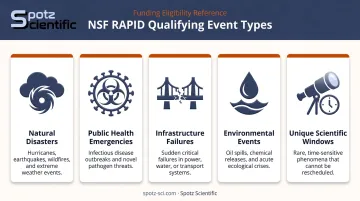
Qualifying Event Categories
Common RAPID-triggering scenarios include:
- Natural disasters — hurricanes, earthquakes, wildfires, floods
- Public health emergencies — disease outbreaks, contamination events
- Infrastructure failures — bridge collapses, power grid disruptions
- Environmental events — oil spills, harmful algal blooms
- Unique scientific windows — rare specimens, one-time observational conditions
Two cases illustrate the scale RAPID can reach. During COVID-19, NSF issued more than 400 RAPID awards by May 2020. After the Deepwater Horizon spill, NSF issued a Dear Colleague Letter specifically inviting RAPID proposals. One of those awards funded East Carolina University's research on crude oil effects on fish larvae development.
RAPID's Core Parameters
| Parameter | Requirement |
|---|---|
| Maximum budget | $300,000, including indirect costs |
| Maximum duration | 12 months |
| Project Description | 5 pages maximum |
| Proposal title | Must begin with "RAPID:" |
| Prior authorization | Concept Outline + Program Officer concurrence required |
| Review type | Internal NSF merit review (external review optional at PO discretion) |
| Renewal | Not renewable through this mechanism |
That final row in the table carries real strategic weight. RAPID awards are explicitly non-renewable. If your research warrants continued funding, the appropriate path is to use RAPID-collected data as the basis for a subsequent standard NSF proposal — not to request an extension of the RAPID award itself.
RAPID vs. EAGER: Choosing the Right Mechanism
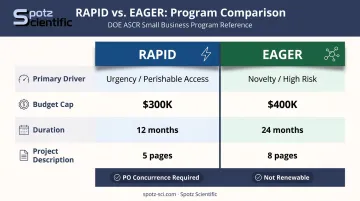
Researchers sometimes conflate RAPID and EAGER because both require Program Officer concurrence and bypass external panel review by default. The distinction is straightforward once you know what to look for.
RAPID is about time. The research must happen now because data or conditions are perishable.
EAGER is about risk. The idea is too novel or unconventional for standard review, with no time pressure attached.
Side-by-Side Comparison
| Dimension | RAPID | EAGER |
|---|---|---|
| Primary driver | Urgency — perishable access | Novelty — high-risk, high-payoff idea |
| Budget cap | $300,000 | $400,000 |
| Duration | 12 months | 24 months |
| Project Description | 5 pages | 8 pages |
| PO concurrence | Required | Required |
| Renewal | Not available | Not available |
If your work is both time-sensitive and scientifically novel, discuss with your Program Officer which mechanism fits better. The time-sensitivity of RAPID often makes it the stronger choice even when the approach is exploratory: novelty alone doesn't create a closing window, but a hurricane does.
How to Get Program Officer Concurrence Before You Submit
Program Officer (PO) concurrence is a formal submission control, not a courtesy step. Proposals submitted without it are returned without review — this is the gate that determines whether your RAPID proposal enters the pipeline at all.
What to Include in Your Initial Contact Email
Keep the email to one page or less. Cover four things:
- The triggering event — what happened and why it matters scientifically
- What's at risk — what data or conditions are perishable and on what timeline
- What you propose — a concise description of the work and why your team is positioned to do it
- Deployment readiness — equipment availability, IRB approvals if applicable, field access
POs in disaster-prone fields — natural hazards, infectious disease, climate extremes — expect these inquiries and are prepared to respond quickly. The entire exchange from first contact to submission can happen in under two weeks, which is why having your materials ready before you reach out makes a measurable difference.
Prepare Before an Event Occurs
Researchers in fields where RAPID-triggering events are foreseeable should know their Program Officer before an event strikes. Build basic field protocols in advance. Have equipment lists ready. When a qualifying event occurs, the researchers who respond in days — not weeks — are the ones who capture the data.
Documentation Requirement
Once your PO concurs, their concurrence email must be uploaded to Research.gov as a supplementary document, typically titled "RAPID – Program Officer Concurrence Email." Answer any PO questions within hours during the exchange. That responsiveness demonstrates the same operational readiness your proposal will need to convey on the page.
How to Write a Compelling 5-Page RAPID Proposal
Five pages have to establish scientific rigor and make urgency undeniable. Most researchers are trained to open with background literature — for RAPID, that's the wrong approach. Lead with the event and what's at stake. Program Officers already know the field.
Recommended Page Structure
| Section | Suggested Length |
|---|---|
| Triggering event and what data/conditions are at risk | 0.5–1 page |
| Research objectives (2–3 focused objectives, not a broad agenda) | 0.5 page |
| Data collection plan — what, how, when, where, and why delay means loss | 1.5–2 pages |
| Analysis approach and expected outcomes | 0.5–1 page |
| Team qualifications and deployment readiness | 0.5 page |
| Broader Impacts | 0.25–0.5 page |
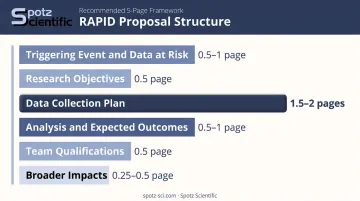
The data collection plan is the proposal's core. This is where most proposals succeed or fail.
Quantify Perishability — Specifically
Vague urgency language does not move Program Officers. Compare these two framings:
A weak framing reads: "Conditions are changing rapidly and data collection should begin soon." A strong one reads: "Floodwaters will recede within 10 days, after which sediment samples will be unrecoverable and the contamination gradient will be permanently altered."
The second version gives the PO something concrete to evaluate. Specific timelines, named data types, and clear loss conditions are far more persuasive than general claims of urgency.
Keep the Budget Lean
$300,000 should go primarily toward field deployment, data collection, and essential personnel. Avoid equipment purchases that could be handled through institutional resources — they raise questions about whether the scope is genuinely sized for a 12-month effort. A credible, achievable plan within the budget cap strengthens the proposal.
Don't Skip Broader Impacts
Space is limited, but NSF evaluates Broader Impacts for every proposal type — RAPID included. A brief, direct statement works: informing emergency response protocols, enabling rapid data sharing with the broader research community, or training students through real-world field deployment. Omitting it signals a misunderstanding of NSF requirements.
Getting an Outside Read on Your Proposal
Program-side experience makes a measurable difference when reviewing whether your urgency argument holds, your scope is appropriately sized, and your data collection plan is concrete enough to withstand scrutiny. Spotz Scientific — led by Dr. Bill Spotz, who spent eight years as a program manager at the U.S. Department of Energy Office of Science and managed over $264 million in scientific computing research — offers proposal consulting and red team review for federal agency submissions.
Given RAPID's compressed timelines, a premium review rate of $300/hour applies when materials arrive less than two weeks before the deadline. Contact Dr. Spotz at info@spotz-sci.com.
Common Mistakes That Sink RAPID Proposals
Most RAPID proposals fail for one of a small set of predictable reasons.
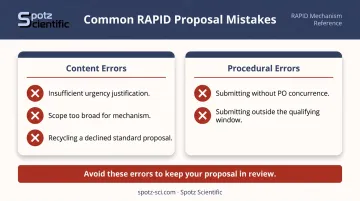
Content Errors That Disqualify Proposals
1. Insufficient urgency justification. If a Program Officer reads your proposal and concludes the work could wait six months for standard review, it won't be funded as RAPID. The policy is explicit: RAPID is not for work appropriate for a regular NSF proposal. Urgency must be demonstrated, not asserted.
2. Scope too broad for the mechanism. Five pages and $300,000 demand tight focus. A proposal that tries to address a wide research agenda signals the researcher doesn't understand what RAPID is designed for. Two to three focused objectives are appropriate; a sweeping research program is not.
3. Recycling a declined standard proposal. Shortening an existing proposal and adding urgency language produces a fundamentally misaligned document. RAPID proposals are structured differently, prioritize different content, and serve a different purpose. They require original framing from the start.
Procedural Mistakes That Get Proposals Returned
- No PO concurrence means automatic return. Submitting without prior Program Officer approval is a disqualifying error — the proposal will not be reviewed.
- Submitting outside the qualifying window. If the triggering event occurred months ago and conditions have stabilized, RAPID is no longer appropriate. Submitting anyway undermines credibility with the program office.
What to Expect After a RAPID Award
Post-Award Obligations
- Annual reports are due in Research.gov no later than 90 days before the end of each budget period
- Final reports — including a public Project Outcomes Report — are due within 120 days of the award end date
- No-cost extensions of up to 12 months are possible when unspent funds remain and more time is needed; the AOR submits the request in Research.gov at least 10 days before expiration
Plan your 12-month period so data collection completes early, leaving time for analysis and reporting. Overdue reports can delay future NSF administrative actions.
Planning Your Follow-On Research
Once your reporting obligations are met, the data you've collected becomes your next strategic asset. RAPID awards don't fund long-term programs, but the time-bound findings they generate serve as strong preliminary evidence for a subsequent standard NSF proposal. Design your data collection with that transition in mind:
- Identify what questions a full-scale follow-on proposal would need to answer
- Capture data at a scope and resolution that supports those larger claims
- Document methodological decisions so reviewers can assess rigor and reproducibility
- Position your RAPID outcomes as proof-of-concept, not a standalone endpoint
Frequently Asked Questions
What is an NSF proposal?
An NSF proposal is a formal application submitted by researchers or institutions to the National Science Foundation requesting funding for a scientific research project. NSF offers multiple proposal types — including standard grants, CAREER awards, and RAPID grants — each designed for different research contexts and timelines.
Is NSF still accepting proposals?
NSF accepts proposals year-round across its programs, though specific programs have their own deadlines and submission windows. RAPID proposals in particular can be submitted at any time of year once Program Officer concurrence is obtained, making them accessible whenever a qualifying event occurs.
What is the NSF two-month rule?
The two-month rule limits how much salary a Principal Investigator can charge to NSF awards in a given year — generally no more than two months of regular salary across all NSF-funded projects. RAPID budget planning must account for this constraint when allocating personnel costs; the rule applies to RAPID with no exceptions.
Can RAPID proposals be renewed?
RAPID awards are explicitly non-renewable — the mechanism is designed for a one-time, time-bounded research effort. Researchers looking to build on that work should submit a standard NSF proposal, citing RAPID results as preliminary findings.
How long does it take to receive a RAPID funding decision?
Because RAPID proposals are reviewed internally by Program Officers without mandatory external panel review, decisions can come in weeks rather than the 6–9 months typical for standard proposals. In major disaster situations, NSF has expedited decisions even further.
Do RAPID proposals require preliminary data?
PAPPG 24-1 does not require preliminary data for RAPID proposals — the qualifying criterion is urgency, not prior results. That said, demonstrating team readiness, relevant field experience, and existing protocols shows the Program Officer your team can execute immediately.