Good science alone doesn't win. Every serious applicant has good science. What separates funded proposals from declined ones is how the idea gets framed, structured, and stress-tested before a reviewer ever opens the file.
This guide covers the exact process: what to confirm before you start writing, a step-by-step framework for the proposal itself, the factors reviewers weigh most, and how to recover if you're not funded on the first try.
Key Takeaways
- Match your idea to the funder's mission—strong science alone rarely wins
- Focused aims, feasible methods, and a justified budget outweigh broad ambition
- Most rejections come from preventable issues: vague goals, ignored formatting rules, or skipped outside review
- Resubmitting with reviewer feedback—or pivoting to a better-fit program—improves long-term odds
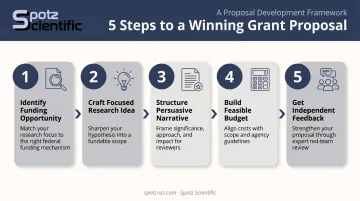
How to Write a Winning Grant Proposal: A Step-by-Step Framework
A competitive proposal follows a deliberate process that starts weeks before you open a blank document. Treat it as a sequence, not a writing sprint the week before the deadline.
Step 1: Identify the Right Funding Opportunity and Agency Priorities
Read the entire Notice of Funding Opportunity (NOFO), not just the abstract. DOE's FY2026 Office of Science NOFOs are organized into nine sections, from eligibility through review criteria, and skipping any of them is an easy way to get eliminated before review even begins.
Before writing anything:
- Study recent award history. Search NSF's award database and DOE ASCR's funding opportunity index for abstracts of funded projects in your area.
- Check for "out of scope" language. ASCR's own proposal guidance flags this as a common trap for otherwise strong ideas that simply don't fit the current call.
- Confirm deadlines, page limits, and required sections. Technical non-compliance can trigger an administrative rejection before a single reviewer reads your science.
If your idea doesn't map cleanly onto what the program has already funded, that's worth knowing now, not after three months of writing.
Step 2: Craft a Focused, Compelling Research Idea
Narrow your research question into 2-4 specific, testable aims. Neither NSF's PAPPG nor DOE guidance mandates an exact number, but both expect clear objectives, methods, and significance stated up front.
Each aim should be:
- Novel and significant enough to justify funding on its own
- Logically connected to the other aims, without depending entirely on them
- Framed as a concrete, falsifiable hypothesis
ASCR's own review guidance specifically flags weak hypothesis framing, like "we will build a better, faster tool," as a red flag. Reviewers want a scientific question that could plausibly be wrong, not a vague engineering promise.
With some CISE units funding as few as 15% of applicants, that sharpness is what creates separation.
Step 3: Structure a Persuasive Narrative That Tells Your Research Story
Open broad: why does this problem matter to the field? Narrow to the specific gap your work addresses, then present your methods as the solution. Reviewers are often generalists relative to your specific subfield, so plain, jargon-light language matters more than technical density.
NSF weighs two criteria equally: intellectual merit and broader impacts. Neither is sufficient on its own. DOE's Office of Science applies its own standard, checking for sufficient technical content, completeness, and relevance to the agency's mission.
Whichever agency you're targeting, state explicitly how your aims connect to its stated priorities. Don't make the reviewer infer alignment. Say it directly.
Step 4: Build a Feasible, Well-Justified Budget and Timeline
Every line item in your budget should trace back to a task described in the narrative. Reviewers cross-check costs against the proposed work, and unexplained expenses raise doubts about your planning.
NSF's budget justification typically runs up to 5 pages, and it must document and justify every line for every requested year. A few practical rules:
- Map each cost to a task. If you're requesting compute time, name the specific aim it supports.
- Build a realistic timeline. Include milestones and clear ownership for each task.
- Address feasibility directly. A power analysis, benchmark comparison, or preliminary data set shows reviewers the work is achievable, not just hoped for.
DOE's ASCR reviewers specifically look for how a proposal handles both scientific and execution risk, meaning they want evidence your team is staffed and resourced to actually pull this off.
Step 5: Get Rigorous, Independent Feedback Before You Submit
Circulate your draft to subject-matter experts, but also to at least one colleague outside your subfield. If a smart non-specialist can't follow your logic, a mixed review panel probably can't either.
Many teams also bring in an outside reviewer for a red-team pass: a critical review designed to mimic how a real DOE or NSF panel would score the draft.
Bill Spotz, a former DOE ASCR program manager who managed more than $264 million in scientific computing research, offers this kind of review through Spotz Scientific. His perspective comes from years of seeing which proposals get funded and which get declined.
Whatever feedback you get, revise based on it. The goal is a fundable proposal, not preserving your original draft.
Is This the Right Grant for You? What You Need Before You Start Writing
Confirming fit before you write saves months of wasted effort. A technically strong proposal submitted to the wrong program still gets declined.
Before drafting, verify:
- Genuine fit. Does the opportunity match your research direction and your institution's actual capacity to execute it?
- Institutional readiness. Many agencies require compliance sign-off, cost-share commitments, or facility access confirmed before submission, not promised after award.
- Reusable materials. Gather team biosketches, prior related work, and organizational history early so you're not scrambling during the final week.
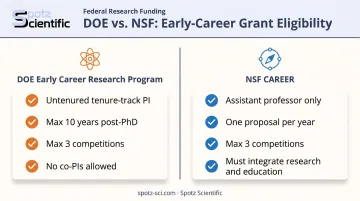
Eligibility rules vary sharply by program. Early-career applicants especially need to check the fine print:
DOE Early Career Research Program (FY2026):
- PI must be an untenured, tenure-track assistant or associate professor at the applying institution.
- No more than 10 years between your PhD and the start of the federal fiscal year (for FY2026, that means a doctorate on or after January 1, 2015).
- No more than 3 ECRP competitions total, and no co-PIs allowed.
NSF CAREER (2022-2026 solicitation):
- PI must be an assistant professor or equivalent; tenured associate professors are ineligible.
- One CAREER proposal per year, capped at 3 competitions, with no prior CAREER award.
- Must integrate research and education within your organization's context.
Mismatched eligibility is one of the most avoidable ways to lose months of preparation.
Key Factors That Determine Whether Your Grant Gets Funded
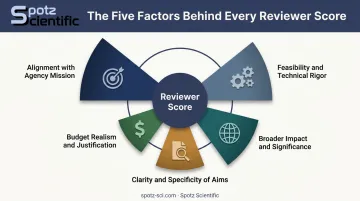
Reviewers score proposals against several weighted criteria. Writing directly to these factors, rather than hoping strong science speaks for itself, improves your odds.
Alignment With Agency Mission and Program Priorities
Reviewers score fit against the funding call itself. Excellent science still gets rejected when it sits outside that program's stated priorities. Mirror the NOFO's language in your framing so relevance is obvious on a first read—not something the panel has to infer.
Feasibility and Technical Rigor
Reviewers need evidence that your methods can answer the question inside the stated budget and timeline. Weak or missing technical justification is among the most commonly cited reasons for decline, especially when preliminary data or risk-mitigation plans are thin.
Clarity and Specificity of Aims
Vague, sprawling aims leave reviewers unsure what success would even look like. Sharply defined, testable aims give them a clear basis to recommend funding—and make progress easy to evaluate at annual review.
Budget Realism and Justification
Panels cross-check every major line item against the work described. Unexplained or inflated costs read as weak planning, not ambition. Tie each significant request to a specific aim or deliverable.
Broader Impact and Significance
Federal agencies expect an explicit statement of how the work benefits the field or society beyond immediate results. Describe that impact in concrete terms—who uses the methods, what capability improves, what community gains access—rather than resting on general claims of importance.
Common Mistakes to Avoid (and How to Recover If You're Not Funded)
Most rejections come from a short, predictable list of preventable errors:
- Overly broad aims that try to cover too much ground in a single proposal
- Ignoring formatting or eligibility rules, which can trigger administrative rejection before review even begins
- Skipping external review and submitting a first draft with zero outside feedback
- Treating the budget as an afterthought instead of tying every cost to a described task
If you're declined, the process doesn't end there. Federal agencies typically send reviewer comments, and those comments are worth more than the rejection itself.
- Request the reviewer feedback. NSF and DOE typically send declined applicants the reviews and the specific reasons considered during evaluation.
- Decide: resubmit or pivot. If the core science was well received but execution needs work, revise and resubmit. If reviewers flagged a mission mismatch, a different program or agency may fit better.
- Bring in outside expertise for the next round. A red-team review or strategic advisory session on the specific NOFO can catch what internal reviewers missed. Spotz Scientific provides this external review for scientific computing proposals to agencies such as DOE and NSF.
Conclusion
Winning a grant is a process: matching your idea to the right opportunity, writing a clear and feasible narrative, and getting rigorous feedback before you hit submit. Most rejections stem from preventable issues, not a shortage of good science.
Researchers who treat proposal writing as a coachable, repeatable skill—and who bring in outside expert review—see stronger results across funding cycles. Spotz Scientific provides that red-team review for scientific computing proposals headed to agencies such as DOE and NSF.
Frequently Asked Questions
What are the chances of winning a grant?
Federal success rates vary widely by agency and program, often falling between 10-20%. First-time applicants should expect more than one submission cycle before securing funding.
How do you win a grant?
Winning requires matching a focused idea to the right funder, following a clear step-by-step writing process, and getting rigorous outside feedback before submission. Rushing any of these steps usually shows in the final score.
What makes a grant proposal stand out to reviewers?
Clarity of aims, demonstrated feasibility, and explicit alignment with the funder's mission. Reviewers reward proposals that make their job easy, not ones that require guesswork.
How long should you spend preparing a grant proposal before submitting?
Start several months in advance to allow time for drafting, internal review, and at least one full revision cycle. Compressed timelines usually mean skipped feedback—and weaker proposals.
What is a "red team" review, and why does it help?
It's a critical, panel-style review of a draft proposal designed to surface weaknesses before real reviewers see them. It works best when the reviewer has actual experience sitting on or managing agency review panels.
Should I contact the program officer before submitting my proposal?
Yes. Both NSF and DOE encourage pre-submission conversations with program officers, and these conversations can clarify fit and sharpen alignment with program priorities before you invest months in writing.