The instinct to handle proposals internally makes sense on paper. Why pay for outside help when your researchers know the science better than anyone? The problem is that knowing the science and knowing how program officers evaluate it are two very different things — and the gap between them is where proposals die.
Key Takeaways
- Grant consultants with agency-side experience understand how proposals are evaluated internally, not just technically
- Federal grant proposals average 120 hours of preparation time — hours your senior researchers can't afford to lose
- NSF and DOE each use distinct evaluation criteria that require tailored strategic responses — not a one-size-fits-all approach
- Pre-submission red team review catches misalignments before a rejection notice does
- Consulting costs are a small fraction of the grant awards being pursued — which often range from $400K to $875K or more
What Grant Consulting for Research SMEs Actually Covers
Grant consulting in the federal research context means more than hiring someone to polish your prose. It's a strategic service where an external expert with direct agency experience helps you identify fundable opportunities, shape your proposal around program priorities, and pressure-test your draft before it reaches reviewers.
This applies directly to programs like:
- DOE ASCR open calls and competitive research solicitations
- NSF CISE directorate programs
- DOE Early Career Research Program (approximately 100 awards planned for 2026)
- NSF CAREER awards (minimum $400,000 over five years, with higher minimums for BIO, ENG, and OPP directorates)
Across these programs, the structural demands are consistent: strict page limits, rigorous review criteria, and panels that weigh scientific quality alongside programmatic fit. A consultant who understands that distinction can mean the difference between a competitive submission and a preventable decline.
The goal is improving your probability of success. That requires both scientific credibility and strategic positioning — two things that rarely align without deliberate effort.
Three Reasons to Outsource Grant Consulting
Access to Agency-Side Expertise
Experienced grant consultants bring something internal teams genuinely cannot replicate: an understanding of how proposals are evaluated from inside the agency.
NSF reviewers score submissions on both Intellectual Merit and Broader Impacts — and Broader Impacts is not an optional outreach section. Program officers then factor in portfolio balance, strategic priorities, and available funds.
DOE's Office of Science adds another layer: merit review criteria include scientific merit, method appropriateness, team competence, and budget reasonableness, with program-policy factors applied afterward. A technically sound proposal can fail on any of these dimensions without ever receiving a substantive critique.
Consultants who have worked as program managers at these agencies know exactly how this plays out in practice. They can identify when a proposal's framing signals unfamiliarity with the program's current direction, flag sections likely to draw scrutiny during review, and help position the work within the broader portfolio the agency is trying to build.
Spotz Scientific's consulting model is built on exactly this kind of insider knowledge. Bill Spotz spent eight years as a program manager at DOE's Advanced Scientific Computing Research office, where he co-led the applied mathematics program and managed over $264 million in scientific computing research. He has sat on the evaluation side of the table and watched proposals succeed and fail for reasons that applicants rarely understand from the outside.

When it matters most: High-stakes, limited-attempt programs like DOE Early Career and NSF CAREER. Applicants typically get narrow windows to apply, and a misaligned submission doesn't just waste months — it can set a research trajectory back by years.
Significant Time Savings for Research Teams
NSF estimates federal grant proposals require an average of 120 hours of preparation per submission — and that figure covers administrative burden broadly, not just the time a PI spends writing. For a research SME without a dedicated grant development office, those hours fall on the most senior and expensive members of the team.
That's the real cost. A principal investigator diverted to proposal development for weeks isn't just inconvenienced — they're pulled away from experiments, publications, student mentorship, and active project work. The hourly value of a senior researcher's time often exceeds the cost of an outsourced consultant, which means internal proposal development frequently costs more than it appears to.
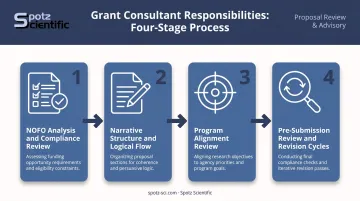
Outsourcing shifts the structural and strategic burden to a specialist. The consultant handles:
- NOFO analysis and compliance review
- Narrative structure and logical flow
- Alignment between proposed work and stated program goals
- Pre-submission review and revision cycles
Research staff contribute the technical content — the science they know best — without getting buried in proposal logistics. For teams pursuing multiple funding opportunities in a single cycle, this is often the only way to maintain submission quality without burning out staff or delaying active research.
In practical terms: more researcher hours recovered per cycle, more competitive submissions per year, and fewer proposals lost to deadline slippage.
Higher Success Rates Through Strategic Alignment and Red Team Review
Strategic alignment means identifying which programs are actually worth pursuing before committing to a full application. This sounds obvious, but many research SMEs apply broadly — spending weeks on a proposal to a program whose current priorities don't match the research agenda. A consultant with program-side knowledge can assess fit early, preventing months of wasted effort and improving the ratio of competitive submissions in a funding cycle.
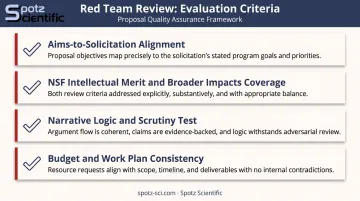
Red team review means evaluating a draft proposal through the lens of a skeptical reviewer panel — before submission rather than after rejection. The consultant examines:
- Whether the aims map clearly to the solicitation's stated goals
- Whether every review criterion (NSF's Intellectual Merit and Broader Impacts, DOE's merit and mission factors) is explicitly addressed
- Whether the narrative logic holds up under critical scrutiny
- Whether the budget and work plan are internally consistent
Consulting fees are a fraction of the grant value being pursued. DOE Early Career university awards for 2026 are planned at approximately $875,000 over five years; NSF CAREER minimums start at $400,000. Even a modest improvement in success probability produces a strongly positive return on the consulting investment.
Spotz Scientific's red team review service is built around exactly this process — Dr. Spotz reviews draft proposals and pre-proposals as a critical outside evaluator, identifying weaknesses that the submitting team, too close to their own work, won't catch on their own.
When this matters most: First-time applicants to a specific program, researchers pivoting to a new funding agency, and teams rebuilding their strategy after a prior rejection.
What Happens Without Grant Consulting Support
The pattern is consistent and costly. Research SMEs managing grant development internally tend to apply broadly without filtering for fit and submit proposals that are scientifically credible but programmatically misaligned. Rejections arrive with little actionable feedback.
After several cycles of this, teams often disengage from federal funding altogether — not because they lack competitive research, but because the process feels impossible to win.
The compounding damage goes beyond individual proposal failures:
- No coherent funding strategy develops — teams react to deadlines instead of planning around program cycles
- Early-stage opportunities like pre-proposals get missed or deprioritized
- Institutional knowledge doesn't accumulate from one cycle to the next
- Program officers never become familiar with the research agenda
NSF's FY2023 Merit Review data shows early-career PIs funded at a 26% rate versus the overall 29% NSF average. That gap points directly to proposal development challenges — the kind that external consulting is designed to close.
That misalignment is especially costly for DOE Early Career and NSF CAREER applicants. Both programs are built around a specific vision of early-career research trajectories, and a proposal that doesn't reflect that vision, however technically strong, won't advance past review.
Getting the Most Value from an Outsourced Consultant
Outsourcing works best when it starts early. Engaging a consultant after a draft is written limits what's possible — you get a review of what exists rather than strategic shaping of what gets built. Engaging before a NOFO is even published creates the most room to position the research narrative around program priorities.
For Spotz Scientific clients specifically, the pricing structure reflects this directly. The standard rate of $200–$250/hour applies when materials are submitted more than two weeks before a NOFO deadline; a premium rate of $250–$300/hour applies for expedited reviews. The financial incentive and the strategic incentive point in the same direction: earlier is better.
Early timing alone isn't enough, though. The most effective engagements involve genuine information sharing from the start. Giving the consultant access to the right materials makes the difference between a surface-level review and a strategically targeted submission:
- Existing technical documentation and prior proposals
- A clear description of the current research agenda
- Honest context about prior submissions or rejections
That depth of input allows for a more accurate read on which programs are realistic targets — and a stronger, better-positioned final submission.
Conclusion
For research teams and institutions without dedicated grant development staff, outsourcing grant consulting is a practical decision. Federal funding is competitive, and success consistently goes to proposals that reflect insider knowledge, strategic positioning, and disciplined development.
The advantages compound over time. Each successful engagement builds institutional understanding of how to approach specific agencies, which programs genuinely fit the research agenda, and how to position submissions for continued funding rather than isolated wins. That accumulated knowledge translates directly into stronger future submissions — and a consulting relationship built around your specific research focus is one of the most efficient ways to develop it.
Frequently Asked Questions
Why do SMEs outsource grant consulting?
Research SMEs typically lack the internal bandwidth and agency-specific expertise to develop competitive federal proposals without pulling senior researchers away from their core work. Outsourcing addresses both problems: a specialist handles the strategic and structural burden while your team focuses on the science.
What is the role of a grant consultant?
Grant consultants provide strategic guidance across the full funding cycle — funder identification, alignment with program priorities, pre-submission red team review, and advice on which opportunities are worth pursuing. Rather than writing proposals for you, they strengthen your approach and sharpen what you've built.
How much does a grant consultant cost?
Costs vary based on scope and engagement type. Spotz Scientific charges $200–$250/hour for standard engagements and $250–$300/hour when materials arrive fewer than two weeks before a NOFO deadline. Evaluated against grants worth $400,000 to $875,000 or more, consulting fees represent a small fraction of a successful award.
How do federal grants impact small business growth?
Federal research grants provide non-dilutive funding that lets SMEs advance R&D, build credibility with future investors and partners, and establish a track record with major agencies — all without giving up equity. That track record also opens doors to larger future awards.
What is the difference between a grant writer and a grant consultant?
Grant writers focus on drafting proposal documents. Grant consultants provide broader strategic guidance: opportunity assessment, funder alignment, red team review, and long-term funding strategy, often backed by specific domain expertise in particular agencies or research programs.
When should a research SME hire a grant consultant?
The best time is at the start of a funding cycle, ideally before a specific NOFO is published. Consulting is particularly valuable when entering a new agency's program for the first time or preparing for high-stakes programs like DOE Early Career or NSF CAREER, where submission opportunities are limited.