Introduction
Every year, hundreds of assistant professors submit NSF CAREER proposals that never reach a single reviewer. Not because the science is weak — because the proposal violated a formatting rule, exceeded a page limit, or was missing a required document. NSF's compliance checks are automatic and unforgiving.
The CAREER award (formally the Faculty Early Career Development Program) is NSF's flagship early-career grant: five years of sustained funding for tenure-track faculty who can articulate a unified vision of research and education.
According to the current NSF CAREER solicitation (NSF 22-586), NSF estimates approximately 500 awards per year, with top awardees eligible for nomination to the Presidential Early Career Awards for Scientists and Engineers (PECASE).
This guide covers every required section, the exact page limits enforced under PAPPG NSF 24-1, how to write the 15-page Project Description, and the integration standard that reviewers weight most heavily when evaluating research-education coherence.
Key Takeaways
- The Project Description is capped at 15 pages — figures, tables, and charts count against this limit
- Missing the Departmental Letter or listing a co-PI gets your proposal returned without review
- Research and education must be genuinely integrated — not bolted together as two separate plans
- The annual deadline is the 4th Wednesday of July (July 22, 2026 for the current cycle)
- PIs are limited to three CAREER competitions total across their career
What Is the NSF CAREER Award?
The Faculty Early Career Development Program is NSF's Foundation-wide flagship grant for tenure-track faculty. It funds five years of integrated research and education, with minimum total awards of:
- $400,000 for most directorates
- $500,000 for BIO, ENG, and OPP directorates
What separates CAREER from standard NSF research grants is the integration requirement. NSF doesn't want a research plan and an education plan sitting next to each other: it wants evidence that these two activities reinforce each other as a unified career vision. A proposal that reads as "here's my lab work, and here are some students I'll mentor" will score poorly regardless of how strong the science is.
Beyond the funding itself, a CAREER award also opens the door to national recognition. NSF selects up to 26 nominees per year for the Presidential Early Career Award for Scientists and Engineers (PECASE) from among CAREER awardees. That eligibility is automatic with the award — nomination is not.
NSF CAREER Proposal Structure and Page Limits
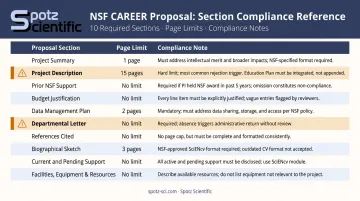
Every section has a firm limit. Proposals that exceed those limits or use non-compliant formatting are returned before any reviewer reads the science. Use this table as a reference throughout your preparation.
| Section | Page Limit | Notes |
|---|---|---|
| Project Summary | 1 page | Must include labeled Intellectual Merit and Broader Impacts statements |
| Project Description | 15 pages | All figures, charts, and tables count against this limit; no URLs permitted |
| Results from Prior NSF Support | Up to 5 of the 15 pages | Not additional pages — counted within the 15-page limit |
| Budget Justification | 5 pages per proposal | Subawards have a separate 5-page maximum |
| Data Management and Sharing Plan | 2 pages | Uploaded as a supplementary document |
| Departmental Letter | 2 pages | Must go in Supplementary Documents, not Single Copy Documents |
| References Cited | No limit | Citations only — no narrative that circumvents the Project Description limit |
| Biographical Sketch | No hard limit | Must be prepared in SciENcv |
| Current and Pending Support | No hard limit | SciENcv format required |
| Facilities, Equipment, and Resources | No hard limit | Narrative only; no financial figures |
Formatting Requirements That Apply Everywhere
NSF's font and margin rules are non-negotiable:
- Approved fonts: Arial, Courier New, or Palatino Linotype at 10pt or larger; Times New Roman or Computer Modern at 11pt or larger
- Line density: No more than six lines of text per vertical inch
- Margins: At least one inch on all sides — no text may appear in the margins
Using a smaller font to squeeze in an extra paragraph is grounds for return without review.
Formatting compliance is checked before reviewers ever open your file. Document upload locations are subject to the same scrutiny.
A Critical Note on Required Documents
The Departmental Letter must be uploaded under Supplementary Documents — not Single Copy Documents. This upload location error is common, and it triggers return without review. The letter confirms your tenure-track status and your department's support for the proposed work; without it, the proposal is administratively incomplete.
Letters of Collaboration, if included, must use this exact sentence format per the solicitation: "If the proposal submitted by Dr. [PI full name] entitled [proposal title] is selected for funding by NSF, it is my intent to collaborate and/or commit resources as detailed in the Project Description or the Facilities, Equipment and Other Resources section of the proposal." Any deviation from this wording may result in return without review — and letters of support or recommendation for the PI are not permitted.
Writing the 15-Page Project Description
The Project Description is where proposals succeed or fail. NSF does not require separate labeled sections for research and education — you can intersperse them if that serves the presentation — but the connection between the two must be explicit and substantive throughout.
Research Plan
The research component needs a focused, five-year scope. Reviewers assess:
- Feasibility — Is the proposed work achievable in five years with the resources described?
- Novelty — What does this work contribute that current approaches cannot?
- Independence — Does this demonstrate the PI can lead a sustained research program?
Specific objectives, clear methods, preliminary data where available, and a realistic annual milestone timeline are expected. Reviewers consistently score broad or vague research scopes poorly — if the five-year scope reads like a ten-year program, expect pushback on feasibility.
Education Plan
Generic education statements are one of the most consistent weaknesses in CAREER proposals. "I will mentor graduate students" is not an education plan. An evaluable education plan includes:
- Specific activities and their design rationale
- Clearly identified target populations (K-12, undergraduates, graduate students, or the general public)
- Estimated reach — how many participants, over what timeframe
- An evaluation method that can demonstrate whether the activities achieved their goals
- A sustainability plan that extends beyond the five-year award period
NSF expects the education plan to receive the same level of rigor as the research plan. Reviewers flag weak education sections explicitly under Broader Impacts — and those scores drag down the overall rating.
Integration Narrative
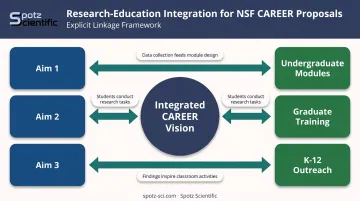
Research and education plans that are parallel but not connected — where the education activities could be lifted out and dropped into any other proposal — do not meet NSF's integration standard. This is the most common structural failure in otherwise competitive CAREER submissions.
Integration means the research and education activities inform each other in specific, describable ways. Examples include:
- Research data used in undergraduate coursework modules developed under the award
- Graduate student research training explicitly tied to the project's scientific questions
- K-12 outreach content drawn directly from the research's subject matter
Use explicit language to make these connections visible. A sentence like "the datasets generated in Aim 2 will directly populate the undergraduate module described in Section 3" does more work than a paragraph of general integration claims.
Results from Prior NSF Support
If any PI holds an active NSF award or one that ended within the past five years, results must be reported under two explicit headings: Intellectual Merit and Broader Impacts. This section counts against the 15-page limit — up to 5 of those pages may be used for it, but those pages are not additional to the limit.
Early-career faculty with limited prior NSF funding should not fabricate results or inflate this section. If prior support is minimal or absent, the section can be brief or omitted accordingly. What matters is accuracy and honest framing.
Intellectual Merit and Broader Impacts: What Reviewers Actually Evaluate
Both merit review criteria must be addressed explicitly throughout the Project Description — not just in the Project Summary, and not just in a single paragraph at the end. Reviewers are instructed to evaluate how well each criterion is satisfied across the full narrative.
What Reviewers Assess Under Intellectual Merit
- The novelty and significance of the research questions
- Rigor and appropriateness of the methodology
- The PI's qualifications and capacity to carry out independent research
- Availability of adequate resources to support the work
What Reviewers Assess Under Broader Impacts
- Quality and specificity of the education plan — this is the primary Broader Impacts vehicle for CAREER proposals
- Activities that broaden participation of underrepresented groups in STEM
- Societal benefits of the research
- Dissemination plans for findings and educational materials
Use headers or callout language within the Project Description to mark where each criterion is addressed. In proposals that weave research and education together — rather than presenting them in separate labeled sections — this helps reviewers navigate the document without hunting for coverage of each criterion.
That navigation becomes especially important because relegating either criterion to a single paragraph — often placed at the very end of the Project Description — is one of the most common and costly mistakes in CAREER submissions.
Eligibility Requirements and Submission Rules
Who Can Apply
All five conditions must be met as of the annual deadline:
- Hold a doctoral degree in an NSF-supported field
- Be engaged in research in an area supported by NSF
- Hold at least a 50% tenure-track or tenure-track-equivalent appointment as an assistant professor or equivalent
- Be untenured as of the deadline
- Have never previously received a CAREER award
Associate professors — tenured or not — are ineligible. Adjunct faculty are ineligible. NSF 22-586 states that no exemptions from these criteria will be granted.
Meeting these eligibility criteria gets you in the door — but the competition itself has structural rules that carry equal weight.
Competition Rules
- One CAREER proposal per PI per annual competition
- Maximum of three CAREER competitions total per PI
- Proposals returned without review (for non-compliance) do not count toward the three-competition limit
- No co-PIs permitted on the Cover Sheet
Submission Timeline
The deadline is the 4th Wednesday of July — July 22, 2026 for the current cycle. NSF won't accept late proposals.
- New organizations: begin SAM registration at least five weeks before the deadline
- New or inactive PI accounts: resolve account issues at least three weeks in advance
Missing either of these windows means missing the submission deadline entirely, with no recourse.
Common Mistakes That Sink CAREER Proposals
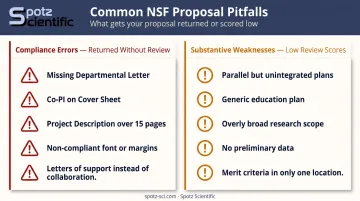
Compliance Errors (Returned Without Review)
These issues are caught before any reviewer reads the science:
- Missing Departmental Letter, or uploaded to the wrong location
- Co-PI listed on the Cover Sheet
- Project Description exceeding 15 pages
- Non-compliant font size or margins
- Letters of support included instead of letters of collaboration
Substantive Weaknesses (Low Review Scores)
These reach reviewers but result in poor scores:
- Research and education plans that are parallel but not integrated
- Education plan consisting of generic activities with no evaluation strategy or sustainability plan
- Research scope too broad for five years of realistic work
- No preliminary data or evidence that the proposed approach is feasible
- Intellectual Merit or Broader Impacts addressed in only one location in the document
Both categories of problems are fixable — but only if they're caught early enough.
Working with an experienced reviewer before submission can surface both compliance gaps and narrative weaknesses while there's still time to fix them. Spotz Scientific's red-team review service is specifically designed for CISE-focused CAREER proposals. Dr. Bill Spotz, a former DOE program manager who oversaw more than $264 million in scientific computing research, leads each review personally. Standard review starts at $250/hour; expedited review for materials submitted fewer than two weeks before the deadline starts at $300/hour.
Frequently Asked Questions
How many pages is an NSF CAREER proposal?
The answer depends on the section. The Project Description is limited to 15 pages; the Budget Justification to 5 pages; the Project Summary to 1 page; the Data Management and Sharing Plan to 2 pages; and the Departmental Letter to 2 pages. Sections like References Cited and Facilities/Equipment/Resources have no hard page limit.
What is the structure of an NSF CAREER proposal?
Required sections include:
- Cover Sheet
- Project Summary (1 page)
- Project Description (15 pages) — covering the research plan, education plan, integration narrative, Broader Impacts, and prior support
- References Cited
- Budget and Budget Justification (5 pages)
- Biographical Sketch
- Current and Pending Support
- Data Management and Sharing Plan
- Facilities/Equipment/Resources
- Departmental Letter (supplementary document, 2 pages)
What are the eligibility requirements for the NSF CAREER award?
All five conditions must be met:
- Doctoral degree in an NSF-supported field
- Active engagement in NSF-supported research
- At least a 50% tenure-track (or equivalent) appointment as an assistant professor
- Untenured status as of the submission deadline
- No prior CAREER award
Associate professors and adjunct faculty are ineligible with no exceptions.
What is the minimum budget for an NSF CAREER award?
The minimum total award over five years is $400,000 for most directorates, or $500,000 for BIO, ENG, and OPP. CISE proposals carry additional expectations: one month of PI salary per year, one graduate student per year, and two conference trips annually — though these can vary. Confirm specifics with your program officer.
What supplementary documents are required?
The only required supplementary document is the Departmental Letter, which must be uploaded under Supplementary Documents (not Single Copy Documents). Optional documents include Letters of Collaboration and, for those interested in PECASE consideration, a single-copy PECASE eligibility statement. Appendices are not permitted.
Can I resubmit if my CAREER proposal is declined?
Yes, but resubmission counts toward your three-competition lifetime limit. PAPPG NSF 24-1 requires substantial revision that clearly addresses the major comments or concerns from the prior review — a proposal that hasn't been meaningfully revised may be returned without review. A proposal that was returned without review (for non-compliance) does not count toward the limit.