
Introduction
Standard NSF merit review panels are designed to evaluate work that builds on established foundations. That creates a real problem for researchers with genuinely novel, unconventional, or boundary-crossing ideas. A five-year study reported by Science found that researchers with records of publishing novel work were 31% less likely to receive funding—not because their science was weak, but because novelty itself can read as speculation to domain-expert reviewers.
NSF's EAGER mechanism exists precisely to address this gap. It routes high-risk, exploratory proposals away from standard panel review and into direct Program Officer evaluation—a fundamentally different process with different criteria.
This guide covers what you need to submit a competitive EAGER proposal in 2026:
- What EAGER is and who qualifies
- How the mandatory Program Officer concurrence process works
- How to structure the 8-page Project Description
- Common mistakes and budget planning under the $400,000 cap
Key Takeaways
- EAGER funds genuinely high-risk, exploratory work, not conventional research avoiding panel review
- Program Officer concurrence is mandatory before submitting; skipping it gets your proposal returned
- The $400,000 cap covers total costs, including indirect costs, across both years
- Proposals must explicitly justify why standard review is inappropriate — this is required, not optional
- EAGER awards are non-renewable; build your next proposal strategy into day-one planning
What Is an NSF EAGER Grant? Key Parameters for 2026
EAGER—EArly-concept Grants for Exploratory Research—is NSF's funding mechanism for work that is too novel, unconventional, or interdisciplinary to survive a standard merit review panel. It replaced the older SGER (Small Grants for Exploratory Research) mechanism in January 2009.
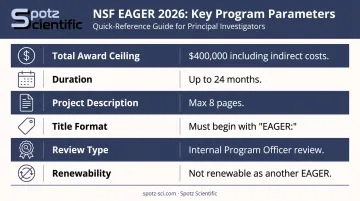
The key parameters under PAPPG NSF 24-1, as updated by Supplement 1, are:
| Parameter | Current Rule |
|---|---|
| Total award ceiling | Up to $400,000 (including indirect costs) |
| Duration | Up to 24 months |
| Project Description | No more than 8 pages |
| Title | Must begin with "EAGER:" |
| Review type | Internal merit review by Program Officer (external review possible but not required) |
| Renewability | Not renewable as another EAGER; follow-on requires standard proposal |
Note: NSF deferred the planned NSF 26-1 PAPPG and is issuing updates through policy notices to NSF 24-1. Verify any parameter changes against the current PAPPG before submitting.
What Actually Defines EAGER
The $400,000 ceiling and 8-page limit are secondary details. The defining characteristic of EAGER is that the work would be unfairly evaluated by a standard review panel, not that the budget is modest or the timeline is short.
NSF's own PAPPG describes EAGER work as:
- High risk-high payoff in nature
- Involving radically different approaches
- Applying new expertise to an existing problem
- Engaging novel disciplinary or interdisciplinary perspectives
If your proposal doesn't fit one of these descriptions, EAGER is not the right mechanism, no matter how convenient a smaller or faster award might be.
EAGER Eligibility: When This Mechanism Is—and Isn't—the Right Choice
Institutional vs. Idea Eligibility
EAGER follows the same institutional eligibility rules as standard NSF proposals. Eligible organizations include accredited U.S. institutions of higher education, U.S.-based nonprofit research organizations, and independent research laboratories. Federal agencies and federally funded R&D centers are generally not eligible except under unusual circumstances described in the PAPPG.
The eligibility test that actually determines whether EAGER fits your work is about your idea, not your institution.
Four Research Scenarios Where EAGER Fits
- The concept is too novel to have preliminary data. The work is untested; generating proof-of-concept is the point.
- The methodology is unconventional. Standard reviewers would likely dismiss it not because it's wrong, but because it doesn't fit their disciplinary framework.
- The work crosses disciplines. No single program's review panel has the expertise to evaluate it fairly.
- An early-stage tool or computational approach needs proof-of-concept before a full proposal is defensible.
A Practical Self-Assessment
If your work fits one or more of those scenarios, apply this test: Would a panel of domain experts score this poorly—not because the science is bad, but because it's too speculative or unconventional?
If yes, EAGER may be appropriate. If the work is solid, incremental, and well-supported—but you'd prefer a smaller, faster grant—submit a standard proposal.
EAGER vs. RAPID: A Clear Distinction
These two mechanisms are frequently confused:
- EAGER is triggered by the nature of the idea—high risk, untested, high-impact if it succeeds
- RAPID is triggered by time-sensitive external events—perishable data from disasters, unanticipated phenomena, or ephemeral research opportunities
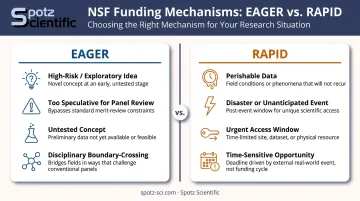
EAGER should never be used as a workaround to avoid panel review for work that is conventional but simply convenient to fund quickly.
The Non-Renewability Constraint
Once you've confirmed EAGER is the right mechanism, plan for its endpoint from day one — EAGER awards cannot be renewed as another EAGER. Follow-on funding requires a Traditional or Accomplishment-Based Renewal proposal subject to full external review. Plan from the outset: what does a successful EAGER result enable? The answer is usually preliminary data strong enough to support a competitive standard grant or CAREER proposal.
The Program Officer Concurrence Process: Your Most Critical First Step
Why This Step Cannot Be Skipped
Unlike standard NSF proposals, EAGER cannot be submitted cold through Research.gov. The PI must first submit a Concept Outline to the cognizant Program Officer and receive written concurrence before a full proposal is submitted. A proposal submitted without this concurrence will be returned without review.
The PO's approval email must be uploaded in the Program Officer Concurrence Email section of Research.gov. This isn't a formality—it's a hard requirement that reflects how fundamentally different EAGER's review process is from standard submission.
Finding the Right Program Officer
Identifying the correct PO is where many researchers stumble. A mismatched submission (even with PO concurrence from the wrong program) wastes everyone's time.
Effective ways to identify the right PO:
- Search NSF's funding opportunities by directorate and program area
- Use NSF Award Search with relevant keywords to find recent EAGER and standard awards
- Examine the active portfolio of candidate POs—does their current work actually align with your concept?
- Check Dear Colleague Letters (DCLs) from relevant programs, as some CISE DCLs specifically invite EAGER proposals in defined topic areas
For researchers navigating NSF CISE specifically, a strategic advisory review before initial PO contact can sharpen the programmatic fit and strengthen the Concept Outline before it lands in an inbox.
What a Strong Concept Outline Contains
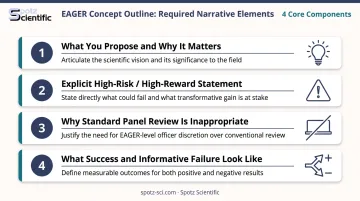
Per the PAPPG, a Concept Outline includes the title, proposed proposal type, PI information, potentially relevant NSF organizational units, and keywords. The narrative—limited to two attached pages or 6,000 characters unless otherwise specified—should address:
- What you propose and why it matters
- An explicit statement of why the work is high-risk/high-reward
- A clear explanation of why standard panel review would be inappropriate
- What success and informative failure would look like
How to Frame the Initial PO Contact Email
Be direct. One page maximum. Lead with the idea and its potential impact, name the risks explicitly rather than burying them, and state why EAGER—not a standard proposal—is the right mechanism.
POs respond well to honesty. Minimizing risk in the initial contact sends the wrong signal: either the work isn't truly high-risk and EAGER is the wrong mechanism, or the science hasn't been thought through carefully enough. Both readings undermine the conversation before it starts.
Treat the PO as an advisor at this stage. Their feedback can reshape the proposal direction, flag a better-fitting program, or confirm that the concept is genuinely strong.
How to Structure Your 8-Page EAGER Project Description
The Fundamental Mindset Shift
Eight pages is roughly half a standard NSF proposal. The writing strategy must change entirely. Standard proposals build a case through context and literature before arriving at the research plan. EAGER proposals must lead with the vision and move immediately to why the risk is worth taking.
Every paragraph carries weight—nothing earns its place by convention alone.
Recommended Section Breakdown
| Section | Length | Purpose |
|---|---|---|
| Introduction and vision | 1–1.5 pages | State the big idea and what it could open up for the field |
| Why EAGER? | 0.5–1 page | Acknowledge risks explicitly; explain why standard review is inappropriate |
| Technical approach | 3–4 pages | Specific aims, methods, success criteria, and informative failure definition |
| Expected outcomes and significance | 1–1.5 pages | What a successful result opens up for future work |
| Timeline and milestones | 0.5 page | Key decision points, not just tasks |
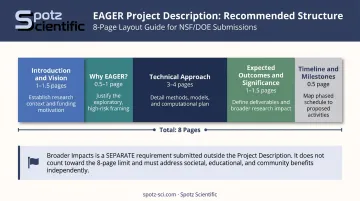
Note: The PAPPG also requires a separate Broader Impacts section with the heading on its own line. This requirement applies to EAGER even though there is no external panel. A submission that omits or superficially treats Broader Impacts will be returned or declined.
Once the structure is clear, the harder strategic challenge begins: how you write about uncertainty.
Honest Risk Articulation as a Credibility Strategy
Proposals that minimize or hide risks undermine the PO's trust. If the work were low-risk, it wouldn't qualify for EAGER. Naming specific risks—technical, methodological, or conceptual—and explaining why they are worth taking is what distinguishes a serious proposal from one pretending to be high-risk to avoid panel review.
This is counterintuitive for researchers trained to present their work as likely to succeed. EAGER inverts that instinct deliberately.
Defining Outcomes for Exploratory Work
Define success broadly enough to include what the team will learn even if the primary hypothesis doesn't hold. A well-articulated "informative failure" outcome demonstrates scientific maturity. It tells the PO that the investment generates knowledge regardless of result—which is exactly what NSF expects from exploratory funding.
What to Cut
Given the page constraint, eliminate:
- Extensive literature reviews
- Lengthy broader impacts narratives (keep it substantive but concise)
- Detailed personnel justifications
- Boilerplate introductory paragraphs
- Standalone context that doesn't directly serve the vision or risk argument
One addition worth making: a brief connection to future standard proposals. This signals to the PO that EAGER funding is a strategic investment in a research trajectory—not an endpoint.
EAGER Budget Planning Within the $400,000 Cap
Understanding the Real Direct Cost Available
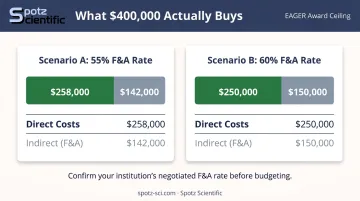
The $400,000 ceiling covers total costs including indirect costs across the full award period. At a typical F&A rate of 55%, the available direct costs drop substantially:
- $400,000 total ÷ 1.55 = approximately $258,000 in direct costs
At a 60% F&A rate, that number falls to roughly $250,000. Confirm your institution's negotiated indirect cost rate early—this calculation significantly affects what personnel and activities are actually fundable.
Note: NSF's proposed 15% indirect cost cap was vacated by a federal court on June 20, 2025 and is no longer in effect. Use your institution's federally negotiated rate.
Realistic Personnel and Cost Allocation
For a 24-month EAGER, realistic allocations typically include:
- Partial PI effort (often 1–2 months summer salary)
- One graduate student or postdoc (primary labor)
- Limited undergraduate support where justified
- Minimal travel and supplies, each specifically justified
Major equipment purchases are difficult to justify within these constraints unless your institution already has the necessary infrastructure. General-purpose equipment is not eligible for direct-cost support under PAPPG rules.
These allocations matter beyond internal planning—POs scrutinize every line.
What POs Notice in EAGER Budgets
POs review EAGER budgets directly, with no panel buffer to absorb weak justifications. Budget problems that would draw panel questions here go straight to the program officer. Watch for these common signals that invite scrutiny:
- Line items that appear disproportionate to a 24-month exploratory scope
- A cost structure implying deliverables that exceed what EAGER is designed to produce
- Overscoped personnel or equipment that signals the project belongs in a full proposal
Scope the work tightly to what is genuinely achievable in 24 months with the available direct costs.
Common EAGER Proposal Mistakes That Lead to Rejection
The Three Most Consequential Framing Errors
Submitting work that isn't genuinely high-risk. If a standard proposal would fund it, the PO will redirect it. The PAPPG explicitly prohibits using EAGER for work appropriate for a regular proposal, planning grants, or preliminary data collection.
Treating EAGER as a shortened standard proposal. Simply cutting a 15-page proposal to 8 pages without changing the framing, emphasis, or argumentation produces a document that feels wrong from the first paragraph. The structure, tone, and argument hierarchy must change entirely.
Failing to explicitly justify why standard review is inappropriate. This explanation is required by the PAPPG—not optional context. Proposals that omit it or treat it as a brief aside will not be competitive.
The Over-Promising Trap
EAGER funds exploration, not guaranteed results. Proposals that claim definitive outcomes misunderstand the mechanism and feel misaligned to experienced POs. Successful EAGER proposals define ambitious but honest success criteria—including what will be learned if the primary hypothesis fails.
Broader Impacts Still Matter
The complete proposal—including Broader Impacts—is evaluated by the PO. A superficial or missing Broader Impacts section will get a proposal returned or declined. This surprises researchers who assume internal review means lighter scrutiny; it doesn't.
These pitfalls—individually and in combination—are exactly what a red team review is designed to catch before the proposal reaches a PO's desk. Spotz Scientific's red team service draws on Bill Spotz's background managing over $264M in scientific computing research at DOE—the same program officer's vantage point that determines whether a proposal reads as credible or misaligned.
Frequently Asked Questions
Who is eligible to apply for an NSF EAGER grant?
EAGER follows the same institutional eligibility as standard NSF grants—accredited U.S. universities, eligible nonprofits, and independent research laboratories. The critical eligibility test is whether the research idea itself is genuinely high-risk and exploratory, not simply unfunded or novel.
Can I submit an EAGER proposal without first contacting a Program Officer?
No. The Concept Outline and written PO concurrence are mandatory prerequisites under PAPPG NSF 24-1. Submitting without them results in the proposal being returned without review. This step exists to confirm the work is appropriate for EAGER before the PI invests time in a full 8-page proposal.
What is the difference between an NSF EAGER and an NSF RAPID grant?
EAGER funds high-risk, exploratory ideas that are too speculative or unconventional for panel review. RAPID funds time-sensitive research where data or access will be lost if standard review timelines are followed—natural disasters, unanticipated events, and similar urgent opportunities. EAGER is triggered by the nature of the idea; RAPID by urgency of the opportunity.
How long does it take to receive a decision on an NSF EAGER proposal?
Because EAGER skips panel review, decisions move faster than standard grants. NSF generally issues awards within 30 calendar days of a division recommendation, but the time from submission to that recommendation varies by directorate and PO workload. Budget one to three months post-submission.
Is an NSF EAGER award renewable?
EAGER awards are explicitly non-renewable as another EAGER under NSF policy. Follow-on work must be submitted through standard mechanisms—a Traditional or Accomplishment-Based Renewal proposal subject to full external review. Design your EAGER scope so the deliverables—preliminary data, validated methods, or proof-of-concept results—directly support the narrative of a future standard or CAREER proposal.
Can early-career faculty use EAGER as a strategy to build their funding portfolio?
Yes—EAGER can generate proof-of-concept data that strengthens future proposals, including CAREER applications. Since the PO has sole decision authority, the relationship with the PO matters enormously. Build that relationship through workshops, conference conversations, and Concept Outlines on ideas you're genuinely developing—not only at the moment you need a quick decision.