The Department of Energy is the third-largest federal SBIR funder by dollar obligations. According to the FY2022 SBA Annual Report, DOE obligated over $377 million in combined SBIR and STTR funding that year — and the agency currently supports roughly 400 Phase I and 160 Phase II awards annually across 13 participating program offices. For small businesses doing R&D in energy, scientific computing, or related fields, this is one of the most accessible pools of nondilutive federal funding available.
This guide covers what you need to know: how DOE releases funding announcements, who qualifies, how the application process works, and what separates competitive proposals from the rest.
Key Takeaways
- DOE releases SBIR/STTR topics twice yearly — in July (Release 1) and November (Release 2)
- Applications go through Grants.gov; Letters of Intent are submitted through PAMS
- The PI must be primarily employed by the small business for SBIR (STTR has different rules)
- System registrations (SAM.gov, Grants.gov, PAMS) can take weeks, so begin the process as early as possible
- A non-responsive LOI does not bar you from submitting a full application
What Is the DOE SBIR Program?
The Small Business Innovation Research (SBIR) program provides nondilutive grants — not equity — to U.S. small businesses conducting R&D that supports DOE's mission. That mission spans energy production, fundamental energy sciences, environmental management, and defense nuclear nonproliferation.
SBIR vs. STTR: The Key Differences
The two programs share funding mechanics but differ in key structural requirements:
- SBIR: The Principal Investigator must be primarily employed (more than half their time) by the small business. No mandatory research institution partner.
- STTR: The PI may be employed by either the small business or a partnering nonprofit research institution. A formal cooperative R&D relationship with that institution is required, with the small business performing at least 40% of R&D and the research institution at least 30%.
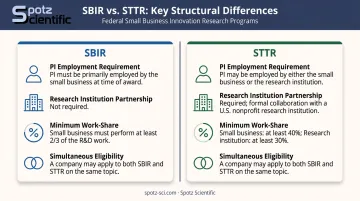
Both programs can be pursued simultaneously if all requirements are met. Knowing which structure fits your situation shapes where you apply next.
The 13 Participating Program Offices
DOE's SBIR program spans three broad clusters:
Office of Science
- Advanced Scientific Computing Research (ASCR)
- Basic Energy Sciences
- Biological and Environmental Research
- Fusion Energy Sciences
- High Energy Physics
- Nuclear Physics
Applied Programs
- Energy Efficiency and Renewable Energy
- Nuclear Energy
- Cybersecurity, Energy Security, and Emergency Response
- Electricity
- Fossil Energy and Carbon Management
Environment & Defense
- Environmental Management
- Defense Nuclear Nonproliferation (within NNSA)
Identifying which office aligns with your research is the first practical step: offices participate in different funding releases and carry distinct technical priorities that shape what proposals they fund.
How DOE Releases SBIR Funding Opportunity Announcements
DOE operates on a twice-yearly solicitation cycle. Topics are released in July (Release 1) and November (Release 2), with the formal Funding Opportunity Announcement (FOA) issued approximately four to six weeks later.
For reference, FY2025 timelines were:
- Release 1: Topics July 8, 2024 → FOA issued August 5, 2024 (28-day lag)
- Release 2: Topics November 12, 2024 → FOA issued December 27, 2024 (45-day lag)
The Full Application Timeline
A single release typically follows this sequence:
- Topics Released — Review topic documents to identify relevant subtopics
- Topic Webinars — DOE hosts webinars by program office cluster shortly after release
- FOA Issued — Formal solicitation published with all requirements and deadlines
- Letter of Intent (LOI) Deadline — Submitted via PAMS (required, not optional)
- Non-Responsive LOI Feedback — DOE notifies applicants of responsiveness determinations
- Full Application Deadline — Submitted through Grants.gov
- Award Notification
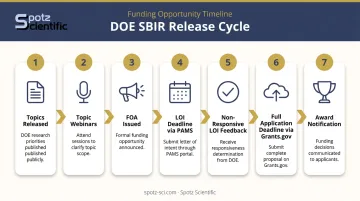
This full cycle spans roughly four to five months from topic release to awards.
Don't Skip the Topic Webinars
DOE hosts separate webinars for different program office clusters shortly after topics are published. Register even if you can't attend live — recordings go to registered participants, and pre-submitted questions get answered directly by Topic Managers. These sessions let you clarify directly with Topic Managers whether your innovation fits a specific subtopic.
Where to Find FOAs
Current and upcoming announcements are posted at science.osti.gov/sbir/Funding-Opportunities. Submission happens across two platforms depending on the document type:
- Grants.gov — Full applications, submitted using the specific FOA number
- PAMS (Portfolio Analysis and Management System) — Letters of Intent (LOIs)
Check both Release 1 and Release 2 topic documents each fiscal year. Different program offices often participate in different releases, so relevant opportunities may appear in either cycle.
Who Is Eligible for DOE SBIR Funding?
DOE SBIR awards are available only to organizations that meet specific structural, ownership, and registration requirements. Here's what you need to confirm before investing time in an application.
Core Eligibility Requirements
To qualify as a U.S. Small Business Concern (SBC), your organization must:
- Be a for-profit entity with a U.S. place of business
- Have no more than 500 employees, including affiliates
- Be more than 50% owned and controlled by U.S. citizens or permanent resident aliens
- Operate under a recognized structure (LLC, S-corp, C-corp, sole proprietorship — all qualify)
PI Requirements
For SBIR, the Principal Investigator must be primarily employed by the small business at the start of the award and throughout performance. No Ph.D. is required, but the PI must demonstrate relevant expertise to lead the Phase I feasibility study. DOE allows only one PI — co-PIs are not permitted.
TABA Funds
Beyond PI qualifications, applicants can access supplemental support. Up to $6,500 in Technical and Business Assistance (TABA) funds can be added above the Phase I maximum budget. Eligible uses include:
- Market research and validation
- Intellectual property protection
- Regulatory or manufacturing planning
- Cybersecurity assistance
- Access to technical expertise
What Triggers an Administrative Decline
Even strong technical proposals can be dismissed before a reviewer ever sees them. Applications are declined before review if they:
- Don't meet stated FOA eligibility requirements
- Have a topic/subtopic mismatch between the LOI and full application
- Are missing required documents
- Duplicate existing DOE-funded work
- Exceed the maximum budget for the topic
System Registrations — Start Now
Clearing these eligibility hurdles only matters if your systems are in order. Before you can submit, you need active registrations in multiple systems — allow at least four to six weeks for the full process:
- SAM.gov — Required for Grants.gov submission; activation alone can take up to 10 business days, and incomplete information can extend it to weeks or months
- Grants.gov — Where full applications are submitted
- PAMS — Where LOIs are submitted
- SBA.gov — Required for program participation
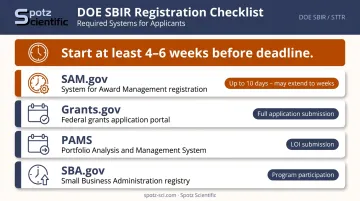
Expired or incomplete SAM registrations are one of the most common reasons applications are declined before review. Treat registration as step one, not an afterthought.
The DOE SBIR Application Process: Step by Step
Letter of Intent (LOI)
Submitting an LOI through PAMS is required — applicants who miss the LOI deadline cannot submit a full application. The LOI is submitted by the Business Official and helps DOE identify appropriate technical reviewers.
After LOI submission, certain elements are locked:
- Topic and subtopic
- Prime small business
Elements that can change between LOI and full application:
- Principal Investigator
- Research institution
- Subcontractors and consultants
- Application title (minor changes only)
If you receive a non-responsive determination, it does not prevent you from submitting a full application. Use the feedback to assess fit, and consider contacting the Topic Manager to clarify scope before proceeding.
Once your LOI is accepted, the next step is assembling the full application — starting with the Project Narrative and its supporting documents.
Project Narrative and Supporting Documents
The Project Narrative has a 15-page limit. That count includes the cover page, table of contents, and references — so plan accordingly. The Commercialization Plan is a separate document capped at 4 pages and must outline a credible, evidence-backed path to commercial application.
Other required documents include:
- Biosketches for senior/key personnel (SciENcv format strongly encouraged — old NSF fillable PDFs are no longer available)
- Current and pending support forms for the PI and all senior/key persons
- Budget and budget justification using DOE's Level of Effort and Max Funding Workbook
- Letters of commitment from all consultants and subcontractors
- Data Management Plan
- Foreign Relationships Disclosure Form — required even if no foreign relationships exist
Budget Considerations
Budget rules are strict. Before you build yours, confirm the following:
- Fee/profit: Cannot exceed 7% of total direct and indirect costs
- Indirect costs: No hard cap, but DOE evaluates for reasonableness
- Business development: Cannot be charged to the grant — only R&D activities qualify. The fee (profit) may be used for business development instead
- TABA: Budgeted separately from R&D maximum, up to $6,500
Tips for Strengthening Your DOE SBIR Proposal
Contact Topic Managers early. Once topics are released and before the LOI deadline, reach out with specific clarifying questions about subtopic scope. Topic Managers can confirm whether an innovation fits a subtopic — they cannot advise whether to apply — but early clarity prevents wasted effort on misaligned proposals.
Take peer review seriously. Applications that clear administrative review go to external technical experts who evaluate scientific merit, technical feasibility, and commercialization potential. Strong proposals:
- Clearly tie R&D to DOE mission priorities
- Demonstrate the team's qualifications and relevant experience
- Present a commercialization plan backed by actual market evidence — not just an aspirational narrative
Get expert eyes on your draft before submission. The FY2022 SBA data shows a 19% Phase I selection rate for DOE SBIR — meaning roughly four out of five proposals are not funded. A red-team review can surface weaknesses that seem invisible to the people closest to the work.
Spotz Scientific offers SBIR proposal consulting specifically for small businesses pursuing DOE funding. Dr. Bill Spotz spent eight years as a program manager at DOE's Advanced Scientific Computing Research (ASCR) office, where he co-led the applied mathematics program and managed over $264 million in scientific computing research. That experience — evaluating proposals from the program manager's chair — gives him a direct read on where applications lose reviewers and why.
Services include:
- Red-team review of draft proposals
- Strategic advisory for specific solicitations
- Pre-proposal evaluation and down-selection support
Standard consulting is billed at $200–250/hour; premium rates of $250–300/hour apply when materials are submitted fewer than two weeks before a deadline. Reach out at info@spotz-sci.com to discuss your timeline.
Frequently Asked Questions
What is the maximum funding limit for SBIR Phase I?
The maximum budget for DOE SBIR Phase I varies by topic and subtopic — check the specific topic document for the cap that applies to your subtopic. Up to $6,500 in TABA funds can be added above that cap for approved third-party business assistance services.
Who is eligible for SBIR funding?
Eligibility requires being a U.S.-based, for-profit small business with fewer than 500 employees (including affiliates), more than 50% owned and controlled by U.S. citizens or permanent resident aliens, and organized under a recognized business structure such as an LLC, S-corp, or C-corp.
What is the success rate of the DOE SBIR program?
FY2022 SBA data shows DOE SBIR Phase I received 1,925 proposals and made 376 awards — a 19% selection rate. Phase II had a 36% selection rate. Awards go to the highest-ranked, most technically meritorious applications.
What is the difference between DOE SBIR and STTR?
The two key differences are PI employment and partnership requirements. SBIR requires the PI to be primarily employed by the small business. STTR allows the PI to be employed by the partnering research institution and mandates a formal cooperative R&D agreement with a qualifying nonprofit, including minimum work-share thresholds for both parties.
When does DOE release its SBIR funding opportunity announcements?
DOE releases SBIR/STTR topics twice per year — Release 1 topics in July and Release 2 topics in November — with the formal FOA issued approximately four to six weeks after topics are published. Current and upcoming announcements are posted at science.osti.gov/sbir/Funding-Opportunities.
What happens after I submit my Letter of Intent?
DOE reviews LOIs for responsiveness to the chosen topic and notifies applicants of non-responsive determinations within approximately three weeks of the deadline. This outcome does not bar you from submitting a full application; contact the Topic Manager to ask how to revise your approach.