Introduction
A research statement is the most decisive document in an academic job application. Unlike a CV, which lists accomplishments, or a cover letter, which introduces you, the research statement has one job: prove you have a coherent scholarly identity and a viable future.
Search committees at R1 and R2 institutions read dozens of these documents each cycle, and they already have your publication list in hand. What they're evaluating is whether your research shows a clear trajectory and whether you're ready to lead an independent program that fits their department.
Quality varies enormously. Some statements read like annotated bibliographies. Others tell a story a non-specialist can follow in five minutes.
This guide walks through the full process, from preparation to submission:
- A step-by-step framework for writing your statement
- What to gather and prepare before you start
- The elements separating strong statements from weak ones
- Common mistakes that undermine otherwise solid research
- How to tailor the document by discipline and institution type
Key Takeaways
- A strong research statement tells a past-present-future story, not a list of projects
- Length norms vary by field — typically 2-3 pages in sciences and engineering
- Search committees expect clear independence from your PhD advisor or postdoc mentor
- Future plans should name specific funding mechanisms, not vague ambitions
- Tailoring your statement to each institution's mission and resources signals genuine fit to search committees
How to Write a Research Statement: A Step-by-Step Framework
Most weak statements fail for structural reasons, not scientific ones. Following a deliberate framework fixes that.
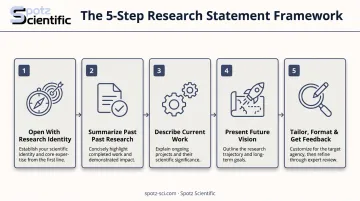
Step 1: Open With Your Research Identity and Motivation
Top programs use what's often called the hourglass approach: start broad with the big-picture problem your field cares about, then narrow into your specific contribution. This helps a mixed-discipline search committee follow your narrative without needing subfield expertise.
Draft a 2-3 sentence "branding statement" that names who you are as a scholar. For example: "I am a computational scientist who develops scalable algorithms for climate simulation."
Write this opening last, even though it appears first. It has to reflect everything that follows, and you won't know exactly what that is until you've drafted the rest.
Step 2: Summarize Past Research and Contributions With Evidence
List your key findings, methods, and technical contributions, but back every claim with evidence. Citations, awards, and grant numbers carry weight; phrases like "significant impact" do not.
Not every paper deserves a mention. Group your work into two or three themes and give the most space to your strongest, most field-shaping results. A statement that tries to cover everything ends up explaining nothing well.
Step 3: Describe Current Work and Preliminary Results
For each ongoing project, note its actual stage:
- Data collection underway
- Manuscript in preparation or under review
- Results in revision after peer feedback
Then connect each one back to the trajectory you established in Step 2. Reviewers are looking for forward momentum: proof your research program is active and gaining traction, not stalled since your dissertation defense.
Step 4: Present Future Research Vision and Funding Strategy
This is where most statements either earn or lose credibility. Propose two to three distinct but related projects spanning a 5-year horizon, ideally sketching where things head over 10:
- A "safe" project building directly on demonstrated expertise
- A high-risk, high-reward direction that shows ambition
- A middle project bridging the two
Name realistic funding sources, such as specific NSF programs, DOE Office of Science solicitations, or foundation grants, and briefly explain why your work fits current priorities.
This isn't optional detail. NSF's CAREER program, for instance, funds five-year awards with an expected minimum of $400,000 including indirect costs, and reviewers want to see that you understand what that money is meant to accomplish.
Researchers targeting DOE or NSF computing-related roles benefit from aligning this section with actual program language rather than generic ambition. Specialized proposal consultants such as Spotz Scientific, founded by a former DOE ASCR program manager, can help identify which solicitations and framing will resonate with agency reviewers before you submit.
Step 5: Tailor, Format, and Get Feedback
Adjust length, jargon level, and emphasis based on the specific department and institution type. A statement built for a national lab reads wrong at a liberal arts college, and vice versa.
Circulate drafts to colleagues both inside and outside your immediate subfield. Search committees include non-specialists: if your labmate understands the statement but your officemate from a different department doesn't, you have a problem.
What to Prepare Before You Start Writing
Preparation prevents the single most common problem: a statement that reads as a list instead of a narrative.
Before drafting, gather:
- A complete list of publications, grants, and awards
- Citation counts or another impact metric
- Notes on each target department's faculty, current grants, equipment, and student population
Skipping that last step is a mistake. Future-work sections that reference realistic, institution-specific resources land far better than generic proposals.
It also helps to review one or two successful statements in your discipline before you write your own. Several university career centers publish annotated real examples. MIT's EECS Communication Lab is a good starting point, with sample statements broken down section by section so you can see how structure, tone, and length work in practice.
Key Elements That Make a Research Statement Stand Out to Search Committees
Outcomes depend heavily on a handful of controllable factors beyond raw research quality.
- Clear, audience-appropriate language. Committees often include faculty outside your subfield who screen applications quickly. Jargon-heavy statements risk being skimmed or misread, cutting into your interview odds.
- Demonstrated independence from mentors. Committees need proof you can lead your own program, not merely extend an advisor's agenda. State your original angle and its distinct contribution explicitly, especially outside fields where shared projects with a PI are common.
- Concrete funding and broader-impact plans. Vague future-work sections without named funding mechanisms or student roles raise red flags with hiring committees. For DOE Early Career or NSF CAREER-track proposals, consultants such as Spotz Scientific help pinpoint which solicitation language and priorities actually land.
- Appropriate length and formatting. Reviewers often only skim a one-page summary during initial screening, so documents exceeding 3-5 pages, per common EECS and chemistry norms, risk not getting a full read.
- Institutional fit. The same statement rarely works for both an elite R1 and a small teaching-focused college; generic, one-size-fits-all versions are the top reason strong candidates get passed over.
Common Mistakes to Avoid
Even accomplished researchers stumble on the same handful of issues:
- Writing a list of past projects instead of a narrative connecting past, present, and future
- Proposing future work indistinguishable from a PhD advisor's or postdoc mentor's ongoing agenda
- Overloading the page with jargon, tiny fonts, or dense two-column layouts nobody wants to read
- Leaving out funding strategy, student involvement, or institutional resources in the future-work section
Any one of these can undercut an otherwise strong application. Together, they're often the difference between an interview invite and a quiet rejection. A pre-submission red-team review often catches these before search committees do.
Tailoring Your Research Statement by Career Stage and Institution Type
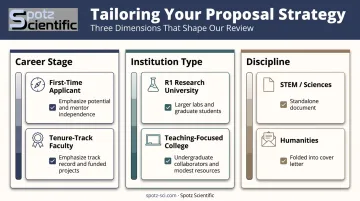
By Career Stage
First-time applicants and postdocs should emphasize potential and a clear break from mentor work — committees want to see where you're headed, not just where you've been. Advanced assistant professors going up for tenure should instead lean on a track record: funded projects, published results, and evidence the lab is self-sustaining.
By Institution Type
R1 statements can assume larger labs, graduate students, and heavier equipment budgets. Statements for primarily undergraduate or teaching-focused colleges need the opposite framing: show how ambitious research is still achievable with undergraduate collaborators and modest resources.
The DOE's Early Career Research Program anticipated awards of roughly $875,000 over five years for academic applicants in FY2025. Use figures like that as a benchmark for scaling your proposed budget realistically to your institution type.
By Discipline
In many humanities fields, research content gets folded into the cover letter rather than submitted as a standalone document. Confirm your discipline's convention before you spend a week drafting something the search committee wasn't expecting.
Frequently Asked Questions
How long should a research statement be?
Two to three pages is typical in most sciences and engineering fields, though some disciplines allow more space when figures are involved. Always confirm the specific department's expectations first.
How is a research statement different from a research proposal or teaching statement?
A research statement summarizes past, current, and future work broadly to show trajectory and fit. A research proposal details one specific funded project, while a teaching statement addresses pedagogy rather than scholarship.
Should I include figures or images in my research statement?
Well-designed figures can clarify complex results or future plans, but use them sparingly. They consume valuable space that reviewers may only briefly scan.
How do I show independence from my PhD advisor or postdoc mentor?
Propose new questions, methods, or directions distinct from your mentor's ongoing work. Have your mentors' reference letters explicitly support that independence rather than leaving it implied.
Do I need a separate research statement for every discipline, such as humanities vs. sciences?
STEM and social science fields typically expect a standalone research statement. Many humanities job postings fold this content into the cover letter instead, so check the posting closely.
How can I get feedback on my research statement before submitting it?
University career centers and faculty mentors outside your subfield are a solid first pass. Specialists like Spotz Scientific add DOE- or NSF-specific insight that generalists often miss.