](https://file-host.link/website/spotz-sci-wc8nl1/assets/blog-images/82a38f3b-e5e7-46dc-9cc4-b9a7360a622d/1784577286560194_11dbb78d29c5421b97a517827ee55d37/360.webp)
What's striking is that most rejections aren't about weak science. They're about proposals that fail to communicate value — to the right reviewers, for the right program, in the right format. A technically excellent proposal that misaligns with program priorities will lose to a merely good proposal that speaks the funder's language.
This guide walks through exactly how to write a research grant proposal: the groundwork before you write, the step-by-step structure, what federal reviewers actually evaluate, and the mistakes that sink otherwise competitive submissions.
Key Takeaways
- A research grant proposal is a persuasive argument that your project is important, feasible, and worth funding — not merely a description of your research
- Read the NOFO before writing anything; eligibility violations and formatting errors can result in disqualification regardless of scientific merit
- Specific aims are the spine of the proposal — every other section should connect back to them
- NSF evaluates proposals on Intellectual Merit and Broader Impacts; weakness on either criterion can sink an otherwise strong submission
- Starting early and building in time for peer review is the single most controllable factor in proposal quality
Before You Write: Laying the Groundwork
The writing process is the last step. Successful proposals begin weeks — sometimes months — earlier, with strategic decisions most researchers skip.
Finding the Right Funding Opportunity
Start with the agency portals:
- Grants.gov — the federal portal for searching all active funding opportunities
- DOE ASCR Funding Opportunities — ASCR-specific FOAs and program announcements
- NSF CISE solicitations — current core programs and focused solicitations
Sign up for program alerts so you're not scrambling when a deadline appears. Beyond that, read the funder's mission and browse their existing award portfolio before committing to a submission. The real question is whether this program is actively funding work like yours right now.
This fit assessment is worth doing before you invest a single hour in writing. If the portfolio shows the agency recently funded five projects nearly identical to yours, that's a signal — not a green light.
Reading the NOFO Like a Reviewer
Every NOFO contains eight defined sections under federal rules (2 CFR 200.204), but the two you need to internalize before writing are:
- Application Review Information — merit criteria and their relative weights
- Application Contents and Format — page limits, font requirements, required sections
Failure to follow any of these can mean disqualification before a reviewer reads your science. Map each required section in the NOFO to a corresponding section in your outline before you write a word. Note which criteria carry the most weight — NSF's dual criteria (Intellectual Merit and Broader Impacts) are equally weighted, which surprises many first-time applicants.
How to Write a Research Grant Proposal: Step by Step
Step 1: Define Your Research Question and Specific Aims
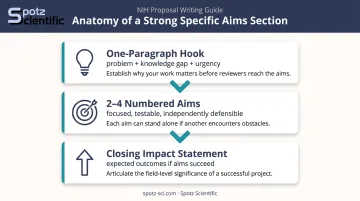
Specific aims are the spine of your proposal. Every other section must connect back to them. Before structuring your aims, confirm what the solicitation requires — NSF's PAPPG doesn't prescribe a universal "Specific Aims" section, and DOE's Early Career NOFO asks for a "Project Objectives" section with a clear statement of aims without mandating a fixed number.
A strong aims structure typically includes:
- One-paragraph hook — establishes the problem, the knowledge gap, and why it matters now
- 2–4 numbered aims — focused, testable, logically connected but each defensible on its own
- Brief closing statement — articulates the expected impact if the aims succeed
Each aim should be specific enough that a reviewer can assess novelty and feasibility within minutes. Broad aims signal that you haven't thought through what's actually achievable in the grant period.
Step 2: Write the Problem Statement and Significance
Move from broad context (why this field matters) to the specific gap your research addresses. Use published literature to establish that the gap is real and your approach is novel.
The most common trap: writing a literature review instead of a problem statement. A literature review summarizes what others have done. A problem statement argues that something important is unsolved and that you're positioned to solve it. These serve different rhetorical purposes — and reviewers notice when one is substituted for the other.
Step 3: Develop Your Methodology and Timeline
Your methodology section must answer three questions:
- What exactly will you do? — specific methods, not general approaches
- How will you know it worked? — measurable success criteria for each aim
- What will you do if it doesn't work? — contingency plans showing you've thought beyond the optimistic scenario
DOE's Early Career NOFO explicitly requires hypotheses, methodological details, and a timeline identifying responsible personnel and when activities will occur. NSF's PAPPG expects a clear plan with success assessment criteria.
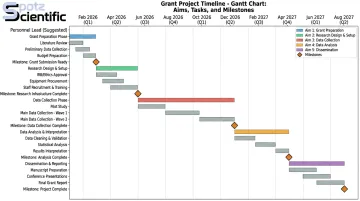
A timeline (Gantt chart or table) is almost universally expected. Reviewers consistently cite vague or overly optimistic methods as a top reason for low scores.
Step 4: Demonstrate Feasibility with Preliminary Data
Preliminary data serves one purpose: it reassures reviewers that the research is viable and that you are the right person to execute it.
When data is strong, present it clearly and connect it explicitly to each aim. When data is thin (common for early-career researchers), compensate with:
- Detailed, rigorous methodology that demonstrates you've thought through execution
- Letters of support from collaborators with access to relevant resources or datasets
- Explicit acknowledgment of risks, paired with specific mitigation strategies
What reviewers penalize isn't thin data — it's thin thinking. Show that you've anticipated likely failure points, and you've already planned around them.
Step 5: Build a Realistic Budget and Justification
NSF's budget framework covers: salaries and wages, fringe benefits, equipment, travel, participant support, other direct costs, subawards, and indirect costs. NSF permits a budget justification of up to five pages, plus five additional pages per subaward. DOE requires equivalent detail with supporting documentation for personnel effort, equipment, and travel.
Every line item needs narrative justification. The test isn't whether the number looks reasonable — it's whether it meets the federal standard: costs must be necessary, reasonable, allocable, allowable, consistently treated, and adequately documented under 2 CFR 200.403–200.405.
Two common budget mistakes:
- Padding — line items that don't map to specific project activities raise red flags, particularly for DOE, which scores budget reasonableness as a merit criterion
- Inconsistency — a budget that doesn't match the personnel or timeline described in the methodology signals that sections were written independently without coordination
Step 6: Write the Abstract Last
The abstract must accurately summarize a proposal that's already fully developed — which is why it can't be written first. It answers three questions in clear, jargon-light language:
- What is the problem?
- What will you do?
- Why does it matter?
Use key terms from the agency's NOFO to signal alignment with program priorities. Reviewers often read the abstract first; for busy program managers, it may be the most influential single page in your submission.
What Federal Reviewers Are Actually Looking For
Federal reviewers follow explicit evaluation frameworks — and proposals that ignore those frameworks get scored down, regardless of scientific quality.
NSF's Dual-Criteria Framework
NSF instructs reviewers to evaluate every proposal against two equally weighted criteria:
- Intellectual Merit — the potential to advance knowledge within or across fields
- Broader Impacts — the potential to benefit society and contribute to desired societal outcomes
Under each criterion, reviewers consider: what you want to do, why, how, how success will be measured, and what benefits may result. A proposal weak on Broader Impacts — even if scientifically excellent — will be scored down. This surprises many researchers who treat Broader Impacts as an afterthought.
DOE's Merit Review Criteria
The current DOE Office of Science framework evaluates proposals on five criteria:
- Scientific and/or technical merit
- Appropriateness of the proposed method or approach
- Competency of personnel and adequacy of resources
- Reasonableness and appropriateness of the proposed budget
- Appropriateness of the Data Management and Sharing Plan
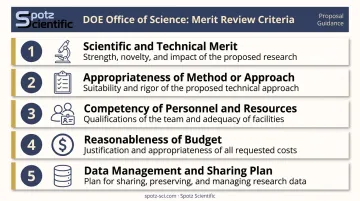
Budget appropriateness is a scored merit criterion at DOE — not just an administrative check. DOE also considers portfolio factors in final selection: available funds, balance among program activities, relevance to Office of Science priorities, and whether a proposal duplicates existing funded work.
Writing for a Mixed Reviewer Panel
ASCR panels seek individual assessments rather than consensus and do not compare proposals against one another. The panel will include deep experts in your subfield and generalists from adjacent disciplines. Your proposal must work for both. Write so that the generalist understands the significance without talking down to the expert.
A red team review — having someone with program management experience read your draft before submission — catches assumptions your colleagues can't see because they're too close to the work. For DOE ASCR and NSF CISE proposals specifically, Spotz Scientific offers this kind of review: critical evaluation from a former DOE program manager who spent years on the other side of the process.
Common Mistakes That Get Research Proposals Rejected
Most rejection reasons fall into three categories, and none of them involve weak science.
Misalignment with Funder Priorities
This is the most common fatal flaw. Submitting excellent science to a program that isn't funding it right now wastes everyone's time. Researchers must connect their work explicitly to the agency's current strategic priorities — not just the general mission — and demonstrate awareness of what the program has recently funded.
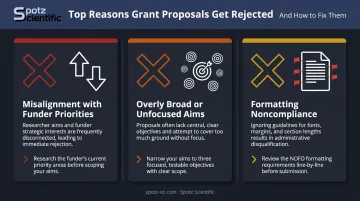
Overly Broad or Unfocused Aims
Scope problems tell reviewers the project isn't ready. If success can't be measured, if every aim is interdependent, or if the work would take a decade, the proposal signals the team hasn't thought through what's achievable. Aim for depth over breadth.
Formatting and Submission Noncompliance
This is the most avoidable rejection reason — and the most frustrating. NSF's documented grounds for returning proposals without review include noncompliant font sizes, exceeding the 15-page Project Description limit, and unauthorized letters of support. DOE can reject proposals that fail to meet NOFO requirements before scientific review even begins. Follow the instructions exactly — not approximately.
Frequently Asked Questions
What is a research grant proposal?
A research grant proposal is a formal written document requesting financial support from a funding agency for a specific project. It outlines the scientific problem, proposed methods, expected outcomes, and budget required to execute the work.
How long should a research grant proposal be?
Length varies by agency and program. NSF's Project Description limit is 15 pages unless a solicitation states otherwise. DOE proposals vary by solicitation. Letters of intent may be 2–3 pages. Always follow the specific page limits in the NOFO exactly.
What is the difference between a pre-proposal and a full proposal?
A pre-proposal is a short summary submitted before the full application, used by agencies to gauge interest and fit. Researchers invited to submit a full proposal have passed an initial screening — but an invitation does not guarantee funding.
How do you write specific aims for a research grant?
Each aim should address a distinct, testable aspect of your central question. Write them in logical order, but make each independently defensible — reviewers should be able to assess success or failure for each aim on its own terms.
What are the most common reasons research grant proposals get rejected?
Misalignment with program priorities, overly broad or unfocused aims, lack of feasibility evidence, formatting noncompliance, and failure to address reviewer criteria explicitly — roughly in that order.
How do you tailor a research grant proposal to a specific funding agency?
Start with the agency's current strategic plan and NOFO — read both carefully. Then:
- Use language directly from the program's stated priorities
- Study previously funded awards in that program
- Frame your significance around what reviewers for that program are trained to value