
There are two distinct worlds where program management consulting matters. The first is corporate: an external expert brought in to manage complex transformation initiatives. The second — and far less understood — is federal: a program manager sitting on the funding side of a scientific agency, deciding which research proposals get resourced.
For scientists and researchers, understanding the second world is not just interesting. It's a competitive advantage.
This article covers the core definition of a program management consultant, their key responsibilities, how the role differs from project management, the specialized federal science context, and what researchers can do to leverage this expertise when competing for funding.
Key Takeaways
- Program managers oversee portfolios of related projects, not individual deliverables
- In consulting, they are external advisors who bring deep process knowledge and strategic perspective to complex programs
- Federal science program managers manage portfolios of research grants — not internal projects
- Their role directly influences which proposals advance through merit review
- Understanding how they evaluate proposals helps researchers submit stronger, more competitive applications
What Is a Program Manager in Consulting?
A program management consultant is an external expert brought in to oversee a collection of related projects, ensuring they work together toward a single strategic objective. Unlike internal program managers, consulting program managers arrive with specialized expertise, operate across a defined engagement, and aren't bound by the organizational politics that often limit insiders.
PMI's Program Management Professional (PgMP) framework describes this as coordinating multiple related projects and activities over time to deliver organizational benefits aligned with strategic objectives. Deloitte frames the same idea as "agile, on-demand project management consulting talent": PMO specialists who standardize processes, tighten controls, and reduce risk.
Two Contexts for "Program Management Consulting"
The phrase covers two very different situations:
Corporate transformations: A consultant embedded in a company to manage a major initiative — a technology overhaul, a merger integration, or a multi-year organizational change. Their job is to coordinate all moving parts so the effort actually delivers its intended value.
Federal funding agencies: A program manager who sits inside an agency like DOE's Office of Science or NSF and manages a portfolio of externally funded research grants. This person evaluates proposals, makes funding recommendations, and shapes which scientific problems get resourced. When they move into consulting, they bring insider knowledge that is nearly impossible to find elsewhere.
For researchers navigating DOE or NSF funding, understanding how that second role works — and what those program managers are actually looking for — is what separates competitive proposals from the rest.
Core Responsibilities of a Program Manager in Consulting
Whether operating in a corporate or federal setting, program management consultants share five core responsibilities.
Strategic Alignment
Every project in a portfolio must connect to the organization's overarching objectives — not simply deliver on schedule. A program management consultant tracks whether individual efforts are pointing in the right direction, redirecting when strategy shifts. PMI's MSP framework treats this alignment as the organizing principle of program management: without it, completed projects can still fail to produce organizational value.
Risk Management
Program managers identify risks that project managers often miss — scope creep spreading across multiple projects, resource conflicts between teams, and interdependencies that could cascade into failures. According to PMI's 2020 Pulse of the Profession, 11.4% of investment was wasted due to poor project performance — a figure that disciplined program management exists specifically to reduce.
Resource Allocation and Budget Oversight
Consulting program managers assess how funding, people, time, and materials are distributed across the entire portfolio. They identify inefficiencies that no single project team can see from their vantage point and optimize allocation before waste compounds into cost overruns.
Stakeholder Management and Communication
Program managers serve as the bridge between senior leadership and individual project teams — translating strategic intent downward and reporting progress upward. PMI notes that stakeholder engagement at the program level is broader in intent and scope than simple communications, requiring active management of relationships with executives, agency leadership, and delivery teams at once.
Benefits Realization and Outcome Tracking
This is the defining difference between program and project management. Project managers focus on outputs — did the deliverable get done? Program managers focus on outcomes — did the collection of projects produce the intended value? PMI's Benefits Realization Management Framework identifies this as a discipline in its own right, requiring ongoing measurement, risk assessment, and course corrections when expected benefits aren't materializing.
Program Manager vs. Project Manager: Key Differences in Consulting
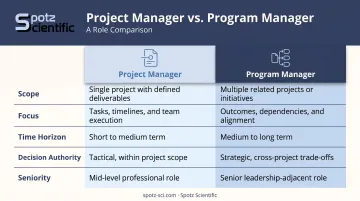
| Dimension | Project Manager | Program Manager |
|---|---|---|
| Scope | One project with a defined start, end, and deliverable | Multiple related projects managed simultaneously |
| Focus | On-time, on-budget delivery of a specific output | Strategic impact and benefit realization across the portfolio |
| Time Horizon | Weeks to months, tied to the project lifecycle | Months to years, aligned with strategic cycles |
| Decision Authority | Within one project's constraints | Across resource trade-offs affecting multiple teams |
| Seniority | Typically mid-level | Typically senior advisory level |
In federal agencies, this distinction carries direct funding consequences. A project manager at a university oversees one grant's execution. A program manager at DOE or NSF oversees dozens of grants — and shapes which ones get funded in the first place.
That expanded authority translates directly into compensation. BLS data from May 2024 shows project management specialists earn a $100,750 median annual wage, while PMI's 14th Salary Survey reports a $135,000 median salary for PMP-certified professionals — a 24% premium that reflects the added strategic responsibility of program-level work.
The Federal Science Program Manager: A Specialized Consulting Role
Within agencies like DOE's Office of Science or NSF, the program manager function looks fundamentally different from anything in the corporate world.
What Federal Science Program Managers Actually Do
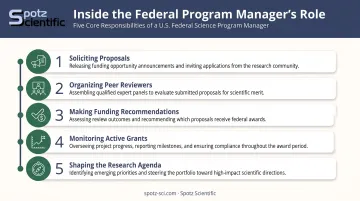
They do not manage the internal delivery of government projects. They manage portfolios of externally funded research grants. Their day-to-day responsibilities include:
- Soliciting research proposals through Notices of Funding Opportunity (NOFOs/FOAs)
- Selecting and organizing peer reviewers to evaluate scientific merit
- Making funding recommendations based on review outcomes, strategic fit, and portfolio priorities
- Monitoring active grants — tracking milestones, connecting funded researchers with complementary projects, and ensuring portfolio alignment with the agency's scientific mission
- Shaping the research agenda by writing program descriptions that define which scientific problems get prioritized
DOE Office of Science job postings for program manager positions confirm this directly: program managers determine the scientific focus and direction of a research portfolio and prepare calls for proposals. NSF's rotator program page describes the same function — interacting with potential principal investigators, facilitating merit-review panels, and recommending funding.
The Scale Involved
The numbers here are significant. ASCR's FY 2026 Congressional Budget Request totals $1,016 million in scientific computing research funding. NSF CISE's FY 2024 funding rate was 22% — meaning roughly four out of five proposals did not convert to awards. A single program manager's portfolio can span dozens of active grants and hundreds of millions of dollars in research investment.
Why This Creates Consulting Value
Those numbers represent real decisions made by real people — and former program managers know exactly how those decisions get made. When one transitions to consulting, they carry direct knowledge of how proposals are scored, what language reviewers respond to, which scientific gaps a program is actively trying to fill, and where submissions typically lose ground.
Most researchers never see that side of the process. That's the gap a former program manager closes.
Essential Skills That Define Effective Program Management Consultants
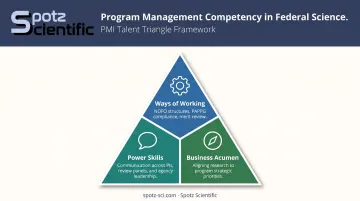
For researchers navigating federal funding, understanding what a program manager actually values is half the battle. PMI's Talent Triangle — the professional standard for program management competency — identifies three skill domains: ways of working (process mastery), power skills (stakeholder communication and leadership), and business acumen (strategic alignment and decision-making).
That last domain is the rarest: PMI's 2025 Pulse of the Profession found that only 18% of project professionals have high business-acumen proficiency — meaning most program managers struggle to connect their portfolio decisions to the broader strategic goals funding them.
In federal science programs, all three domains take on specific, concrete forms:
- Ways of working → Deep fluency with NOFO structures, PAPPG compliance requirements, and merit review processes
- Power skills → Ability to communicate between principal investigators, review panels, grants offices, and agency leadership
- Business acumen → Understanding which research directions align with a program's strategic priorities — not just what's scientifically interesting, but what a program manager is actively trying to accomplish with their portfolio
How Researchers Can Leverage Program Management Consulting Expertise to Win Funding
The Real Reason Proposals Fail
Most proposal failures are not scientific. A researcher can have genuinely strong ideas and still fall short if the proposal doesn't frame those ideas in language that maps to a program manager's priorities. With NSF CISE awarding roughly 1 in 5 proposals, the margin between funded and unfunded work often comes down to strategic positioning, not scientific quality.
NSF notes that proposals may be returned without review for misalignment with the solicitation — a compliance failure that has nothing to do with the quality of the underlying science.
The Red Team Advantage
A consultant who has managed a federal research portfolio can simulate the review process a proposal will undergo — identifying gaps in strategic alignment, unclear impact narratives, and mismatches with the funding opportunity's objectives before submission. That is the core value of a red team review: catching what researchers, too close to their own work, cannot see from their own vantage point.
Strategic NOFO Targeting
Submitting to the wrong funding opportunity wastes months of effort. An experienced program management consultant helps researchers:
- Evaluate whether their research aligns with a specific NOFO's stated priorities
- Decide whether to pursue a pre-proposal or full submission
- Position the research narrative within the program's active gaps rather than its general topic area
- Avoid spending months on a proposal with structural misalignment issues that could have been identified in week one
Researchers targeting DOE Office of Science or NSF CISE funding can work directly with Dr. Bill Spotz through Spotz Scientific. He spent eight years as a program manager at DOE's Advanced Scientific Computing Research (ASCR) office, co-led the applied mathematics program, and managed over $264 million in scientific computing research.
That background informs his current work: proposal reviews, strategic NOFO advisory, and targeted support for DOE Early Career and NSF CAREER applications for computational scientists and applied mathematicians.
Frequently Asked Questions
What are the top 3 skills of a program manager?
According to PMI's Talent Triangle, the three core skills are strategic/systems thinking (ways of working), stakeholder communication and leadership (power skills), and business acumen — the ability to connect program work to organizational outcomes. All three apply directly in both corporate and federal science contexts.
What is the difference between a program manager and a project manager in consulting?
A project manager oversees a single deliverable-focused effort with a defined start and end. A program manager oversees multiple related projects to achieve a broader strategic outcome. In consulting, program managers typically operate at a more senior advisory level, making decisions that affect priorities across the entire portfolio.
Is a program manager a high position?
Yes. Program managers typically hold senior roles in both corporate and government settings, with responsibility for large budgets, multiple teams, and strategic outcomes. In federal agencies, they also control which research priorities get funded — giving them significant influence over entire fields of scientific inquiry.
What are the 5 C's of consulting?
The 5 C's is an informal consulting mnemonic — not a standardized framework. Common versions include Clarify, Categorize, Connect, Create, and Communicate. Program management consultants apply the same logic: align projects to a strategic objective, map interdependencies, and communicate progress at every level.
What does a federal science program manager do differently from a corporate program manager?
Federal science program managers oversee portfolios of research grants rather than internal projects. They evaluate proposals from universities and national labs, set funding priorities for their scientific domain, and run peer review panels to inform award decisions. That inside view of the funding process is what makes their perspective uniquely useful to researchers.