Introduction
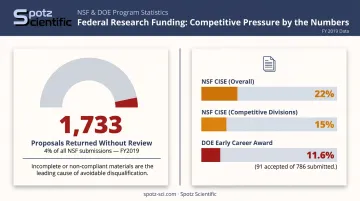
Federal research funding is genuinely competitive. NSF's CISE directorate funded just 22% of proposals in FY2024, with some divisions as low as 15%. The DOE Early Career Research Program accepted only 91 of 786 applications in FY2024 — an 11.6% acceptance rate. At those odds, a scientifically strong proposal that fails to communicate clearly, misses a required section, or doesn't explicitly map to reviewer criteria will simply lose.
The core problem: researchers who spend months building a proposal cannot read it fresh. They know what they meant to write, which makes it nearly impossible to spot what they actually wrote — and what's missing. A peer reviewer encountering the proposal for the first time will notice these gaps immediately.
That's the exact problem a red team review solves. This article covers what a red team review is, why it matters for DOE and NSF proposals specifically, and how to structure one so reviewers encounter your strongest argument — not the version you meant to write.
Key Takeaways
- A red team review is a structured pre-submission critique by independent reviewers who simulate a funding agency panel
- Even strong proposals lose points for compliance gaps, unclear narratives, and poor criterion alignment
- DOE Early Career and NSF CAREER each allow only three lifetime submissions, making every attempt too valuable to leave unreviewed
- Schedule the review early enough for substantive revisions, not last-minute cosmetic edits
- Reviewers with program management experience offer the most actionable feedback
What Is a Red Team Review for Research Proposals?
A red team review is a pre-submission evaluation of a near-complete proposal draft by independent reviewers who assess it through the eyes of a funding agency evaluator. They look at scientific merit, narrative clarity, responsiveness to the solicitation, and overall persuasiveness — not as colleagues, but as skeptical panelists.
Where it fits in the proposal timeline:
- After a substantively complete draft exists (all required sections present, core scientific argument in place)
- Before final editing and submission
- With enough lead time to incorporate meaningful revisions — typically two to three weeks minimum
The distinction matters: a red team review is not a quality-assurance checkbox at the end of the process. It's a deliberate mechanism to surface the gap between what your team believes the proposal communicates and what an outside reviewer actually reads.
That gap is larger than the proposal team expects — consistently.
Key Advantages of Red Team Reviews for Scientific Research Proposals
Catching Compliance and Structural Gaps Before They Cost You
Federal solicitations — Notices of Funding Opportunity, program announcements — contain explicit requirements: page limits, required sections, specific questions to address. Reviewers penalize proposals that miss them, even when the underlying science is excellent.
NSF's PAPPG permits returning proposals without review for noncompliance, including a Project Summary that doesn't separately address Intellectual Merit and Broader Impacts. As of December 2025, NSF also added proposals with "insufficient content to permit effective merit review" to the return-without-review list. DOE's FY2026 ECRP NOFO similarly allows declining applications for failure to comply, incompleteness, or non-responsiveness to program objectives.
NSF returned 1,733 proposals — 4% of submissions — without review in FY2019. That's a meaningful share of proposals eliminated before a single scientific judgment was made.
A red team catches these issues by having reviewers work directly from the FOA or solicitation document and verify that every required element is present, properly addressed, and positioned correctly. This matters because:
- Proposal teams experience review blindness after weeks inside the document — they assume key points are there because they know them, not because they wrote them
- A fresh reader surfaces omissions before a reviewer panel does
- The cost of a missed compliance issue isn't just a low score — it's months of lost effort and a missed funding cycle
Most critical for: Complex multi-section solicitations like DOE ECRP or NSF CAREER, where every required element is evaluated against a strict rubric.
Strengthening Clarity for Non-Specialist Reviewers
Federal review panels typically include experts across a range of sub-fields, not just specialists in the exact topic of the proposal. A proposal that reads as self-evident to the PI's closest collaborators can be genuinely opaque to a reviewer one sub-field removed.
A red team composed of knowledgeable but not identical-specialty reviewers will surface exactly this problem:
- Sections that seem self-explanatory to the author but require context for an adjacent-field reader
- Jargon that narrows the audience without adding precision
- Logical jumps that specialists assume but generalists cannot follow
Program officers at DOE and NSF carry broad portfolios. A proposal that communicates only to a narrow specialist audience loses points from panelists who cannot independently assess its significance. Clarity across that range directly affects overall panel scores.
Most critical for: Proposals crossing disciplinary lines — applied mathematics combined with domain science, scientific machine learning integrated with climate modeling — where no single reviewer will be expert in every component. Dr. Bill Spotz's background — spanning computational fluid dynamics, climate modeling at NCAR, and applied mathematics program management at DOE ASCR — gives him direct experience identifying exactly where cross-disciplinary proposals lose non-specialist readers.
Aligning the Proposal to Merit Review Criteria
NSF evaluates proposals on Intellectual Merit and Broader Impacts. DOE's FY2026 ECRP publishes six explicit criteria:
- Scientific or technical merit
- Appropriateness of method or approach
- Competency of personnel and adequacy of resources
- Reasonableness of budget
- Appropriateness of the Data Management and Sharing Plan
- Potential for scientific leadership
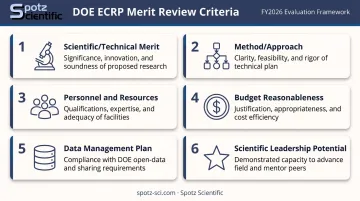
Reviewers use score sheets anchored to these criteria. If the proposal doesn't make the connection to each criterion explicit — in clear language, not just implied — reviewers cannot give full credit even when the connection actually exists.
A red team checks whether the proposal's narrative:
- Directly addresses each stated evaluation criterion
- Uses language that maps to the solicitation's framing
- Repeats these connections at the right points in the document, not just in the introduction
Most critical for: Highly competitive programs where the difference between funded and unfunded proposals is a matter of a few reviewer score points. Criterion alignment is also one of the fastest fixes a red team can make — a revision that takes days but can shift a proposal from unfunded to competitive.
What Happens When the Red Team Review Is Skipped
The consequences are predictable and compounding:
- Compliance failures that disqualify or heavily penalize an otherwise strong proposal — missed required sections, incorrect formatting, unanswered solicitation questions
- Opaque narratives that score low on significance or clarity because the review panel can't follow the argument the authors thought was obvious
- Misalignment with program priorities that a program manager notices even when reviewers don't flag it explicitly
The cost compounds over submission cycles. Researchers who skip the red team review tend to receive similar critical feedback from actual reviewer panels, cycle after cycle. The proposal changes; the underlying communication problems don't.
NSF estimates 120 hours of preparation burden per proposal response. That's the time at risk when a preventable gap causes a low score or return without review.
For early-career programs specifically, the stakes are sharper. Both DOE ECRP and NSF CAREER limit researchers to three lifetime submissions. Submitting without a red team review and receiving an avoidable rejection consumes one of those three submissions — with no path to get it back.
How to Run an Effective Red Team Review for Federal Research Proposals
Timing: Schedule the review when a substantively complete draft exists — all required sections present, core scientific argument in place — with at least two to three weeks remaining before the deadline. This leaves time for real revisions, not just cosmetic edits.
Select Reviewers Who Simulate the Actual Evaluation Panel
Effective red team reviewers must be:
- Independent of the proposal (not co-investigators or close collaborators)
- Scientifically literate in the relevant area, but not so specialized they miss where the narrative loses a broader reader
- Experienced with how the target agency evaluates proposals — ideally through direct service on or management of a review panel
The most valuable reviewer type is someone who has sat on the other side of the funding process. Spotz Scientific's red team reviews are led by Dr. Bill Spotz, a former DOE ASCR program manager, whose assessments reflect how program managers actually evaluate submissions — not just how the guidelines describe the process.
Provide Reviewers with the Right Materials
Reviewers should receive:
- The complete draft proposal
- The Notice of Funding Opportunity or program announcement
- The stated review criteria or evaluation factors
- Specific questions the proposal team wants addressed
Structure Feedback Around Reviewer Scoring Criteria
Vague feedback ("this section needs work") is not actionable. Ask reviewers to assess specific elements — scientific merit, clarity of objectives, feasibility of approach, quality of the Broader Impacts or mission-relevance argument — mirroring the actual review panel's process.
Prioritize Revisions by Impact
After the review, categorize feedback by severity:
- Compliance issues that must be resolved before submission
- Clarity improvements that directly affect how reviewers score significance
- Stylistic preferences to address only if time permits
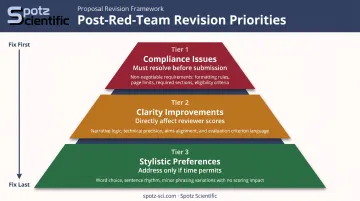
Fix compliance and clarity issues first. Every revision should be tied to how it affects a reviewer's score, not just how it reads to the authors.
Frequently Asked Questions
Is a red team proposal review worth it?
For competitive federal research funding — where acceptance rates can be in the single digits — a red team review is one of the most cost-effective steps a researcher can take. The time invested is small compared to the months already in the proposal and the funding at stake.
What is the red team assessment process?
It's a structured independent review of a near-complete proposal draft. Reviewers simulate the funding agency's evaluation panel, assess the proposal against stated merit review criteria, and deliver written feedback the proposal team uses to make targeted revisions before submission.
What are the color teams for proposal review?
"Color teams" refer to sequential review stages: Pink (early draft structure), Red (near-complete content critique from the evaluator's perspective), and Gold (final leadership review). In scientific research proposal development, the red team stage is where the most substantive, evaluator-simulated feedback occurs — making it the pivot point for competitive submissions.
Who should be on the red team for a scientific research proposal?
Ideal red team reviewers are independent of the proposal and scientifically literate in the relevant area, but not co-investigators. Reviewers with direct funding agency experience add the most value: former program managers, grant review panel members, or experienced proposal consultants who know how evaluators think.
When should a red team review take place in the proposal development timeline?
The red team review should occur two to three weeks before the submission deadline, once a substantively complete draft exists. All required sections should be present and the scientific argument in place, so the team has time to incorporate meaningful revisions rather than surface-level edits.
How is a red team review for a federal research grant different from a commercial proposal review?
Unlike commercial RFP reviews focused on pricing and contracting compliance, a scientific research proposal red team review focuses on scientific merit, alignment with program mission and merit review criteria (such as NSF's Intellectual Merit and Broader Impacts), and clarity for a multi-disciplinary academic review panel.