Introduction
SBIR funding is not easy to get. Across all participating agencies in FY2022, only 16% of Phase I proposals received awards — and at NIH, the Phase I success rate dropped to just 8% in FY2025. Those numbers don't leave much room for error.
This post is for small business researchers, scientist-entrepreneurs, and scientific computing teams applying to agencies like DOE, NSF, or NIH. Most applicants approach SBIR with an academic grant mindset — leading with scientific depth and treating commercialization as an afterthought. That approach consistently hurts scores.
What you'll find here are practical tips for writing proposals that reviewers can score confidently and program managers can defend. Scientifically sound isn't enough — the proposals that win are written with the reviewer's perspective in mind from the first page.
Key Takeaways
- SBIR funds commercialization, not discovery — that distinction must shape every section you write
- Pre-writing groundwork — registrations, solicitation research, team alignment — is as critical as the writing itself
- Structure your proposal so reviewers can easily locate and score each evaluation criterion
- Measurable milestones, clear innovation claims, and a credible commercialization plan are non-negotiable
- A red team review before submission is one of the highest-value steps you can take
Know What SBIR Really Funds — and What It Doesn't
The SBIR program exists to stimulate technological innovation with real commercial potential. It is not a mechanism for advancing basic science. That distinction shapes every judgment a reviewer makes about your proposal.
SBIR vs. Academic Grants
The differences go beyond framing:
- Devote the majority of your time to the small business applicant during the award period — this is a statutory requirement, not a guideline
- Show reviewers a path to a product or service, not a publication
- Propose work where technical failure is genuinely possible — a hypothesis-driven feasibility test, not a foregone conclusion
What SBIR Does NOT Fund
NSF explicitly identifies these as non-responsive:
- Incremental or evolutionary modifications to established products
- Routine engineering or non-hypothesis-driven testing
- Business development, market research, or sales activities
- Basic research not connected to a market opportunity
If your project description sounds like any of the above, reframe it before writing anything else.
Phase I vs. Phase II — Scope Matters
Phase I ($50,000–$275,000 over 6–12 months) is about proof of concept and feasibility. Phase II ($400,000–$1.8M over roughly 24 months) advances that work toward a commercial-ready product. Scope your Phase I aims to fit that reality. Reviewers notice when a Phase I reads like a Phase II — and it signals poor judgment, not ambition.
Agency Differences Are Real
Each agency uses a distinct review structure — know yours before writing:
- DOE: Emphasizes scientific and technical approach, plus broader impact
- NSF: Adds a standalone Commercial Impact criterion and uses a Project Pitch as a pre-submission fit check
- NIH: Reviews against Importance, Rigor and Feasibility, and Expertise/Resources
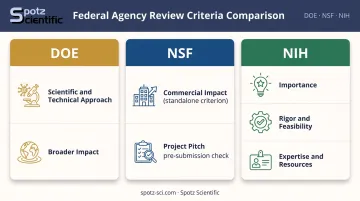
Research your target agency's specific criteria before writing a single sentence.
Start Early: Build Your Proposal Preparation Strategy
Most applicants underestimate how much time a competitive SBIR proposal requires. The SBA's own preparation tutorial recommends allowing 10 weeks — and that assumes you start with your registrations already sorted and your team already in place. Waiting until a solicitation drops is too late.
Review Prior Solicitations and Funded Awards
Before a new solicitation is released:
- Read the prior year's solicitation carefully — agency priorities rarely change dramatically year-to-year
- Search the SBIR awards database to see what has been funded in your technical area
- Identify whether your work fits an existing topic or requires a new direction
This reconnaissance shapes your framing and saves time once the solicitation drops.
Complete Administrative Registrations Early
Registration delays are among the most preventable reasons proposals miss deadlines. NIH notes the full registration sequence can take 6 weeks or more. NSF warns that SAM processing alone can take up to 3 weeks. The required systems include:
- SAM.gov — active registration required before most submissions
- SBA Company Registry — required for all SBIR applicants
- Grants.gov — organization registration required
- Agency-specific portals (Research.gov for NSF, eRA Commons for NIH)
Start these before you have a final solicitation in hand.
Build Your Team Before You Write
Several proposal elements require lead time that can't be compressed:
- Confirming PI eligibility and time commitment (>50% to the small business)
- Identifying collaborators and defining their roles
- Securing letters of support from potential partners, customers, or end-users
- Aligning subcontractor agreements if applicable
It also pays to work with an advisor who has sat on the program office side. Someone like Bill Spotz of Spotz Scientific — who spent eight years as a program manager at DOE's Advanced Scientific Computing Research office — can help you interpret solicitation language and anticipate reviewer priorities before you write a single word.
Engage Program Managers Before You Write
Every major SBIR agency provides a legitimate channel for pre-submission contact — and using it is standard practice, not a shortcut.
| Agency | Pre-Submission Contact Channel |
|---|---|
| DOE | Contact the listed Topic Manager from topic release through Phase I submission |
| NSF | Submit a Project Pitch; attend virtual office hours and Q&A sessions |
| NIH | Contact Institute/Center Program Officers through SEED |
How to Make These Conversations Productive
Program managers can clarify whether your proposed work is in scope, explain what the agency most wants emphasized, and confirm whether your technical approach aligns with the solicitation's intent. They cannot tell you what to write or predict funding outcomes — but a well-prepared conversation can sharpen your proposal significantly.
Good questions to ask:
- "Is this technical approach responsive to Topic X as written?"
- "Are there aspects of the solicitation where you'd want applicants to provide more detail?"
- "Does the agency have any funded work in this area we should be aware of?"
What to Avoid
Some missteps can undermine that impression before you've submitted a single page:
- Asking questions clearly answered in the solicitation — this signals poor preparation
- Contacting program managers multiple times on the same issue
- Requesting feedback on draft text or asking for a funding prediction
The person you contact before submission may be involved in evaluating your proposal. A sloppy or demanding email is a first impression that follows you into the review process.
Write for the Reviewer: Clarity, Evidence, and Criteria Alignment
SBIR reviewers often evaluate proposals outside their precise area of specialization, particularly on panels that span broad technical domains. Your proposal must work for the non-specialist reviewer without boring the specialist. That's harder than it sounds — but a few habits make it manageable:
- Define all acronyms on first use
- State the problem and your proposed solution in the first paragraph, not on page three
- Avoid jargon that assumes the reader shares your technical vocabulary
Support Every Claim
Every assertion — about the significance of the problem, the novelty of your approach, the team's qualifications — needs backing. Use data, literature citations, or preliminary results. If a reviewer reads a sentence and thinks "how do they know that?", you've lost a point.
Write Outcomes, Not Activities
Reviewers fund results, not effort. For each technical objective, specify what measurable results will prove success — not just what the team plans to do. Ask:
- What does success look like, numerically?
- How will we know if the approach is working at the midpoint?
- What constitutes a go/no-go decision?
A milestone like "explore algorithm performance" gives reviewers nothing to evaluate. "Achieve 10x speedup over baseline on benchmark X by Month 6" does.
Map Directly to Review Criteria
Once your outcomes are clear, make sure reviewers can connect them to the agency's scoring rubric. DOE, NSF, and NIH each publish their evaluation criteria — structure your proposal so reviewers can find evidence for each criterion without hunting for it. Use subheadings that mirror or reference the agency's language. A strong score on four criteria won't save you if the fifth is impossible to locate.
Make a Compelling Case for Innovation and Commercialization
"Innovation" in SBIR context means something specific: a conceptually new approach that carries genuine technical risk. Incremental improvements to established products are routinely declined or sent back without funding. Your proposal must articulate what has not been done before — and why it matters technically and commercially.
What Counts as Innovation
Frame your innovation claim around:
- What existing approaches cannot do (and why)
- What makes your approach fundamentally different, not just better
- What the genuine possibility of technical failure looks like — and how you'll test against it
Components of a Strong Commercialization Argument
For Phase I, reviewers want to see that you've thought seriously about the path beyond the grant. NSF's Commercial Opportunity instructions require:
- Address the societal need and explain why market conditions make this the right moment
- Quantify the addressable market — specific numbers, not vague estimates
- Map the competitive landscape and explain why your approach wins
- Define a revenue model that can sustain itself without federal funding
- Lay out a realistic timeline with milestones toward market entry
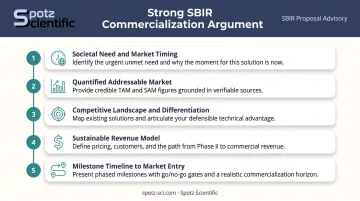
For Phase II, this becomes a formal commercialization plan. Addressing these elements clearly in Phase I strengthens your application and builds a coherent case for continuation.
Letters of Support
Letters from potential end-users, partners, or customers signal real demand. Pursue them early — they take time to arrange, and a well-written letter from a credible end-user signals real market demand. Check your target agency's solicitation rules on letters before including them; NSF, for example, has restricted letters in some Phase I solicitations.
Avoid Common Pitfalls That Sink Otherwise Strong Proposals
Many proposals fail on execution, not on the quality of the underlying science. The most common reasons:
- Unfocused aims — trying to solve too much in a Phase I budget and timeline
- Overambitious scope — the workplan doesn't fit the 6–12 month Phase I window
- Thin methodology — reviewers can't tell how you'll actually test your hypothesis
- Missing or weak commercialization plan — treated as a checkbox rather than a genuine argument
- Team credibility gaps — the proposed work requires expertise the team can't demonstrate
These are strategic failures — but administrative ones are just as costly, and entirely preventable.
Follow the Instructions Exactly
Administrative non-compliance is one of the most avoidable rejection reasons. DOE performs administrative review before technical review. NSF will return proposals that exceed page limits or fail to address prior-review concerns. Treat every formatting requirement — page count, font size, required sections, attachment labels — as a hard requirement. Even a strong proposal gets eliminated before a reviewer ever reads it if the submission doesn't comply.
Run a Red Team Review
Before you submit, share your draft with colleagues who weren't involved in writing it. Give them the agency's evaluation criteria and ask them to score the proposal as a reviewer would. Their confusion, skepticism, or unanswered questions reflect what actual reviewers will experience.

If you want structured feedback from someone who's evaluated proposals from the other side of the table, Spotz Scientific's red team review offers that perspective. Dr. Spotz spent eight years as a program manager at DOE ASCR and reviews draft proposals against agency-specific criteria — with enough lead time for you to act on the feedback. Engaging more than two weeks before the NOFO deadline keeps the cost at the standard $250/hour rate rather than the premium tier, and gives you more runway to incorporate changes.
Frequently Asked Questions
What is the hardest part of SBIR grant writing?
Balancing scientific rigor with a clear commercialization narrative. Most researchers are trained to write for discovery — depth, novelty, and contribution to knowledge. SBIR reviewers also need to see a viable path to a product or service, which requires a fundamentally different framing of the same technical work.
What are the 5 R's of SBIR grant writing?
The "5 R's" isn't an official SBIR framework — no SBA, DOE, NSF, or NIH source formally endorses it. Some consultants use variations like Research, Relevance, Rationale, Rigor, and Resources, but these aren't what reviewers score. Stick to the evaluation criteria your specific agency publishes; that's the only rubric that matters.
How long does it take to write an SBIR proposal?
The SBA recommends planning for a 10-week preparation schedule. That covers team alignment, registrations, solicitation research, and writing — not just drafting time. Starting after a solicitation drops rarely leaves enough runway for a competitive submission.
What is the difference between SBIR and STTR?
STTR requires a formal cooperative R&D relationship between the small business and a U.S. research institution. The small business must perform at least 40% of the work; the institution at least 30%. Under STTR, the PI may be employed by either partner. Under SBIR, the PI must be primarily employed by the small business. Both programs share similar proposal requirements and review processes.
How do I know if my project is a good fit for SBIR?
Start with three questions: Does it address a significant unmet need? Does it carry genuine technical risk, meaning failure is possible even for skilled practitioners? Is there a credible path to commercialization? If the answer is yes to all three, contact the relevant program manager to confirm fit before investing in a full proposal.
What should a commercialization plan include?
At minimum, your plan should cover:
- Market size and opportunity
- Target customers and end-users
- Competitive advantages of your approach
- Anticipated business model
- Timeline for reaching commercial revenue
Letters of support from potential partners or customers strengthen the case considerably.