The path to securing a grant looks very different depending on what you're pursuing. A private corporate grant and a federal SBIR award have almost nothing in common in terms of process, timeline, or what your application needs to demonstrate. Knowing which category fits your business — and what each requires — is where the work starts.
This guide covers the main types of small business grants, how to find the right opportunities, what a strong application actually looks like, and the mistakes that eliminate otherwise competitive proposals.
Key Takeaways
- Grants are non-repayable but come with strict eligibility rules, use-of-funds restrictions, and reporting requirements
- Federal research grants (SBIR, STTR, DOE, NSF) offer the largest funding pools and demand technically precise, agency-aligned proposals
- The IRS generally treats business grants as taxable income; consult a tax professional before applying
- Strong applications align with the funder's mission, not just their eligibility checklist
- SBDCs, SCORE, and specialized grant consultants can improve your approval odds
What Are Small Business Grants (and How Are They Different from Loans)?
A small business grant is financial assistance from a federal, state, or private source that doesn't require repayment, equity, or interest. That distinction matters, but it comes with real trade-offs that most applicants underestimate.
Loans are credit-based: if your financials qualify, you can generally access one. Grants are competitive and supply-limited. Qualifying doesn't mean winning — many applicants who fully meet the eligibility criteria still don't receive funding because their proposals weren't the strongest in the pool.
A few things to understand before applying:
- The IRS generally treats government grants as taxable gross income. Narrow exceptions exist — certain tribal grants and qualified disaster-mitigation payments — but they don't apply broadly. Plan for estimated tax payments before counting grant proceeds as unencumbered revenue.
- Fund usage is restricted to what the grantor specifies. Misusing grant funds isn't just a compliance problem; it can carry serious legal consequences.
- Federal recipients typically file performance-progress and financial reports (including forms like the SF-425) and may face audits. Private grantors have their own documentation requirements.
The "free money" framing that surrounds grants leads applicants to underestimate what's actually required. Treat grant funding as accountability-paired assistance — reporting obligations, usage restrictions, and tax exposure come with it.
Types of Small Business Grants: Federal, State, and Private
Grants fall into three broad categories, each with different competitiveness levels, dollar amounts, and application requirements.
Federal Research Grants
Federal grants are the largest available to small businesses, and the most demanding to win.
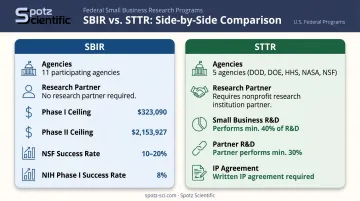
The SBIR (Small Business Innovation Research) and STTR (Small Business Technology Transfer) programs are the primary federal grant mechanisms for small businesses engaged in R&D and technology innovation. Both programs require an eligible U.S. for-profit small business with no more than 500 employees, including affiliates. As of April 2026, general award ceilings are $323,090 for Phase I and $2,153,927 for Phase II — though agencies may award less, and specific solicitations control the actual amounts.
STTR differs from SBIR in one key way: it requires a formal cooperative R&D relationship with a U.S. nonprofit research institution. The small business must perform at least 40% of the R&D; the partner at least 30%. A written IP agreement is required before the award.
11 agencies participate in SBIR; 5 participate in STTR (DOD, DOE, HHS, NASA, and NSF). Competition is fierce — NSF reports historical Phase I funding rates of 10–20%, and NIH's 2025 data shows a Phase I success rate of just 8%.
Beyond SBIR/STTR, agencies like DOE's Office of Science (ASCR program), NSF's CISE directorate, NIH, and DOD fund targeted scientific and technical work directly. These programs require proposals tightly aligned with each agency's published research priorities.
For small businesses pursuing DOE or NSF scientific computing grants, that alignment challenge is significant. Consulting with someone who has managed grants from inside these agencies — such as Spotz Scientific's Dr. Bill Spotz, who co-led DOE's applied mathematics program and oversaw $264M in scientific computing research — can help you understand what reviewers are actually looking for.
State and Local Grants
State economic development agencies, SBDCs, and MBDA centers distribute state-level grants that are less competitive than federal programs, though narrower in scope. Common target areas include:
- Export assistance programs
- Local economic development initiatives
- Infrastructure investment
- Minority business support
Eligibility varies significantly by state. Start your search at Grants.gov and your state's economic development agency website for current opportunities.
Private and Corporate Grants
Corporations, foundations, and industry associations run grant competitions — many targeting specific demographics (women, veterans, minorities) or industries. These are typically smaller in dollar amount but faster to apply for than federal programs.
| Program | Latest Terms | Status |
|---|---|---|
| Verizon Digital Ready | $10,000 grants | 2026 applications open |
| NASE Growth Grants | Up to $4,000 for members | Active, reviewed quarterly |
| Amazon Business Grants | Up to $25,000 (2025 round) | Closed May 2025 |
| FedEx Small Business Grants | $50,000 / $20,000 grants | Program ended 2024 |
Always verify status and deadlines directly on the official program page — corporate programs open, close, and change frequently.
How to Find the Right Grant for Your Business
Knowing where to look is only half the job. Finding a grant you actually qualify for — and have a realistic shot at winning — requires more filtering than most applicants do.
Start with the right databases:
- Grants.gov — the official federal portal covering 1,000+ grant programs
- State economic development agency websites — for local and state-level programs
- GrantWatch — a subscription-supported private directory covering federal, state, and foundation opportunities
- OpenGrants (OpenGrants.io) — a private aggregator for federal, state, local, and private opportunities
When using these tools, filter by industry, location, and eligibility criteria before reading the full program description. Filtering this way cuts out most programs you wouldn't qualify for anyway.
Grantors fund applicants who best advance their goals — not just those who technically qualify. A tech startup applying for a DOE SBIR, for instance, should align their proposal with the agency's current priority research areas, which are spelled out in each solicitation. Eligibility gets you in the door; mission alignment wins the award.
Use free local resources before committing to an application:
- SBDCs (Small Business Development Centers) provide free advising, including help evaluating grant fit and accessing capital
- SCORE mentors can flag region-specific opportunities and sanity-check your plan
- Your local Chamber of Commerce often maintains lists of regional grant programs
They won't write your application, but they can save considerable time by helping you evaluate fit before you commit to a full submission.
Step-by-Step: How to Apply for a Small Business Grant
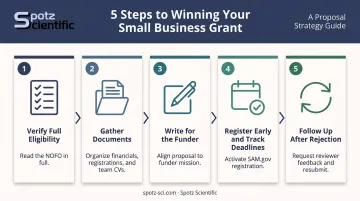
Step 1 — Verify Full Eligibility First
Read the Notice of Funding Opportunity (NOFO) or equivalent document in full — not just the summary. Confirm that your business size, industry, location, revenue, and any demographic or mission-specific requirements all match. One missed requirement, even a minor one, typically results in immediate disqualification regardless of proposal quality.
Step 2 — Gather Documents Early
Common requirements include:
- Business plan and financial statements
- Business license or registration and EIN
- Description of how funds will be used
- Measurable project outcomes and timelines
- For federal scientific grants: technical narratives and PI qualifications
Step 3 — Write for the Funder, Not for Yourself
This is where most applications fail. A strong proposal demonstrates why your project directly advances what the funder is trying to achieve — not just what your business does. Use the solicitation's language. Quantify outcomes. Set specific milestones.
For DOE or NSF proposals, understanding the program manager's priorities is non-negotiable. A red-team review from a consultant with program manager experience can catch misalignments before they reach the review panel — the kind of structural problems that reviewers flag immediately but applicants rarely see in their own drafts.
Step 4 — Register Early and Track Deadlines
Federal applicants must have an active SAM.gov registration before submitting — a Unique Entity Identifier (UEI) alone isn't sufficient. Activation can take up to 10 business days, and longer during high-volume periods. Registration is free but must be renewed every 365 days. Start this process well before the deadline.
Step 5 — Follow Up After Rejection
If rejected, request reviewer feedback where available. Resubmission rules vary by agency:
- NIH: One resubmission allowed (designated A1)
- NSF: Requires substantial revision and a new invited Project Pitch before resubmission
- DOE: Rules depend on the specific FOA — check the solicitation directly
Track what worked, incorporate feedback, and submit again.
What Not to Do: Common Grant Application Mistakes
Applying without meeting all criteria. Program offices routinely disqualify submissions that fail even one stated requirement — eligibility period, institutional affiliation, research scope, or applicant career stage. Partial qualification is not qualification.
Writing a generic proposal. The consistent failure in competitive applications is describing your research program rather than connecting your specific project to the funding agency's priorities. A proposal that reads like a lab overview doesn't answer the question every review panel is asking: why does your project advance our mission?
Vague use-of-funds statements. "We will use funds to advance our research" is an immediate red flag. Program officers expect budget justifications with line-item specificity. List planned expenditures and tie each to a measurable project milestone.
Language and framing mistakes to avoid:
- Overpromising outcomes without supporting data or evidence
- Using technical jargon the review panel doesn't share
- Claiming need without demonstrating capacity to deliver
- Failing to address sustainability — what happens to the project after the grant period ends?
These aren't minor stylistic issues. For federal programs like DOE Early Career and NSF CAREER — where single-digit success rates are common — they're the difference between funded and not.
Frequently Asked Questions
Can I get free money to start a business?
Most federal grants don't fund startups — they fund specific projects, R&D activities, or community goals. Some private and state grants do support early-stage businesses. Search state economic development agency sites and GrantWatch for startup-focused programs.
What not to say when applying for a grant?
Three things that will sink most applications:
- Vague descriptions of how you'll use the funds
- Overclaiming impact without evidence to back it up
- Language that signals you haven't read the funder's priorities
Even hinting that you don't meet the eligibility requirements will typically get your application rejected.
What is the grant for small businesses in Florida?
Key Florida programs include:
- SelectFlorida Trade Grants — export promotion support
- Florida SBDC STEP Grant — up to $2,500 for eligible export/trade-show expenses
- City of Orlando Business Assistance Program — 50% match up to $20,000
Check the Florida SBDC and Grants.gov for current availability and eligibility.
Are small business grants considered taxable income?
Yes — the IRS generally treats business grants as taxable gross income. Limited exceptions exist for certain tribal grants and qualified disaster-mitigation payments. Consult a tax professional and plan for estimated payments accordingly.
What is the difference between the SBIR and STTR grant programs?
Both fund R&D-focused small businesses across multiple federal agencies. STTR specifically requires a formal collaboration with a nonprofit research institution (with a defined work split), while SBIR does not. Eligibility and award amounts are otherwise similar.
How long does it take to hear back after submitting a grant application?
Timelines vary widely. Private grants may notify within weeks. NSF Phase I decisions typically take 5–7 months; DOD programs can notify within 90 days of selection, though final awards take longer to execute. Continue pursuing other funding options while you wait.