Introduction
Federal research grant proposals are brutally competitive. NSF's CISE directorate reported a 22% funding rate in FY2024 — meaning roughly four out of five proposals were declined. At DOE ASCR, competition is similarly fierce, though agency-wide success rates aren't publicly published.
What separates funded proposals from the pile isn't always stronger science. Proposals fail because they miss program priorities, violate formatting rules, or leave reviewers unable to locate the information they need to score a proposal favorably.
This guide draws on the insider perspective of Bill Spotz, founder of Spotz Scientific and former DOE ASCR program manager who co-led the applied mathematics program and oversaw more than $264 million in scientific computing research. The tips cover program alignment, formatting compliance, reviewer psychology, and narrative structure — the specific, avoidable mistakes that cost researchers funding at DOE ASCR and NSF CISE.
Key Takeaways
- Read the full NOFO before writing a single sentence — your proposal must map directly to stated agency priorities
- Structure your narrative around three questions: Why does this matter? Why is this new? Can this team deliver?
- Write for reviewers outside your subfield, because clarity wins over technical density every time
- Every budget line item must trace back to a specific activity in your narrative
- External review two to three weeks before submission dramatically reduces avoidable weaknesses
Read the Notice of Funding Opportunity Before Writing Anything
The Notice of Funding Opportunity (NOFO) — sometimes called a Funding Opportunity Announcement or FOA at DOE — is the governing document for your proposal. Every section you write should be traceable to requirements and priorities stated in that notice. Reviewers are often explicitly instructed to score against NOFO criteria, so misalignment directly costs you points on review.
Map Your Research to the Specific Program's Priorities
Federal programs publish detailed priority areas within each funding cycle that go well beyond general agency missions. ASCR EXPRESS:2025, for example, narrowed eligibility to five specific topics: topological quantum computation, local quantum networking, neuromorphic computing, computational physical systems, and AI model understanding.
A proposal on computational fluid dynamics would have been screened out regardless of its scientific quality.
Before committing significant writing time, verify that your research concept genuinely fits the specific program's current priorities — not just the agency's general mission.
Check Compliance Requirements Before You Write
Administrative non-compliance can disqualify a strong proposal before it reaches reviewers. Check:
- Page limits and font/margin rules
- Required attachments (data management plans, mentoring plans, facilities statements)
- Eligibility restrictions (institution type, PI career stage)
- Whether a pre-application, letter of intent, or concept paper is required before a full proposal is invited
NSF may return noncompliant proposals without review. DOE screens for completeness, relevance, and scientific content before proposals reach peer reviewers.
Contact the Program Officer Before Submitting
A brief, professional email to the program officer listed in the NOFO is not just acceptable — NSF explicitly says program officers can advise whether an idea fits a program, and ASCR similarly encourages researchers to approach the relevant program manager early. A 10-minute conversation can surface insights about current program priorities that never made it into the written announcement — and can save weeks of misaligned writing effort.
Keep the inquiry brief: describe your research concept in two or three sentences and ask whether it fits the program's current priorities.
When the written announcement leaves real ambiguity about fit, Spotz Scientific provides advisory services focused on interpreting individual NOFOs and positioning proposals for the specific program — before writing begins.
Build a Research Narrative That Demonstrates Significance, Innovation, and Feasibility
Every reviewer on a federal panel is holding three questions in mind as they read your proposal:
- Why does this matter? (significance)
- Why is this new? (innovation)
- Can this team pull it off? (feasibility)
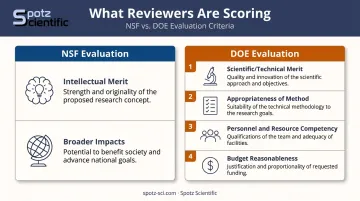
NSF formally evaluates proposals under Intellectual Merit and Broader Impacts, while DOE uses four ordered merit criteria — scientific/technical merit, appropriateness of method, personnel and resource competency, and budget reasonableness. Structure your narrative to visibly answer the agency's actual criteria, not a generic framework.
Specific Aims or Objectives
Most federal proposals include a one-to-two page objectives or specific aims section that functions as a self-contained summary of the entire proposal. Some reviewers form initial impressions based on this section alone.
Objectives should be:
- Concrete and measurable
- Linked to a specific, named gap in knowledge
- Framed so that a non-specialist can understand why achieving them matters
Vague objectives ("advance the understanding of X") signal a lack of rigor. Specific, bounded objectives ("develop and validate a method for Y that reduces computational cost by Z") signal credibility.
Significance and Innovation
Significance establishes the current state of the field, identifies the specific gap, and explains why closing that gap matters beyond your immediate research community. Think about consequences: what goes unsolved or unbuilt if this work doesn't happen?
Innovation distinguishes your approach from prior work without exaggerating novelty. Reviewers are field experts. Overclaiming is easy to spot and damages credibility across the entire proposal.
Research Approach and Methodology
Your methodology section must be specific enough to be credible and accessible enough for non-specialist panelists to follow. Include:
- A clear research timeline or milestone schedule
- Explicit acknowledgment of risks or limitations, paired with mitigation strategies
Reviewers expect you to anticipate concerns — it demonstrates command of the work, not uncertainty about it. The logical chain must be unbroken: identified problem → stated objectives → specific methods → expected outcomes. Gaps in that chain are among the most common weaknesses flagged by review panels.
Write for the Review Panel, Not Just Fellow Experts
A federal review panel typically includes both specialists in your subfield and knowledgeable generalists who are unfamiliar with niche technical details. Both groups score your proposal. A reviewer who cannot follow your logic cannot advocate for it during panel discussion — and panel advocates matter.
Use Plain, Active Language
NIH's guidance on grant writing recommends sentences of 20 words or fewer as a useful readability benchmark. The principle applies equally to DOE and NSF proposals. Passive voice obscures who is responsible for what; active voice makes commitments clear.
Practical rules:
- Start each paragraph with a clear topic sentence
- Define specialized terms on first use
- Lead with the scientific gap and its consequences before introducing methods
Use Structure to Help Reviewers Score Your Proposal
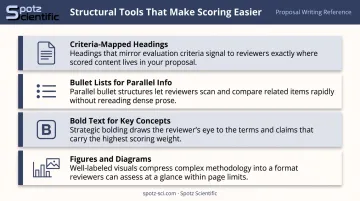
Reviewers read many proposals under time pressure. A well-organized proposal respects that reality. Structural tools that make scoring easier include:
- Headings and subheadings that map directly to review criteria
- Bullet lists for parallel information
- Bold text to flag key concepts
- Figures or diagrams where visual presentation is clearer than prose
One underused technique: after drafting, open the NOFO and score your own proposal as a reviewer would. If you cannot immediately locate the evidence for each criterion, that's a signal to reorganize — not just tighten the prose, but restructure so the evidence surfaces where reviewers expect to find it.
Develop a Realistic and Fully Justified Budget
Think of the budget as your research plan expressed in dollars. Every line item should be directly traceable to a specific activity described in your narrative.
Understand Direct vs. Indirect Costs
- Direct costs include personnel (with person-months specified), equipment, travel, and materials
- Indirect costs (facilities and administrative overhead) are typically set by your institution's negotiated rate under 2 CFR 200.414
Both must be accurately represented. If your institution doesn't have a current negotiated rate, a de minimis rate (a standard fallback) of up to 15% of modified total direct costs may apply.
Calibrate to the Specific Program's Award Envelope
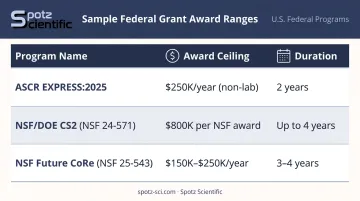
Budget norms vary dramatically by program. Recent solicitation examples:
| Program | Award Ceiling | Duration |
|---|---|---|
| ASCR EXPRESS:2025 | $250K/year (non-lab applicants) | 2 years |
| NSF/DOE CS2 (NSF 24-571) | $800K per NSF award | Up to 4 years |
| NSF Future CoRe (NSF 25-543) | $150K–$250K/year typical | 3–4 years |
Look up recently funded projects in the specific program — DOE and NSF both make award data publicly available — and calibrate your request accordingly.
Common Budget Pitfalls
- Underquoting can win a proposal but leave you unable to deliver, which damages your credibility for future applications
- Overquoting raises cost-effectiveness concerns with reviewers
- Insufficient PI effort signals feasibility problems — if you listed person-months for personnel earlier, your own commitment must be proportionate and credible
- Weak budget justification is a credibility problem on its own; a one-to-two page narrative explaining major cost categories is required
Seek External Feedback Before You Submit
You cannot objectively evaluate your own proposal. The same familiarity that makes you an expert in your work makes it nearly impossible to see what you've assumed, what's unclear, or what's missing. Build in a formal feedback phase at least two to three weeks before the deadline.
Assemble a Diverse Pre-Reader Group
Your pre-reader group should include:
- An expert in your subfield to verify technical accuracy and scientific completeness
- A knowledgeable colleague outside your subfield to flag where logic breaks down or jargon blocks comprehension
Ask pre-readers to evaluate the proposal using the review criteria published in the NOFO — the same framework reviewers will use. This makes feedback directly actionable rather than general.
The Value of a Red Team Review
A red team review goes beyond friendly feedback. Reviewers actively score and critique the proposal as a panel would — identifying weaknesses before submission rather than after rejection.
Spotz Scientific offers red team review for both draft proposals and pre-proposals, drawing on Bill Spotz's firsthand experience managing competitive DOE ASCR programs and evaluating hundreds of proposals from the program manager's side. That perspective — knowing how reviewers think and what panels prioritize — is what separates a red team critique from a colleague's read-through.
Treat Rejection Feedback as a Roadmap
If a proposal is rejected, request reviewer comments. NSF routinely provides unattributed ad hoc reviews and any panel summary. DOE provides an evaluation summary upon request. Read every comment carefully and document how each critique will be addressed in the revised proposal. Resubmission after substantial revision is often worthwhile — most productive research careers include multiple rejections on the path to funded work.
Frequently Asked Questions
How do you write a research proposal for federal research grants?
Start by reading the NOFO carefully to align with agency priorities, then structure your narrative around the formal review criteria and submit a fully justified, correctly formatted budget. Early program officer contact and at least one external review cycle before submission significantly improve your odds.
What makes a federal research grant proposal different from a foundation or nonprofit grant?
Federal proposals must align with published strategic priorities, survive formal peer review using explicit scoring criteria, and meet strict administrative and formatting requirements. A single compliance error can disqualify an otherwise strong submission — a level of rigor most foundation processes don't impose.
Should I contact a program officer before submitting my federal grant proposal?
Yes, and it's worth doing early. A brief inquiry to confirm program fit can save weeks of writing effort and often surfaces current priorities not fully captured in the written announcement. Keep the message professional and concise.
What are the most common reasons federal research grant proposals are rejected?
The most frequent weaknesses include poor alignment with program priorities, unclear or overly ambitious objectives, insufficient methodological detail, weak budget justification, and failure to visibly address all review criteria stated in the NOFO.
How long should I expect the writing process to take for a federal research grant?
Plan on several weeks to several months of active preparation, depending on proposal complexity. That time covers research plan development, team coordination, writing and revision, administrative requirements, and at least one external review cycle before the deadline.
Is it worth resubmitting a rejected federal research grant proposal?
Usually yes. Most funded researchers have faced rejection — often more than once. Treat reviewer comments as a roadmap and address each critique directly in the revised submission before reapplying.