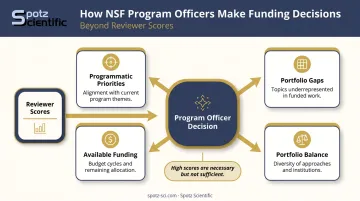
Program officers weigh external reviewer scores alongside portfolio construction, programmatic priorities, and available funding. In FY2021 alone, more than 4,300 proposals rated Very Good or higher were declined. Strong science isn't enough if the proposal doesn't speak the language reviewers and program officers are actually listening for.
This guide is written for researchers at universities, national laboratories, and research institutions — whether you're preparing your first NSF proposal or sharpening a resubmission. It covers the full picture: the proposal lifecycle, how to find the right funding opportunity, what each required component actually needs to accomplish, how to master the merit review criteria, and the strategic writing habits that separate competitive proposals from declined ones.
Key Takeaways
- NSF's FY2025 funding rate was just 19% — strong science alone doesn't guarantee an award
- Every proposal is evaluated on two criteria: Intellectual Merit and Broader Impacts, both weighted equally
- Contacting the program officer before submitting is explicitly encouraged and widely underused
- Compliance failures can get your proposal returned before any scientific review occurs
- Declined proposals include reviewer feedback — resubmission is a normal, expected part of the process
Understanding the NSF Proposal and Award Lifecycle
Before writing a single word, it helps to understand what happens to your proposal once you submit it. NSF's process has three official phases: preparation and submission, merit review and processing, and award processing.
What Happens During Review
Once a compliant proposal arrives, the program officer identifies at least three external reviewers — drawn from ad hoc reviewers, a review panel, or both. Those reviewers assess the proposal and submit written evaluations.
The program officer doesn't simply select the highest-scoring proposals. They weigh reviewer feedback against:
- Programmatic priorities and current portfolio gaps
- Available funding within the division
- Agency-level strategic goals
- The balance of the program's existing award portfolio
Excellent scores are necessary but not sufficient. A proposal can be rated Very Good or Excellent and still be declined if it duplicates work already in the portfolio or falls outside the program's current emphasis.
Timeline and Resubmission
NSF aims to notify applicants within six months of submission — though complex reviews can take longer. If your proposal is declined, you'll receive the reasons for the decision, copies of the reviews, and context about the review process.
A declined proposal can be resubmitted after substantial revision. NSF may return a resubmission without review if it fails to address the prior review's major concerns — so each reviewer comment deserves a direct response in your next draft.
Finding the Right NSF Funding Opportunity
Program fit is as important as proposal quality. A strong proposal submitted to the wrong program will still be declined.
Types of Funding Opportunities
NSF distinguishes between several opportunity types under PAPPG NSF 24-1:
- Program descriptions — broad, ongoing program areas
- Program announcements — focused guidance on a defined research area
- Program solicitations — specific calls with their own eligibility rules, required content, and deadlines
Submission schedules vary. Some programs use rolling or no-deadline submission; others use fixed deadlines or submission windows. Always read the current opportunity document — don't assume a program is rolling because it was last year.
Key Directorates for Scientific Computing and STEM
| Directorate | Abbreviation | Focus Area |
|---|---|---|
| Computer and Information Science and Engineering | CISE | Computing, algorithms, data, AI |
| Mathematical and Physical Sciences | MPS | Math, physics, chemistry, astronomy |
| Engineering | ENG | Engineering research and systems |
Spotz Scientific's primary focus is NSF CISE, the directorate covering scientific computing, high-performance computing, and applied mathematics. Researchers in these areas can work with advisory support calibrated specifically to CISE program priorities.
Contact the Program Officer — Before You Submit
Few applicants take this step, yet NSF actively encourages it. NSF's own guidance states that program officers can tell prospective applicants whether an idea fits a specific program and whether a different program might be a better match.
Before submitting, ask the listed program officer:
- Does this research fit your program's current portfolio?
- Is a letter of intent expected or required?
- Are there submission timing considerations I should know about?
A single conversation can surface a misalignment early enough to redirect your effort — or confirm you're on the right track before committing to a full submission.
Key Components of an NSF Proposal
Every component of an NSF proposal has a specific purpose, and none of them are formalities. Here's what reviewers and program officers actually look for in each section.
Project Summary (1 page)
The Project Summary must include three explicitly labeled sections: Overview, Intellectual Merit, and Broader Impacts. Missing either merit criterion heading can prevent submission or trigger a return without review.
Reviewers read this first. A generic or vague summary signals that the PI hasn't thought carefully about what reviewers need to see — and that impression carries into the rest of the review.
Project Description (up to 15 pages)
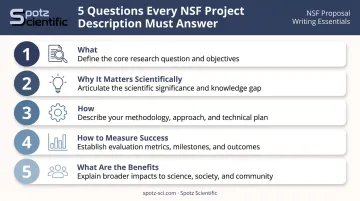
This is the core of your proposal. Every paragraph must earn its space. The Project Description should clearly answer:
- What you propose to do
- Why it matters scientifically
- How you will do it
- How you will measure success
- What the benefits are
It must also include a separately labeled Broader Impacts section — not just a mention, a full section.
Biographical Sketch and Current & Pending Support
These must be prepared in SciENcv and uploaded as NSF-compliant PDFs. Each senior/key person must certify their documents before submission.
Reviewers use the biographical sketch to assess whether the PI has the track record to execute the work. Current & Pending Support tells them whether the team has the bandwidth to take it on.
Budget and Budget Justification (up to 5 pages)
Every line item requires explicit justification. An unrealistic or poorly justified budget signals inexperience and can undermine a scientifically strong proposal. Common issues: vague personnel descriptions, unexplained indirect cost calculations, and equipment requests without clear necessity.
Data Management Plan and Mentoring Plan
The Data Management and Sharing Plan is required and limited to two pages. It must describe how research results — data, software, curriculum materials — will be disseminated and shared. Templated or generic responses raise concerns with reviewers; this section deserves real thought.
Some directorates (including CISE and ENG) have additional specific guidance. Check the relevant directorate page before drafting.
Mastering NSF's Two Merit Review Criteria
Every NSF proposal is evaluated on exactly two criteria:
- Intellectual Merit: The potential to advance knowledge
- Broader Impacts: The potential to benefit society and contribute to specific desired societal outcomes
Both must be addressed explicitly throughout the proposal — not just in the Project Summary. Proposals that treat Broader Impacts as an afterthought consistently rank lower.
The Five Review Elements
Reviewers assess both criteria using the same five sub-elements:
- Potential to advance knowledge (IM) or benefit society (BI)
- Extent to which the work explores creative, original, or potentially transformative concepts
- Whether the plan is well-reasoned, well-organized, and includes a mechanism to assess success
- Qualifications of the individual, team, or institution
- Adequacy of resources available through the home institution or collaborations
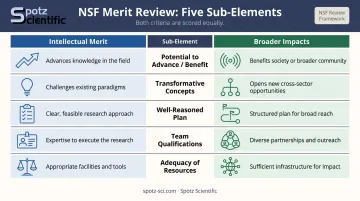
Check your proposal narrative against each of these five elements — for both criteria — before submitting.
Framing Intellectual Merit Without Overstating
Be specific about what's novel. Don't just claim your approach is "new" — explain precisely how it differs from prior work and what it makes possible that wasn't possible before. Reviewers notice when ambition outpaces evidence. Grounded, specific claims of novelty signal competence; unsupported ones undermine it.
Intellectual Merit framing sets the scientific case — Broader Impacts framing determines whether NSF sees your work as aligned with its mission.
Writing Broader Impacts That Actually Work
NSF defines specific outcome categories for Broader Impacts, including:
- Broadening participation of underrepresented groups in STEM
- STEM education and educator development
- Development of a globally competitive STEM workforce
- Public scientific literacy and engagement
- Enhanced research and education infrastructure
Use NSF's own framing. Reviewers are instructed to rate Broader Impacts as a standalone criterion — a weak section here can sink an otherwise excellent proposal regardless of the Intellectual Merit score.
Strong Broader Impacts don't compensate for weak Intellectual Merit — both sections must carry weight independently.
High-Risk, High-Reward Research
Transformative potential is one of the five review elements, and NSF explicitly encourages it. The key is pairing ambition with credibility: acknowledge the risks clearly, then demonstrate a concrete mitigation strategy. Reviewers reward bold thinking when it comes with a fallback plan — show what happens if the primary approach doesn't pan out, and how you'll still produce meaningful results.
Strategic Tips to Write a Stronger NSF Proposal
Write for a Scientist Outside Your Sub-field
NSF review panels draw from across a broad discipline — not specialists in your exact topic. Jargon-heavy writing and proposals that assume narrow technical fluency lose reviewers early. Write so that any competent scientist in your general field can follow your argument from the first paragraph.
Lead with the Problem, Not the Literature
The strongest proposals open with the scientific problem and its significance. Reviewers need to be convinced the question is worth answering before they'll care about your methodology. Don't bury the "so what" in paragraph three.
Use Explicit Structure
Don't make reviewers hunt for your key points. Use:
- Section headings labeled Intellectual Merit and Broader Impacts
- Numbered objectives or research aims
- Summary sentences at the start of each major section
A fatigued reviewer reading proposal number fourteen of the day will appreciate a proposal they can navigate quickly.
Demonstrate Feasibility
Ambition needs grounding. Show that the team has the expertise, resources, and — where applicable — preliminary data to execute the plan. Name specific collaborators, available facilities, and institutional resources. This isn't padding; it's evidence.
Get an Outside Perspective Before You Submit
A colleague outside your sub-field can catch clarity problems, but someone who has sat on the program officer side can tell you something more specific: how portfolio construction shapes funding decisions, what makes a proposal memorable versus forgettable, and where proposals typically fall apart under review.
Spotz Scientific's red team review service brings that perspective directly to your draft. Dr. Bill Spotz spent eight years as a DOE ASCR program manager overseeing more than $264 million in scientific computing research, and he applies that same evaluative lens to proposals before they reach an agency.
Common NSF Proposal Mistakes to Avoid
Submitting a Non-Compliant Proposal
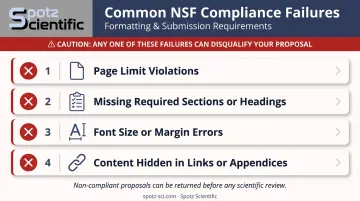
NSF can return proposals without external merit review for PAPPG violations. Automated compliance checks catch some issues, but not all. Common failures include:
- Incorrect page limits (Project Description, Budget Justification)
- Missing required sections or headings
- Font size or margin violations
- Content placed in web links or appendices to circumvent page limits
Read PAPPG NSF 24-1 carefully. Then read it again.
Getting past the compliance check is necessary — but it's only the entry point. Once your proposal reaches review, scoring begins.
Treating Broader Impacts as a Checkbox
Reviewers are explicitly instructed to score Broader Impacts independently. Many researchers write one vague paragraph and move on. That paragraph will be read by a reviewer asked to rate it as a full criterion — and a weak score here has direct consequences for the overall recommendation.
A strong Broader Impacts section won't guarantee funding, but a weak one will reliably cost you.
Not Revising Strategically After a Decline
Only 36% of new PIs received their first NSF award on their first attempt (as of 2020 data from NSF's lifecycle overview). Most successful PIs submit multiple proposals before receiving an award. That's the process — persistence with strategic revision is what separates funded researchers from frustrated ones.
When you're resubmitting:
- Address every major reviewer concern directly
- Signal clearly in the proposal what has changed and why
- Don't assume reviewers remember the prior version
A red team review of your revised draft — before resubmission — can reveal remaining weaknesses you're too close to see. An experienced external reviewer reads your revision the way a panel will: without your assumptions, without your context, and without your blind spots. Spotz Scientific's red team and advisory services are built for exactly this stage — reviewing revised drafts before they go back to the agency.
Frequently Asked Questions
How long does it take to write an NSF proposal?
NSF generally gives applicants a minimum of 90 days from announcement to the earliest submission deadline, but most experienced researchers begin 3–6 months in advance. The Project Description alone — up to 15 pages — typically requires multiple rounds of drafting, revision, and peer review.
What are the criteria for NSF proposals?
All NSF proposals are evaluated on two criteria: Intellectual Merit (the potential to advance knowledge) and Broader Impacts (the potential to benefit society). Both must be explicitly addressed throughout the proposal, not just in the Project Summary.
Is NSF accepting proposals?
NSF accepts proposals through standing core programs (some with rolling or no-deadline submission) and through specific solicitations with fixed deadlines. Use NSF's Funding Search tool to find active opportunities relevant to your field and check the current opportunity document for exact timing.
What is the difference between Intellectual Merit and Broader Impacts?
Intellectual Merit addresses the scientific value of the work — its potential to advance knowledge within or across fields. Broader Impacts addresses societal benefits such as education, workforce development, and broadening participation in STEM. Both are weighted equally in the review process.
Should I contact a program officer before submitting my NSF proposal?
Yes, and most first-time applicants skip this step. NSF explicitly encourages contact with the listed program officer before submission. A brief conversation can confirm program fit, surface guidance not in the solicitation, and sometimes point you toward a better-matched program.
What happens if my NSF proposal is declined?
Declined proposals come with reviewer feedback, panel ratings, and a summary of the decision. You may resubmit after substantial revision, but the new version must directly address the prior reviewers' major concerns or it risks being returned without review.