Many researchers dive straight into writing. Those who invest time in a deliberate outline consistently produce clearer, more compelling proposals. NSF reviewed 38,340 competitive proposals in FY2023 and funded only 27% of research proposals — meaning structural weaknesses in an unfunded proposal cost far more than the time it would have taken to outline properly.
This article covers what a research proposal outline includes, what to prepare beforehand, how to build it step by step, and the mistakes that silently undermine it.
Key Takeaways
- A research proposal outline maps every section before writing begins, ensuring logical flow and completeness
- Core sections include: title/problem statement, literature review, research questions/aims, methodology, timeline, and budget
- DOE and NSF funding proposals require different section emphasis than academic thesis proposals — tailor your structure to the specific program
- Misalignment between research questions and proposed methodology is a primary scored weakness in competitive review
- A complete outline reduces revision cycles and sharpens the argument reviewers score
What Is a Research Proposal Outline and Why Does It Matter
A research proposal outline is a hierarchical skeleton — a section-by-section map of what the final proposal will argue and how each part connects to the others, written before any full prose drafting begins.
The distinction matters. The outline answers "what goes where and why." The full proposal answers in complete, formal language. Skipping the outline means writers often discover structural gaps only after investing weeks in drafting.
Why Reviewers Care About Structure
For funding agency submissions (DOE Office of Science, NSF CISE), reviewers evaluate proposals quickly and in sections. NSF applies two core criteria: Intellectual Merit and Broader Impacts, while DOE ASCR uses four ordered criteria: scientific merit, appropriateness of approach, personnel/resources, and budget reasonableness.
An outline built around these criteria ensures no critical element is buried or missing. One that ignores them forces reviewers to search for answers they're scoring on — and proposals that make reviewers work tend to score lower.
What to Prepare Before You Start Outlining
The outline is only as strong as the groundwork behind it. Researchers should complete a preliminary literature search to identify the specific gap their project will fill before attempting to structure any section.
Three Inputs You Need Before Outlining
- A clear, answerable research question or specific aim — vague questions produce vague outlines; the question must be testable before any section can be structured around it
- The Notice of Funding Opportunity (NOFO) or institutional requirements — the outline should mirror the structure and priorities the program office explicitly describes, not a generic template
- A rough feasibility assessment — timeline, budget constraints, and available resources prevent the outline from proposing work the project cannot realistically deliver
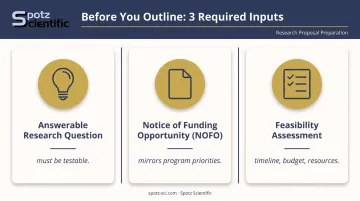
Of these three inputs, the NOFO deserves the most attention for federal proposals. For submissions to agencies like DOE ASCR or NSF, reviewing the NOFO before outlining is non-negotiable. Under 2 CFR 200.204, NOFOs specify program information, eligibility, submission instructions, review criteria, key dates, and contacts — all of which should directly shape the outline's structure.
Interpreting solicitation language accurately is harder than it looks. Spotz Scientific founder Bill Spotz spent eight years as a DOE ASCR program manager and managed over $264M in scientific computing research. He reads NOFO language from the same vantage point as the reviewers scoring submissions, which is a meaningful advantage when structuring a proposal outline around what the program office actually values.
How to Write a Research Proposal Outline: Step by Step
An outline moves from the broadest framing (the problem) to the most specific operational details (timeline and budget). Each step below produces a concrete outline element the writer can later expand into full prose.
Step 1: Write a Working Title and Problem Statement
Draft a working title that names the research variable, population or domain, and context — specific enough that a non-specialist reviewer immediately understands the scope. The title will likely evolve, but it anchors the entire outline.
Under the problem statement node, note three sub-points:
- The specific knowledge gap being addressed
- Why that gap matters to the field or funding priority
- The consequences of leaving it unresolved
These three sub-points become the opening argument of the full introduction.
Step 2: Define Your Research Questions or Specific Aims
Research questions (scientific proposals) or specific aims (federal/NIH-style proposals) are the outline's spine. Every subsequent section exists to support or answer them. Write each question or aim as a single, testable statement before outlining any other section.
Use action verbs — assess, characterize, develop, evaluate — so reviewers can immediately see what work each aim involves and whether the proposed methods can deliver on it.
NIH's model places Specific Aims in a one-page attachment. DOE and NSF don't use a specific aims page — translate that logic into the agency's vocabulary instead (NSF uses "Project Description"; ASCR EXPRESS uses "Project Objectives").
Step 3: Map the Literature Review Structure
Rather than listing sources, outline the literature review as three conceptual nodes:
- What the field has established
- What methods prior studies used and their limitations
- The precise gap the proposed study fills
This three-node structure prevents the literature review from becoming a disconnected summary list. Flag 3–5 key papers or research threads to anchor each node — the writer will later synthesize them, not just summarize them.
Federal proposals rarely include a section literally titled "Literature Review." DOE ASCR places this content under Background/Introduction; NSF embeds it in the Project Description. Name the node to match the agency's structure.
Step 4: Outline the Methodology
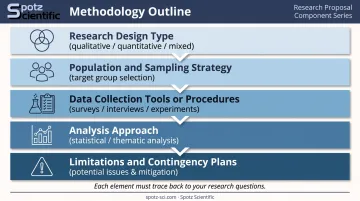
Outline methodology across five sub-elements:
- Research design type — qualitative, quantitative, or mixed
- Population and sampling strategy — or experimental population and conditions
- Data collection tools or experimental procedures — specific enough to be evaluated
- Analysis approach — how results will be assessed and validated
- Known limitations or contingency plans — what happens if a primary method fails
The methodology outline must visibly connect back to the research questions from Step 2. DOE's second ASCR review criterion is explicitly the appropriateness of the method or approach. If a reviewer cannot trace a direct line from each aim to a specific method, the proposal will appear unfeasible regardless of how well-written it is.
Step 5: Plan the Timeline and Budget Nodes
Even when a detailed timeline or budget is not yet calculable, include placeholder nodes for each. The standard phases to outline:
- Background/design
- Data collection or experimental execution
- Analysis
- Writing
- Revision and submission
For funding proposals, the budget node should include a justification sub-node for each cost category. NSF's budget justification may be up to five pages and must document and justify each line item, including personnel, equipment, travel, participant support, and indirect costs. Map each cost to a task and milestone — reviewers assess budget reasonableness against the proposed work plan.
Step 6: Add Supporting Sections and Check Alignment
Add these supporting nodes at the final outlining stage:
- Title page details
- Reference list placeholder
- Ethics/compliance considerations (IRB or IACUC if applicable)
- Contribution-to-knowledge statement — answering answering "so what?"
Once all nodes are in place, perform one alignment pass: read from research question → methodology → significance and confirm that each section of the outline directly serves the one before it. Any section that cannot be traced back to the research question is either misplaced or unnecessary.
Common Mistakes That Weaken a Research Proposal Outline
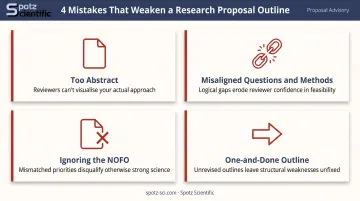
Working at too high a level of abstraction. Labels like "Methods" or "Significance" without sub-nodes leave writers with no real guidance when drafting, and reviewers with no confidence in the researcher's feasibility planning. Every node needs at least two or three sub-points.
The misalignment trap. Outlining ambitious, broad research questions but sketching a methodology that could only answer a narrower version of them is a disconnect often invisible to the writer at the outline stage. It becomes immediately apparent to reviewers, and it is a directly scored weakness under both NSF's merit review criteria and DOE ASCR's evaluation framework. A red-team review of the outline before drafting can catch this early — Spotz Scientific's red team service is specifically designed to surface these structural problems before they reach the funding agency.
Ignoring the funder's solicitation. Outlines written without consulting the NOFO often omit sections the agency requires or misweight the proposal's emphasis. DOE and NSF proposals typically require distinct "broader impacts" or "program relevance" components that standard thesis outlines never include. NSF defines Broader Impacts as the potential to benefit society and requires it to appear in both the Project Summary and Project Description — it is not optional, and it is not the same as DOE's mission relevance screening.
Treating the outline as a one-time document. The best outlines are revised at least once after the literature review deepens and the methodology is pressure-tested for feasibility. An outline that never evolves usually produces a proposal that doesn't either.
Conclusion
Fixing a structural flaw in an outline takes minutes. Fixing the same flaw in a complete draft takes days — and sometimes, it takes a rejection cycle. The outline is where that cost gets paid cheaply.
The outline's real job is to prove — first to yourself, then to the reviewer — that the project holds together and deserves funding. For researchers targeting DOE ASCR or NSF CISE, that means treating the outline as a strategic document. Review criteria exist before the first word of the proposal is written. Use the outline to answer them, section by section, before you're under deadline pressure to do so.
Frequently Asked Questions
What are the 7 parts of a research proposal?
A standard research proposal includes: title page, introduction/problem statement, literature review, research questions or specific aims, methodology/research design, timeline, and references. Funding proposals often add a budget and a broader impacts or program relevance section as required by the agency.
How long should a research proposal outline be?
The outline itself is typically 1–3 pages, with labeled nodes and brief sub-points rather than full sentences. The full proposal built from it ranges from 5,000–8,000 words for PhD dissertations to 15 pages for NSF Project Descriptions, though solicitation-specific page limits always take precedence.
How much does a research proposal cost to develop?
Writing the proposal yourself has no direct cost beyond time. For competitive federal grants, Spotz Scientific offers proposal review and advisory consulting at $200–$250/hour standard, or $250–$300/hour when materials are submitted less than two weeks before a NOFO deadline — a common investment for researchers targeting DOE or NSF programs.
What is the difference between a research proposal outline and a full research proposal?
The outline is a structural map — section headings, sub-points, and logical connections — written before any full prose. The full proposal expands each node into complete paragraphs with evidence, citations, and formal language. The outline answers "what goes where"; the proposal answers "why it matters and how it works."
Does a research proposal outline look different for federal funding proposals versus academic thesis proposals?
Federal funding outlines must align with the specific sections and priorities in the NOFO, often requiring nodes for program relevance, broader impacts, and detailed budget justification. Standard thesis proposal outlines rarely include these elements. Always build the outline structure from the live solicitation, not a generic template.