Introduction
The Specific Aims page is one page. Yet it's often the only page every member of a review panel reads in full before scoring your proposal.
A peer-reviewed grantsmanship study confirms this page's outsized weight in review. It functions as the proposal's master plan, the place where a reviewer either becomes your advocate or starts looking for reasons to set the application aside.
Aims look simple: a short paragraph, then a list. But that simplicity is deceptive. Aims that are too broad, too dependent on one another, or poorly scoped can sink an otherwise strong proposal at NSF, DOE, or NIH.
This guide walks through the exact steps, the inputs you need before you start typing, the quality checks reviewers apply, and the mistakes that most often get aims rejected.
Key Takeaways
- Strong aims tie a real research gap to a feasible, one-page plan reviewers can assess
- Aims should stand independently, so one failure doesn't sink the whole project
- Preliminary data, a hypothesis, and mechanism insight come before drafting, not after
- Vague, overambitious, or misaligned aims are the top reason reviewers push back
How to Write Specific Aims for Grant Proposals
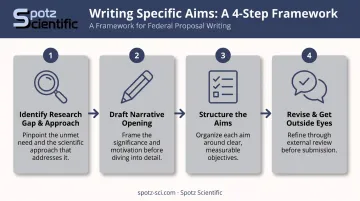
Step 1: Identify the Research Gap and Decide on Your Approach
Start by naming a genuine gap in the literature, not a general area of interest. Reviewers need to see why closing this specific gap matters to the field or to the funding agency's mission.
Next, classify your research question:
- Exploratory (hypothesis-generating): appropriate when you're producing descriptive data about a poorly understood problem. Aims can be organized around questions rather than a single hypothesis.
- Confirmatory (hypothesis-testing): requires a focused, testable hypothesis built on a solid foundation of prior work.
NIH's own guidance draws this exact line, noting that confirmatory research needs hypotheses that are focused, testable, and grounded in existing evidence, while exploratory work doesn't carry that same burden.
Before you write a word, confirm the work is actually doable. Can your team execute this within the award period? Do you have the expertise on hand? If the honest answer is "not quite," fix that first.
Step 2: Draft the Narrative Opening
Open with one to two sentences stating your project's overall goal and why it matters. This is not the place to warm up slowly.
If your work is confirmatory, state the central hypothesis directly and briefly note the preliminary work that supports it. If it's exploratory, explain the rationale for the gap you're addressing instead.
A small formatting trick helps busy reviewers: bold or italicize the hypothesis sentence. Use this sparingly, once per page, not throughout. Overusing emphasis defeats the purpose.
Step 3: Structure the Aims Themselves
List 2-4 aims, each as a standalone header or bullet, written in one to three sentences. Lead each with a strong action verb such as identify, define, quantify, establish, or determine.
For each aim, include:
- The expected outcome, stated concretely
- A brief note on how you'll interpret the results
- A short contingency note addressing the most likely pitfall
That last point matters more than writers often assume. A one-line "if X doesn't hold, we will instead pursue Y" tells reviewers you've already thought through the risks, which builds confidence in the whole plan.
Step 4: Revise, Tighten, and Get Outside Eyes on It
Hand your draft to a colleague outside your immediate field, ideally someone with study section or review panel experience. If they can't follow your aims without asking three clarifying questions, your reviewers won't either. A structured red-team review, the kind grant consultants run before submission, catches these gaps with the same scrutiny a study section would apply.
Then run a hard edit pass:
- Check the one-page limit. Cut anything that doesn't help a reviewer judge feasibility or significance.
- Trim jargon. Replace field-specific shorthand with plain language wherever possible.
- Confirm alignment. Read the narrative opening, the hypothesis, and each aim back to back. They should all point in the same direction, with no contradictions or loose threads.
What You Need Before Writing Your Specific Aims
Preparation is what determines whether this page takes you three hours or three weeks. Gather these three inputs first.
Preliminary Data and Literature Grounding
Confirmatory aims need supporting preliminary data or published results to back the hypothesis. Exploratory aims don't require pilot data in the same way, but they do need a sharp gap analysis showing exactly what's missing from current knowledge and why it matters.
A synthesis-route aim, for instance, needs at least one preliminary result demonstrating the reaction works before a reviewer will trust the hypothesis.
Funding Mechanism and Agency Fit
Page limits and review criteria vary by mechanism. Know your target before you draft:
| Mechanism | Aims/Objectives Format | Page Limit | Primary Review Focus |
|---|---|---|---|
| NIH R01/R21 | Named Specific Aims attachment | 1 page | Importance, Rigor & Feasibility, Expertise & Resources |
| NSF CAREER | Objectives within Project Description | No separate limit (15-page total) | Intellectual Merit, Broader Impacts |
| DOE ECRP | Aims section within Project Narrative | No separate limit (15-page total) | Scientific merit, method, personnel, budget |
According to NIH's own guidance, Specific Aims for R01 and R21 mechanisms are capped at one page, regardless of how many aims you include. NSF CAREER and DOE's Early Career Research Program fold the aims into a longer narrative instead, but they still expect a clearly stated aims section within it.
Team and Resource Readiness
Before committing an aim to paper, confirm your personnel, timeline, and budget can deliver it. An aim that requires equipment you haven't secured or a co-investigator who hasn't confirmed availability isn't ready for a proposal yet, no matter how compelling it sounds.
If your shared HPC allocation isn't confirmed for year two, resolve that now rather than after submission.
Key Elements That Determine High-Quality Specific Aims
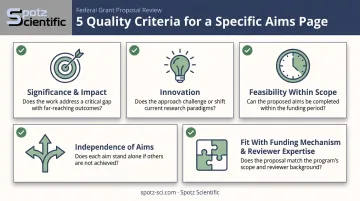
Reviewers apply a fairly consistent set of criteria to every aims page. Check your draft against each one before you submit.
Significance and Impact
Reviewers need to see that solving your problem advances the field or the agency's mission, not just your own research agenda. Aims that skip this reasoning often get triaged before anyone even reaches the methods section, since NIH review criteria explicitly assess whether successful aims would change knowledge, technical capability, or clinical practice.
Innovation
Agencies favor aims that shift current thinking, not incremental extensions of existing work. Under NIH's current simplified review framework, Innovation is folded into Factor 1 alongside Significance, both scored together on a 1-9 scale. That means your innovation argument needs to be woven into your significance narrative, not treated as a separate afterthought.
Feasibility Within Scope and Timeline
Overly ambitious aims raise immediate doubt about whether your team can deliver within the award period. NIMH lists overambitious scope and insufficient preliminary data among its most common application weaknesses, and feasibility concerns show up in summary statements more often than almost any other critique category.
Independence of Aims
If Aim 2 depends entirely on Aim 1 succeeding, a single setback can collapse your entire project. NIAID guidance recommends structuring aims so that different possible outcomes all remain informative, rather than designing a project that dead-ends if one result doesn't materialize. Rewriting a dependent chain into parallel, independently valuable aims measurably strengthens your risk profile in a reviewer's eyes.
Fit With Funding Mechanism and Reviewer Expertise
Aims need to be pitched at the right technical level for the specific study section or panel likely to review them. Program offices like DOE ASCR and NSF CISE assign reviewers based on how a proposal is framed. Pitching aims for a broader audience than the panel that actually reviews them creates a mismatch that can cost you points before the science is even debated.
This is exactly the kind of gap an outside review can catch. Spotz Scientific's red-team service, run by a former DOE ASCR program manager, is built around spotting these mismatches before a program officer reviews the file.
Common Mistakes and How to Fix Weak Specific Aims
Most weak aims fall into one of four recurring traps.
- Too broad or too narrow: An aim you can't assess, or one too small to justify a full proposal. Fix it by testing each aim against SMART criteria (specific, measurable, achievable, relevant, timebound).
- Interdependent aims: Structuring the project so Aim 1's failure undermines Aims 2 and 3. Fix it by rewriting aims to rest on independent data or methods.
- Buried hypothesis: Your significance statement sits in paragraph three instead of your opening lines. Fix it by moving it to the first sentence or two.
- Ignoring the mechanism: Writing aims that don't match what your target program actually rewards. Reread the funding announcement's review criteria one more time before your final edit.
Conclusion
Strong Specific Aims connect a real gap, a feasible plan, and aims independent enough to survive a setback, all assessable by a reviewer in one page. Most weak aims don't fail because the science is bad. They fail because of framing, overreach, or a mismatch with what the funding mechanism rewards.
An experienced outside reviewer catches these problems before a program officer or panel does. That's the value of working with someone who's sat on the other side of the table. Bill Spotz spent eight years as a DOE ASCR program manager overseeing more than $264 million in scientific computing research before founding Spotz Scientific.
Frequently Asked Questions
How do I write a scientific aim?
State why the problem matters, what your specific goal is, and briefly how you'll accomplish it. This why-what-how structure keeps each aim tight and assessable within a sentence or two.
What is an example of a research aim?
A typical structure pairs one overarching goal with 2-3 supporting aims, such as "This project will determine X," "Aim 1: quantify Y," and "Aim 2: identify Z." Each aim uses an action verb and states a measurable outcome.
What are the 4 aims of research?
This phrase usually refers to general research purposes like explore, describe, explain, and predict, not a rule for grant Specific Aims. Grant aims typically number 2-4, regardless of this taxonomy.
How many specific aims should a grant proposal have?
Most proposals use 2-4 aims. Fewer than two looks thin, while more than four risks overreach and creates dependency between aims that reviewers will flag.
How long should the Specific Aims page be?
NIH R01 and R21 mechanisms cap Specific Aims at one page. NSF CAREER and DOE's Early Career Research Program fold aims into a longer project narrative instead, without a separate one-page limit.
What's the difference between specific aims and research objectives?
Specific Aims is a named, required attachment in NIH applications and a required section within DOE's project narrative. Objectives is a more generic term, used in NSF CAREER proposals and academic theses, for breaking a broader goal into measurable steps.