Introduction
Many early-stage companies treat the NSF SBIR Phase I award as a fixed number — submit your proposal, receive a check. The reality is more demanding and more consequential.
The active 2026 solicitation (NSF 26-510), posted May 22, 2026, sets the Phase I ceiling at $305,000 for a performance period of 6–18 months. That ceiling is not a target, a typical award, or a guarantee — it is the maximum you may request.
What you actually receive depends on what you justify, how well your budget aligns with your technical narrative, and whether your cost structure holds up under post-award scrutiny.
Misunderstanding any of those three points has real consequences: underfunded proposals, compliance findings, or a Phase II application that stalls when Phase I financial records are incomplete.
This article explains what the 2026 Phase I funding amount represents, what governs it, how a compliant budget is built, and which misconceptions most frequently derail applicants.
Key Takeaways
- The 2026 Phase I ceiling is $305,000 per NSF solicitation 26-510 — confirm against the live document before finalizing your budget
- Phase I is a grant, not a contract — governed by 2 CFR 200 and 48 CFR 31.2 for commercial recipients
- The amount you receive reflects the budget you justify — NSF does not automatically fund the ceiling
- Companies without a negotiated indirect cost rate may elect 15% of Modified Total Direct Costs (MTDC)
- Weak Phase I financial management can jeopardize your eligibility for NSF Phase II funding
What NSF SBIR Phase I Funding Represents
Phase I is a proof-of-concept grant. Its purpose is to fund feasibility research — early experiments and technical studies that establish whether a technology can work — not to build a product or reach a customer.
A Grant, Not a Contract
Unlike a federal contract, an NSF SBIR Phase I award is a financial assistance mechanism governed by 2 CFR 200 (Uniform Guidance). For commercial (for-profit) organizations, cost allowability is specifically determined under 48 CFR Part 31.2, not 2 CFR 200 Subpart E. Compliance obligations shift toward cost documentation, allocation accuracy, and audit readiness — not deliverable-based milestones.
Phase I vs. Phase II: Different Animals
| Feature | Phase I | Phase II |
|---|---|---|
| Purpose | Feasibility / proof-of-concept | Prototype development / scale-up |
| Period | 6–18 months | Typically 24 months |
| Award ceiling | Up to $305,000 | Up to $1,250,000 |
| Eligibility | Open to qualifying small businesses | Phase I awardees only |
How you manage Phase I funds — your accounting practices, timekeeping, cost documentation — determines whether you can access the significantly larger Phase II award.
Why the Non-Dilutive Structure Matters
NSF takes 0% equity from Phase I recipients. For a pre-seed company that cannot access venture capital without surrendering ownership, this makes the Phase I award especially attractive for pre-revenue companies. The $305,000 ceiling funds real research time — salaries, equipment, subcontracts — without surrendering any ownership stake.
What Sets the Phase I Funding Amount in 2026
The Controlling Document Is NSF 26-510
The Phase I ceiling is set by the active solicitation, not by convention or historical averages. NSF 26-510, posted May 22, 2026, sets the ceiling at $305,000 for 6–18 months. Listed submission deadlines are July 27, 2026 and November 4, 2026.
NSF updates solicitation parameters periodically. The ceiling has progressed substantially over time:
| Solicitation | Posted | Phase I Ceiling |
|---|---|---|
| NSF 09-541 | Feb. 2009 | $150,000 |
| NSF 16-599 | Sept. 2016 | $225,000 |
| NSF 20-527 | Dec. 2019 | $256,000 |
| NSF 23-515 | Nov. 2022 | $275,000 |
| NSF 24-579 | May 2024 | $305,000 |
| NSF 26-510 | May 2026 | $305,000 |
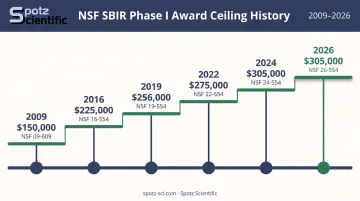
Applicants who rely on outdated sources risk building budgets against the wrong ceiling. Always confirm against the current solicitation at seedfund.nsf.gov.
The Ceiling Is Not the Average
NSF's active award dashboard currently shows $295,822 as the average funding for 224 active Phase I companies. That figure covers companies still conducting funded work — it does not represent a clean SBIR-only historical cohort or confirm what "most" applicants receive, and should not be used as a planning target.
How the Phase I Budget Is Built and Justified
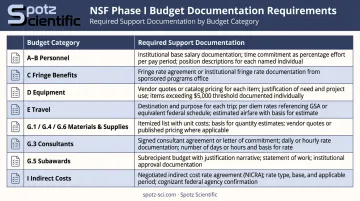
NSF requires a line-item budget with a detailed justification for every nonzero cost. The budget justification is a single PDF, limited to five pages including any subaward justifications.
What Each Budget Line Requires
| Budget Area | Required Support |
|---|---|
| Personnel (Lines A–B) | Names, titles, responsibilities, salary basis, and time commitments |
| Fringe (Line C) | Basis and treatment under established accounting practice |
| Equipment (Line D) | Need and vendor support for qualifying items |
| Travel (Line E) | Trips, destinations, and project necessity |
| Materials / Other Direct Costs (Lines G.1, G.4, G.6) | Itemized descriptions and estimates |
| Consultants (Line G.3) | Days, rate, role, and signed commitment letter (max rate: $1,000/8-hour day) |
| Subawards (Line G.5) | Separate budget and justification for each subaward |
| Indirect Costs (Line I) | Rate, base, and calculation |
The PI Labor Requirement
The Principal Investigator must be at least 51% employed by the small business at award and throughout performance. Minimum effort is one calendar month per six months of the performance period. Reviewers examine it first, and non-compliance creates problems at both the proposal stage and post-award.
Handling Indirect Costs Without a NICRA
Companies without a current Negotiated Indirect Cost Rate Agreement (NICRA) may elect a rate of up to 15% of MTDC under 2 CFR 200.414(f). This applies to awards executed on or after October 1, 2024, and no supporting justification is needed to use this rate.
MTDC includes: salaries, applicable fringe, materials, services, travel, and the first $50,000 of each subaward.
The base does not cover everything, however. MTDC excludes: equipment, capital expenditures, participant support costs, and subaward amounts above $50,000.
Companies with higher indirect rates — or those wishing to propose a rate above 15% — must submit an indirect cost rate proposal. Commercial organizations are required to provide a written Cost Policy Statement describing accounting policies and allocation methodology.
Budget reviewers scrutinize indirect cost structure closely. Errors in the rate base or MTDC calculation directly reduce the direct research effort your award can support — so getting this right before submission matters.
Allowable and Unallowable Costs Under Phase I
For commercial (for-profit) Phase I recipients, cost allowability is determined by 48 CFR Part 31.2, not 2 CFR 200 Subpart E. In practice, costs must be reasonable, allocable to the project, and consistently treated in your accounting system.
Costs That Create Compliance Risk
Common unallowable cost categories that applicants sometimes include — or fail to exclude from indirect cost pools:
- Entertainment (unless it serves a specific, documented programmatic purpose)
- Alcoholic beverages (unallowable without exception)
- Promotional advertising not tied to personnel recruitment or approved outreach
- Compensation that is not reasonable relative to comparable positions
- Expenses unrelated to the approved scope of work
The indirect pool issue is particularly consequential. Unallowable costs cannot be included in indirect cost pools. Companies that fail to exclude them risk findings during NSF's post-award monitoring or the Phase II Administrative/Financial Review. That exposure can jeopardize Phase II readiness even when technical performance is strong.
Common Misconceptions About NSF SBIR Phase I Funding
Misconception 1: The Ceiling Is the Award
Proposing $305,000 without a budget narrative that supports every line item is a common reason proposals are questioned or awarded less than requested. NSF funds what is justified. Every dollar you request must connect clearly to a specific research activity in your technical narrative.
Misconception 2: You Must Incur Costs Before Drawing Funds
NSF uses the Award Cash Management Service (ACM$) for Phase I payments. Under current Phase I Grant General Terms, recipients may draw down the award amount after the start date — with NSF generally withholding the final $25,000 pending approval of satisfactory final reports and Project Outcomes reports. This is not a pure reimbursement-only system, but real-time cost tracking and documentation are still required from day one.
Misconception 3: Phase I Financial Management Doesn't Affect Phase II
Before any Phase II award, NSF conducts a formal SBIR Phase II Administrative/Financial Review (note: "CAP" refers to NSF's Cost Analysis and Pre-Award Branch, not a separate program). This review examines your proposed Phase II budget, accounting and timekeeping systems, indirect cost support, and financial capability — drawing directly on how Phase I funds were managed.
Common Phase I management problems that create pre-award readiness issues in Phase II include:
- Missing or incomplete timesheets
- Inconsistent cost allocations across reporting periods
- An accounting system that can't support federal audit requirements
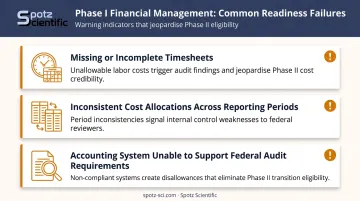
These issues surface during the Phase II review regardless of how strong your technical results are.
Budget structure and financial management decisions made at the Phase I proposal stage carry consequences well into Phase II. Spotz Scientific offers SBIR proposal strategy consulting — including advisory on how program managers evaluate submissions — for small businesses pursuing federal innovation funding. Reach out at info@spotz-sci.com to discuss your specific proposal needs.
Frequently Asked Questions
Is NSF SBIR funding available in 2026?
Yes. NSF 26-510 is active, with submission deadlines of July 27 and November 4, 2026. NSF also accepts Project Pitches on a rolling basis at any time; a response typically takes 1–2 months, and a positive response invites preparation of a full proposal.
What does NSF SBIR stand for?
NSF SBIR stands for National Science Foundation Small Business Innovation Research. It is a federal program providing non-dilutive grant funding to small businesses conducting early-stage R&D with commercial potential.
How much is a Phase I NSF SBIR award in 2026?
The current ceiling under NSF 26-510 is $305,000 for 6–18 months. This is the maximum request, not a guaranteed or typical award. Always confirm against the current solicitation at seedfund.nsf.gov before submitting.
What is the difference between NSF SBIR Phase I and Phase II funding?
Phase I funds feasibility and proof-of-concept work over 6–18 months, up to $305,000. Phase II funds prototype development and scale-up over 24 months, up to $1,250,000. Only NSF Phase I awardees may submit a Phase II proposal. Confirm both figures against the current solicitation, as ceilings are subject to change.
Can Phase I NSF SBIR funding be used for salaries?
Yes. PI and key personnel salaries are a primary and expected direct cost. The PI must be at least 51% employed by the small business. All labor charges must be supported by timekeeping records for every employee charging time to the award.
Can I request the full maximum Phase I award amount?
You may propose up to $305,000, but every dollar requires justification through a detailed budget narrative. NSF will question line items that lack a clear connection to the proposed research scope. Your budget should reflect actual need and documented costs, not the maximum for its own sake.