Most rejections trace back to a fundamental misread of what SBIR reviewers actually evaluate. These are not academic grants. Reviewers score innovation, feasibility, and commercialization potential — and a proposal that treats any one of those as secondary will lose points.
This guide covers what it actually takes to win: from pre-submission groundwork to the proposal sections reviewers scrutinize most, to the mistakes that sink even technically strong applications.
Key Takeaways
- SBIR reviewers score commercialization potential as a required criterion — not optional context
- Registration alone can take up to a month; start before the solicitation drops
- Most applicants skip contacting the program manager before writing — those who do gain a real edge
- Map every section of your proposal to the agency's stated review criteria
- A red team review by someone outside the writing process is essential before submission
Before You Write: Essential Groundwork
Strong proposals are built on preparation that happens weeks before a single sentence is drafted. Skipping this groundwork is one of the most common reasons otherwise competitive applications stall or get disqualified.
Registration and Eligibility Requirements
Federal SBIR submissions require active registrations across multiple systems — and the timeline is longer than most applicants expect.
| System | Purpose | Timing |
|---|---|---|
| SAM.gov | Federal entity registration and UEI | Up to 10 business days (NSF warns up to one month) |
| SBA Company Registry | Small business eligibility verification | Start early; must be current within 6 months of submission |
| Agency portal | Submission system (Grants.gov/ASSIST for NIH, Research.gov for NSF, PAMS for DOE, DSIP for DoD) | Varies by agency |
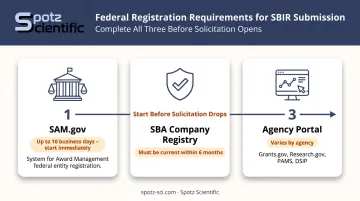
Do not wait until the solicitation releases to start these. A SAM.gov delay alone can disqualify a submission.
Know Your Agency and Solicitation Fit
The 11 participating SBIR agencies are not interchangeable. In FY2022, DoD issued 1,024 Phase I awards, HHS issued 654, NSF issued 411, and DOE issued 383 — each with distinct review cultures, topic structures, and budget norms.
Before writing anything:
- Read prior-year awards from your target agency to understand what gets funded
- Review the agency's review criteria (they differ significantly — more on this below)
- Pick one agency for your first proposal and go deep on its solicitation culture
Dividing your attention across multiple agencies in early rounds spreads your effort too thin — and a mediocre submission to three agencies loses to a focused, tailored proposal to one.
How to Write a Winning SBIR Grant Proposal: Step by Step
Step 1: Download and Thoroughly Read the Solicitation
The solicitation — called a Funding Opportunity Announcement (FOA) or Notice of Funding Opportunity (NOFO) — is the controlling document. Page limits, font requirements, required sections, and evaluation criteria are all defined there.
Skipping a careful read is the most common and most avoidable reason for disqualification.
Before writing a single paragraph:
- Map every required section using the solicitation as your outline
- Note all formatting requirements (page limits, margins, font size, file types)
- Identify the evaluation criteria and keep them visible throughout drafting
Proposals that violate formatting rules are rejected without review. Read the solicitation. Follow it exactly.
Step 2: Contact the Program Manager Before Writing
Program managers — or topic authors at DoD — carry context about what a solicitation is looking for that doesn't always appear in the written document. A 15-minute call or a well-crafted email can tell you whether your proposed approach is a genuine fit and which aspects of your project to emphasize.
Effective pre-submission inquiries focus on:
- Whether your approach aligns with the solicitation's intent
- Which aspects of the problem the agency considers highest priority
- Any ambiguities in the solicitation language worth clarifying
What to avoid: asking the program manager to evaluate your idea or tell you whether you'll win. Come prepared with a brief, specific description of your project and ask targeted questions. The goal is context, not validation.
Step 3: Define Your Innovation and Commercialization Thesis First
Before writing any section, answer these foundational questions in writing:
- What is the specific problem, and at what scale does it exist?
- What is genuinely new about your approach — and why doesn't it already exist?
- Who are your target customers, and what will they pay?
- Why is this team uniquely positioned to deliver?
Vague answers at this stage produce vague proposals. SBA policy explicitly requires agencies to evaluate commercial potential alongside scientific and technical merit — commercialization is not a bonus section.
Before you write, reviewers expect you to identify:
- A concrete product or service
- A named target market
- A realistic path to revenue
If you can't articulate all three, you're not ready to write.
Step 4: Structure Your Technical Approach Around Specific Aims
The technical section should present a phased research plan — typically 2–3 specific aims or research tasks for Phase I — with measurable success criteria for each. Reviewers need to assess both scientific rigor and feasibility within the proposal's budget and timeline.
Note that Phase I award ceilings vary by agency: the current SBA standard ceiling is $323,090, NSF Phase I goes up to $305,000, and DoD components set their own limits. A proposal that scopes work appropriate for a $500K budget into a $300K Phase I will raise red flags.
A common reviewer complaint: applicants propose far more work than the period and budget allow. A realistic, well-scoped work plan builds credibility. An overloaded one undermines it.
Step 5: Write Every Section to the Agency's Review Criteria
Each major SBIR agency uses a distinct review framework:
| Agency | Review Criteria |
|---|---|
| NIH | Significance, Innovation, Approach, Investigator(s), Environment |
| NSF | Intellectual Merit, Broader Impacts, Commercial Impact |
| DOE | Scientific/Technical Approach; Cost-Effective Execution; Impact |
| DoD | Technical Merit and Innovation; Team and Commercialization Ability; Commercial Potential |
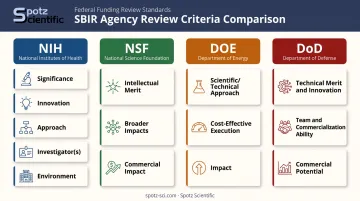
Every section of your proposal should visibly address at least one criterion. If you're writing the Innovation section, make sure it maps explicitly to what "Innovation" means at your target agency — the criteria differ enough to matter.
Write for a mixed audience: clear enough for a non-specialist reviewer to grasp the value immediately, rigorous enough for a subject-matter expert to find it credible. Aim for 7th–8th grade readability in your narrative sections — it signals clarity, not simplicity.
Step 6: Conduct a Red Team Review Before Submitting
A red team review means having qualified reviewers evaluate your proposal against solicitation criteria before you submit. It's the single most effective quality-control step available. Internal team members are too close to the work to spot what a reviewer panel will actually question.
A consultant who has sat on the program manager's side of the table can catch those weaknesses before they count. Spotz Scientific, led by Dr. Bill Spotz — a former DOE program manager who oversaw more than $264M in scientific computing research — offers evaluator-perspective review for SBIR applicants targeting DOE and NSF programs. Engagements are hourly and can be scoped to a pre-proposal, a specific section, or a full draft.
Key Proposal Sections Reviewers Scrutinize Most
Certain sections carry disproportionate weight. These are where most proposals lose points.
The Problem Statement and Significance
Reviewers need to immediately understand why the problem matters, at what scale, and why existing solutions fall short. A vague or undersized problem statement sets a poor tone for everything that follows. Be specific about consequences: who is affected, what it costs them, and why current approaches don't solve it.
The Innovation Claim
The innovation section must articulate what is genuinely new — not incremental improvement, but a meaningful departure from the state of the art. Reviewers have seen hundreds of proposals and can identify overclaiming quickly. Be precise about the technical gap you're filling and why your approach closes it.
The Research Plan and Feasibility Evidence
The technical approach must demonstrate feasibility through preliminary data, prior publications, or a clear technical argument. A timeline with specific milestones is required. Reviewers are asking: has this team done enough work to know this approach will work?
The Commercialization Plan
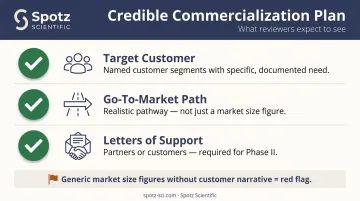
Many technically strong proposals lose points here. A credible commercialization section includes:
- Named customer segments with specific, documented need
- A realistic go-to-market pathway, not just a market size figure
- Letters of support from potential partners or customers (required for Phase II)
Generic market size figures without a real customer development narrative are a red flag at every agency.
PI and Team Qualifications
The federal rule requires that the PI's primary employment — more than half of their employment time — be with the small business at award and during project conduct. That's the eligibility floor, not the finish line.
Beyond that, reviewers evaluate whether the team collectively has the scientific expertise, facility access, and business capability to execute the proposed work. Gaps in any of those areas should be addressed directly, not left for reviewers to discover.
Common SBIR Proposal Mistakes to Avoid
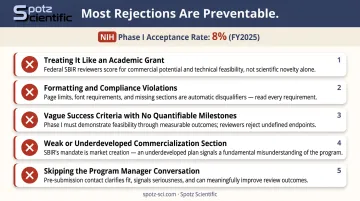
The overall Phase I selection rate was 16% in FY2022 across all agencies, with NIH down to 8% in FY2025. Most rejections are preventable.
- Treating it like an academic grant. Reviewers are explicitly evaluating commercialization viability — a proposal centered on knowledge generation rather than product development will score poorly at every agency.
- Proposals get disqualified for page limit violations, incorrect fonts, missing sections, and wrong topic submissions. Run a pre-submission checklist against the solicitation — it prevents all of these.
- Vague success criteria. Every aim or task needs a stated metric defining what success looks like at Phase I completion. Without quantifiable milestones, reviewers cannot assess feasibility.
- Many technical founders treat the commercialization section as a half-page afterthought. Agencies fund technologies that will generate economic value — give this section the same rigor as the technical approach.
- Skipping the program manager conversation. This step surfaces context about solicitation priorities and fit that can reshape the entire framing of your proposal. Don't skip it.
What to Do If Your SBIR Proposal Is Rejected
Rejection on a first submission is common and not a verdict on the underlying idea. Most agencies provide formal feedback — NIH issues a Summary Statement, NSF releases panel summaries and reviewer comments, DOE provides merit review feedback, and DoD Army components issue a ValidEval Report.
Request and Carefully Analyze Reviewer Feedback
Read reviewer comments systematically. Categorize each critique:
- Scientific approach — Is the technical plan unclear, underdeveloped, or not feasible?
- Commercialization — Did reviewers find the market case unconvincing?
- Team qualifications — Were there gaps in expertise or commitment?
- Proposal clarity — Was the writing unclear or poorly organized?
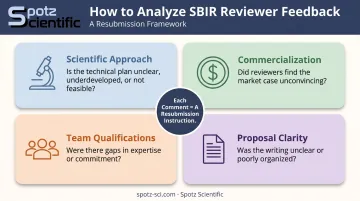
Each comment is an explicit instruction for how to improve the resubmission. Treat it that way.
Consider Expert Consultation for Resubmissions
Once you've mapped the reviewer feedback, outside perspective often reveals blind spots that are easy to miss when you're close to the work. A consultant who knows the target agency's funding culture — how panels are structured, what language resonates, where proposals typically lose points — can identify issues that internal review passes over.
For proposals targeting DOE ASCR or NSF CISE programs specifically, this kind of insider knowledge is particularly useful. Dr. Bill Spotz of Spotz Scientific spent eight years as a DOE ASCR program manager and brings direct experience evaluating the types of scientific computing proposals these panels see. His red team review and advisory services are designed for exactly this stage of the process. Contact info@spotz-sci.com to discuss your resubmission scope and timeline.
Conclusion
Winning an SBIR proposal requires equal rigor across three areas: scientific innovation, a credible and specific research plan, and a realistic path to commercialization. Neglect any one of them and the score reflects it.
Preparation before writing — understanding the agency, talking to the program manager, completing registrations, building the right team — determines outcomes as much as the quality of the writing itself. Proposal writing is also a learnable skill. Applicants who treat reviewer feedback as a roadmap, invest in a genuine red team review, and engage expert guidance are far more likely to succeed on resubmission — often within one or two attempts.
If you're preparing an SBIR submission and want an experienced reviewer in your corner, Spotz Scientific offers red team review and strategic advisory services grounded in 30+ years of federal research funding experience.
Frequently Asked Questions
How do I write a successful SBIR grant proposal?
A successful SBIR proposal clearly defines the innovation, demonstrates feasibility through a research plan with measurable milestones, and makes a credible case for commercialization — written directly to the agency's stated review criteria. Both scientific rigor and commercial potential must come through on the page.
What are common SBIR grant mistakes?
The most frequent mistakes include treating the SBIR like an academic grant, failing to follow solicitation instructions precisely, submitting a weak commercialization section, and not contacting the program manager before writing.
What is the difference between SBIR Phase I and Phase II?
Phase I is a proof-of-concept award — typically up to $323,090 over 6–12 months — designed to demonstrate feasibility. Phase II builds on Phase I results with a larger development award (up to $2,153,927) aimed at moving the technology toward a commercial product.
How long does it take to write an SBIR proposal?
Plan for at least a 10-week window from solicitation release to submission. That time covers writing, team coordination, required registrations, and revision cycles — and registrations alone can take several weeks.
Should I contact the program manager before submitting my SBIR proposal?
Yes. Contacting the program manager — or the topic author at DoD — before you write helps confirm your project fits the solicitation, clarifies ambiguous language, and tells you which aspects of the work to emphasize.
What is the SBIR success rate for first-time applicants?
The overall Phase I selection rate was 16% in FY2022 across all agencies; at NIH, it has fallen to 8% in FY2025. Rates vary significantly by agency. Resubmissions that directly address reviewer feedback have meaningfully better odds.