This guide cuts through that complexity. It covers the types of DOE financial assistance available, the key Office of Science programs, a step-by-step walkthrough of the application process, what your proposal must include, and practical strategies for making your submission more competitive.
Key Takeaways
- DOE funding flows through grants and cooperative agreements announced via FOAs or NOFOs
- Proposals are reviewed on scientific merit, program relevance, and team qualifications
- A missing Data Management and Sharing Plan (DMSP) will get your application rejected without review
- Pre-applications are mandatory for some programs — your response (encouraged vs. discouraged) shapes your next steps
- Submissions go through Grants.gov using SF-424 (R&R) forms and are tracked in DOE's PAMS system
Understanding DOE Financial Assistance: Grants, Cooperative Agreements, and Contracts
DOE funds research through three primary mechanisms. Knowing which applies to your work shapes how you find, apply for, and manage an award:
- Grants: Transfer value to support a public purpose with no substantial federal involvement. The most common instrument for university researchers.
- Cooperative agreements: Same public purpose as grants, but DOE maintains substantial involvement throughout the project.
- Contracts: Procurement vehicles used when DOE is acquiring specific property or services for its direct benefit.
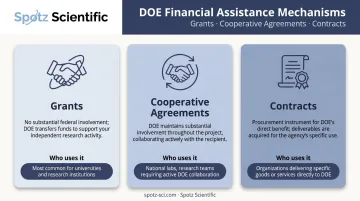
Most academic researchers will pursue grants or cooperative agreements, not contracts.
Who Can Apply
Eligibility is broad but varies by solicitation. Organizations that can apply to Office of Science FOAs include:
- U.S. colleges and universities
- DOE national laboratories
- Non-profit organizations
- For-profit companies
Always verify your organization's eligibility in the specific FOA — do not assume.
Governing Regulations
Awardees must comply with three regulatory frameworks:
- 2 CFR Part 200 — Government-wide uniform administrative requirements and cost principles
- 2 CFR Part 910 — DOE's specific implementation of 2 CFR 200
- 10 CFR Part 605 — The Office of Science Financial Assistance Program rules
These are not optional. Awardees are bound by all three from the date of award.
Two Types of Solicitations
| Type | Description | Key Details |
|---|---|---|
| Open solicitations | Accepts proposals year-round on broad Office of Science research areas | FY 2026 solicitation (DE-FOA-0003600) runs through Sept 30, 2026; ~$500M anticipated; 200–350 awards/year ranging from $5,000 to $5M |
| Topical FOAs | Time-limited, topic-specific announcements with strict deadlines | Drive a significant share of competitive funding; require close monitoring |
Where to Find DOE Funding Opportunities
| Portal | Function |
|---|---|
| Office of Science grants page | Lists open Office of Science NOFOs |
| Grants.gov | Publishes all federal NOFOs; receives SF-424 (R&R) applications |
| FedConnect | DOE NOFOs and modifications |
Subscribe to Office of Science GovDelivery alerts and set up Grants.gov notifications for program offices aligned with your research. Topical FOAs can close quickly — missing the announcement means missing the opportunity.
Key DOE Office of Science Programs for Researchers
Before searching for FOAs, identify which of the eight Office of Science program offices aligns with your work:
| Acronym | Program Office |
|---|---|
| ASCR | Advanced Scientific Computing Research |
| BES | Basic Energy Sciences |
| BER | Biological and Environmental Research |
| FES | Fusion Energy Sciences |
| HEP | High Energy Physics |
| NP | Nuclear Physics |
| ARDAP | Accelerator R&D and Production |
| DOE IP | Isotope R&D and Production |
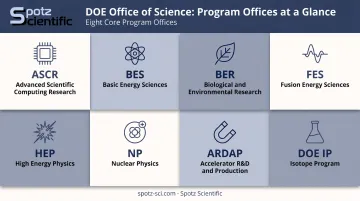
Each office has distinct research priorities. Submitting to the wrong office — or submitting a proposal that doesn't reflect the right office's mission — will typically result in a declined or unfunded application.
The Early Career Research Program
This is the flagship opportunity for newer faculty and national lab researchers. Key details from the FY 2026 NOFO:
- Academic eligibility: Untenured, tenure-track assistant or associate professors at U.S. academic institutions
- Lab eligibility: Full-time, permanent, non-postdoctoral employees at DOE/NNSA national laboratories or eligible Office of Science user facilities
- Ph.D. window: Degree received on or after January 1, 2015 (for the FY 2026 competition); extensions permitted for qualifying life events
- Award amounts: Approximately $875,000 over five years for academic institutions; approximately $2,750,000 over five years for national lab or user facility PIs
- Pre-application: Mandatory, limited to three pages; a non-encouraged application may be declined without merit review
SBIR/STTR Programs
For small businesses and research institutions pursuing commercialization of scientific computing or energy research, note that DOE SBIR/STTR program management now sits under the DOE Office of Technology Commercialization (OTC) — not the Office of Science directly. That said, Office of Science personnel often serve as technical contacts for relevant topics, so identifying the right program office still matters when scoping your proposal.
The DOE Grant Application Process, Step by Step
Step 1 — Identify the Right FOA
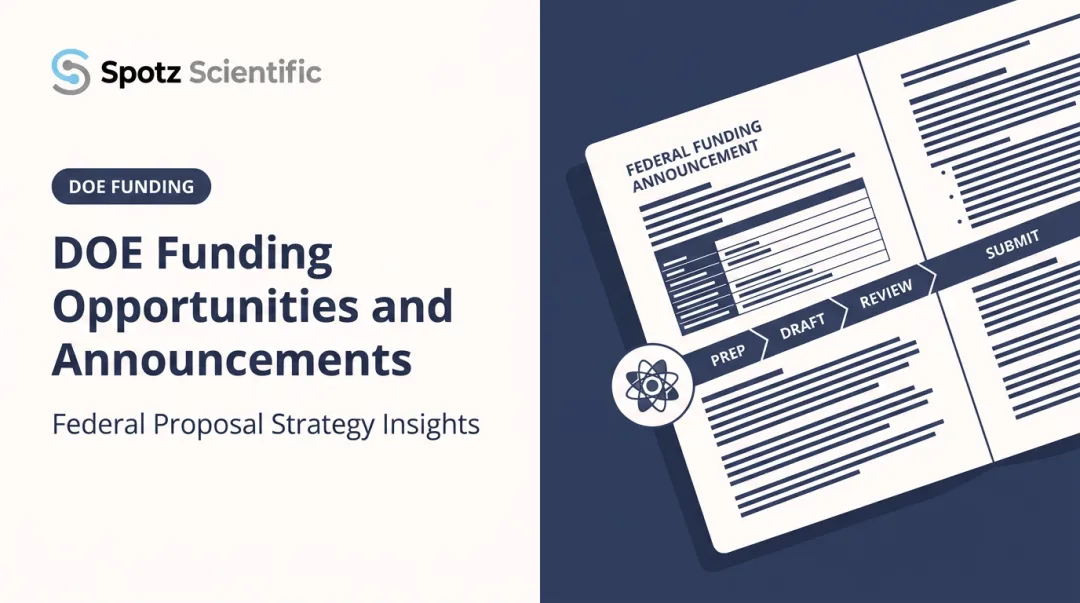
Read the full FOA before doing anything else. Confirm that your research aligns with the stated programmatic priorities — relevance to the program office's mission is a threshold requirement, not a scoring criterion. Note all deadlines, including concept paper or pre-application deadlines, which often fall weeks before the full application is due.
Step 2 — Register and Set Up Accounts
You need three active accounts before you can submit:
- SAM.gov registration — Required for all organizational applicants. Activation can take up to 10 business days, sometimes longer if submitted information cannot be validated. Registration must be renewed every 365 days.
- Grants.gov account — Where you'll submit the application package
- PAMS account — DOE's system for managing proposals and peer reviews
Start the SAM.gov registration well before any deadline. An expired or lapsed registration can block your submission entirely.
Step 3 — Submit a Pre-Application (Where Required)
For many topical FOAs — and mandatory for the Early Career Research Program — a pre-application must be submitted before the full proposal. These are typically up to three pages and describe your research objectives, approach, and team.
DOE responds with "encouraged" or "discouraged" notifications. You may still submit a full application after a discouraging response, but be honest with yourself: a discouraged notice is a substantive signal that the proposal as described may not fit the FOA's priorities. Weigh that feedback before committing to a full application.
Step 4 — Prepare and Submit the Full Application
Full applications are submitted through Grants.gov using SF-424 (R&R) forms. At minimum, your package must include:
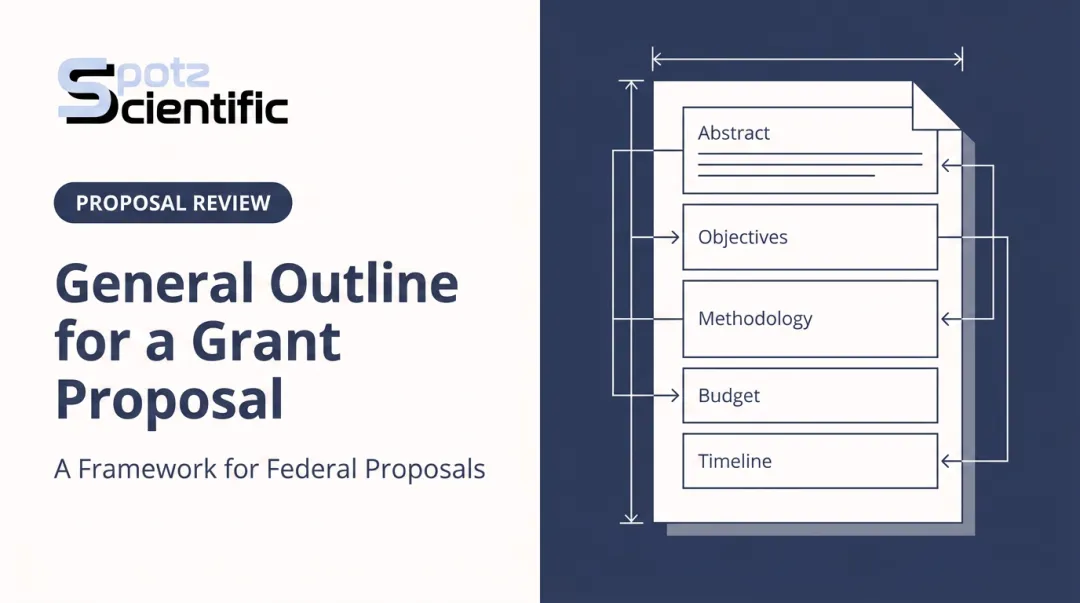
- Technical narrative (project description)
- Budget and budget justification
- Biographical sketches for key personnel
- Current and pending support disclosure
- Data Management and Sharing Plan (DMSP)
- Any program-specific appendices required by the FOA
Applications missing required components may be rejected without review.
Step 5 — Merit Review
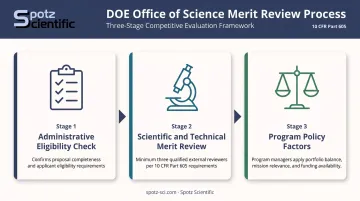
Submitted applications move through three distinct stages:
- Administrative eligibility check — Confirms the application is complete and the applicant is eligible
- Scientific and technical merit review — Under 10 CFR Part 605, a project manager submits each application to at least three qualified reviewers
- Program policy factors — Program managers apply portfolio balance, mission relevance, and funding availability to make final funding recommendations
Step 6 — Award Negotiation and Notice of Award
Selected applications enter a negotiation phase to finalize scope, milestones, and budget. The formal Notice of Award (NoA) marks the official project start and triggers all reporting and compliance obligations. Understanding what comes after the NoA — progress reports, budget modifications, and closeout requirements — is as important as winning the award in the first place.
Proposal Requirements: Technical and Administrative Components
Technical Narrative
The project description is the core of your proposal. It must clearly articulate scientific objectives, technical approach, innovation, and significance — all framed against the specific program office's priorities. This is where DOE proposals differ from NSF submissions: you must demonstrate not just scientific excellence, but direct alignment with DOE's mission. Generic narratives that could apply to any program rarely score well.
Budget and Cost Sharing
Budget components include:
- Direct costs: Personnel, equipment, travel, materials, subawards
- Indirect/F&A costs: Facilities and administrative costs negotiated with your institution
Some FOAs require cost sharing, where you must fund a specified percentage of total project cost. The FOA will state whether cost sharing is mandatory and at what level.
Data Management and Sharing Plan
A DMSP is required for all Office of Science proposals under DOE's Digital Research Data Management policy. The plan must describe:
- How data underlying publications will be made open, machine-readable, and publicly accessible at publication
- How data will be preserved
- Which community-accepted repositories will be used
Proposals submitted without a DMSP may be declined without merit review. Failure to implement the plan as proposed can also affect future funding opportunities.
Biographical Sketches and Current/Pending Support
The PI and all co-PIs must submit biographical sketches and disclose all current and pending sponsored activities. Reviewers and program officers scrutinize these disclosures to check for overlap with other funded work. Required elements include:
- All sponsored activities, paid or unpaid, foreign or domestic
- A digital persistent identifier for covered individuals (required under FY 2026 continuation NOFO)
Program-Specific Requirements
The PIER Plan requirement was ended by the Office of Science effective January 27, 2025. Reviewers no longer comment on PIER Plans, and selections no longer consider them. Because program policies shift — sometimes mid-cycle — always treat the specific FOA as the authoritative source on current requirements before finalizing any section of your proposal.
How DOE Evaluates Research Proposals
DOE's Office of Science uses a two-stage process to evaluate proposals. Merit review criteria typically include:
- Scientific or technical merit and originality
- Relevance to program priorities
- Adequacy of resources and qualifications of the research team
- Reasonableness of the proposed budget
After external merit review, program managers apply program policy factors to finalize funding recommendations. The FY 2026 Early Career NOFO explicitly lists "ensuring an appropriate balance of activities within SC programs" as one such factor. This means a highly-scored proposal is not guaranteed funding — and a proposal just below a cutoff may be funded if it fills a gap in the portfolio.
Search the PAMS Award Search database for current and past funded project abstracts. Seeing what has actually been funded reveals actual program priorities that FOA language often obscures.
Tips for Submitting a Stronger DOE Research Proposal
Respond to the FOA precisely. The most common reason strong science goes unfunded is misalignment with stated programmatic priorities. Every element — title, abstract, technical approach — should explicitly connect to the program office's mission and the FOA's specific focus areas.
Treat the pre-application seriously. For programs where pre-applications are accepted or required, these are strategic documents, not formalities. An encouraged response signals genuine fit. A discouraged response is your cue to reconsider whether a full application is worth the investment.
Look at the portfolio, not just the solicitation. Program managers balance portfolios across research areas, institutions, and career stages. Understanding what a program office has recently funded — not just what the FOA says — helps you position your work where there's genuine demand.
Engage expert review before submission. For researchers preparing DOE Office of Science proposals — particularly for ASCR, the Early Career Research Program, or other competitive topical FOAs — working with a reviewer who has direct program management experience inside DOE makes a meaningful difference.
Spotz Scientific, founded by Dr. Bill Spotz — a former DOE ASCR program manager who co-led the applied mathematics program and managed over $264 million in research funding — offers red team reviews and strategic advisory services specifically built around DOE and NSF scientific computing proposals. Services are available at $250/hour (standard) or $300/hour for materials submitted fewer than two weeks before a NOFO deadline. Reach the team at info@spotz-sci.com.
Frequently Asked Questions
Who is eligible to apply for DOE Office of Science grants?
U.S. universities, DOE national laboratories, non-profit organizations, and for-profit companies can all apply. Specific eligibility requirements vary by FOA — confirm your organization's eligibility in the individual FOA before starting an application.
What is the difference between a FOA and a NOFO?
FOA (Funding Opportunity Announcement) and NOFO (Notice of Funding Opportunity) are interchangeable terms for the official documents DOE publishes to solicit research proposals. Different DOE offices use both terms for the same document.
How long does the DOE grant review and award process typically take?
Timelines vary by program and FOA, but researchers should generally expect several months between the application deadline and award notification, plus additional time for negotiation before a formal Notice of Award. Check the specific FOA for anticipated review and award timelines.
Is a Data Management Plan required for every DOE Office of Science proposal?
Yes. A Data Management and Sharing Plan is required for all Office of Science proposals under DOE's Digital Research Data Management policy. Proposals submitted without one may be rejected without merit review.
Can early-career researchers apply for DOE funding?
Yes. The DOE Early Career Research Program targets untenured, tenure-track faculty at U.S. academic institutions and full-time permanent employees at DOE national labs who meet the Ph.D. recency requirement specified in the active FOA. Pre-applications are mandatory — check the current FOA for the exact eligibility cutoff date.
What happens if my concept paper receives a "discouraged" response?
A discouraged response does not bar you from submitting a full application. It is, however, a clear signal that your proposal may not align with the FOA's priorities. Weigh that feedback carefully before committing to a full submission.